
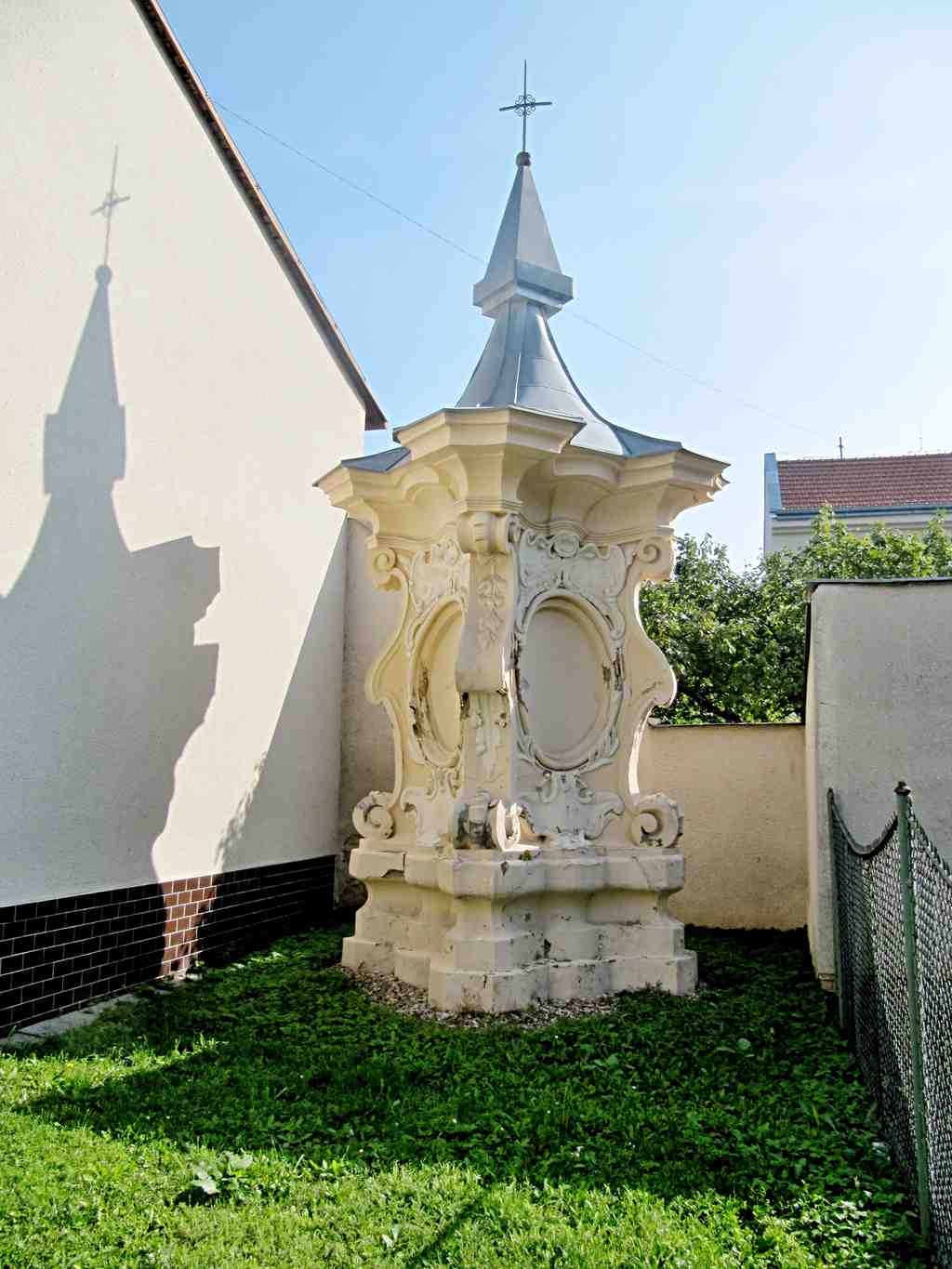
On your right, you will spot an ornate, cream-colored stone pillar with a metal, pyramid-shaped roof and empty oval indentations carved into its curved sides. This little beauty is the Adoration of Saint Vendelín.
Now, it might feel like it is just squeezed between these neighborhood houses, but back in the eighteenth century, this spot was incredibly deliberate. It is actually part of a massive, invisible Baroque axis of astronomical symbolism. It lines up perfectly with other sacred spots in town, including the Chapel of Saint John the Baptist, which we visited a little while ago. Back then, this area was a wide-open space near a busy cattle market and a major crossroads heading out to the vineyards.
The funny thing is, nobody knows exactly who built it or when. Some experts guess around 1740, but another theory ties it to a massive society wedding in 1699. When Dominik Ondřej Kounic's eldest son decided to become a priest, the family legacy fell to his younger brother, Maxmilián. Maxmilián ended up marrying Marie, a wealthy heiress from Germany.
If you want a closer look at the intricate details that survive from that era, pull up the image in your app. Above those empty oval spaces, you can see the alliance coat of arms. An alliance coat of arms is just a fancy heraldic mashup showing two powerful families uniting in marriage. You have the Kounic family symbols, like crossed water lily leaves, combined with Marie's family crest, featuring eagles, leaping bears, and crossed whips.
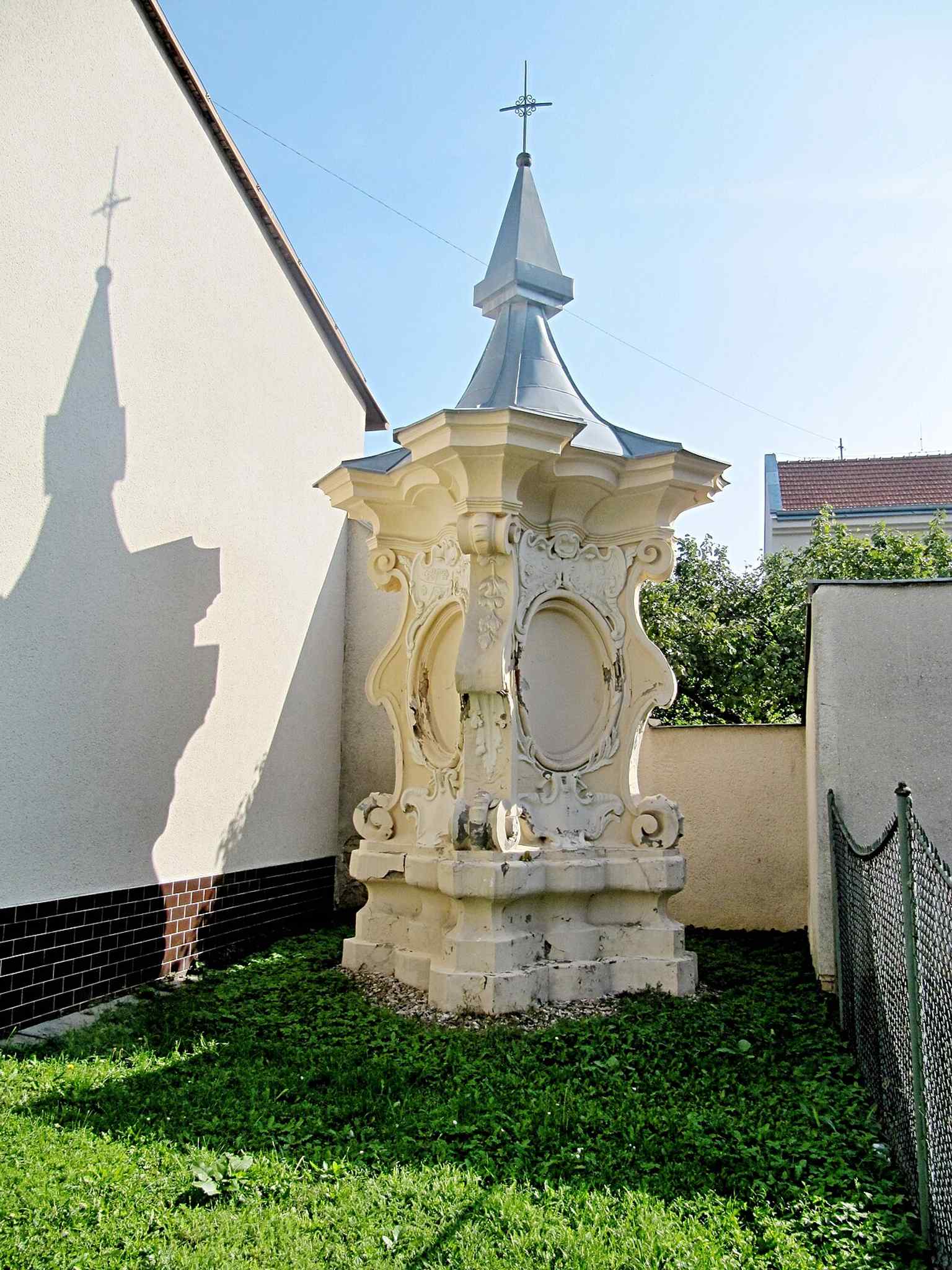
Experts think Marie's German roots are the exact reason this shrine is dedicated to Saint Vendelín. Vendelín has a wild backstory. He was a Scottish royal who gave up his wealth to become a wandering hermit and shepherd. His following was huge in Germany, and since this shrine sat right next to the town cattle market and the lord's manor farm, a patron saint of shepherds and protector of livestock was the perfect fit. Local farmers even used to hold their summer harvest devotions right here at the base.
Notice the swirling, spiral shapes at the corners of the pillar. Those are called volutes, a classic feature of late Baroque design. The whole monument is covered in decorative stucco, which is a fine, moldable plaster architects used to sculpt those delicate flower garlands you see hanging down. Those large oval frames, called mirrors, used to hold actual paintings on metal plates featuring Saint Vendelín and others. Over the centuries, the elements took their toll. The paintings degraded, the plaster crumbled, and the roof rusted. The town has stepped in to rescue and restore this monument several times, most recently in 2023, peeling back the damage to save the stone beneath.
It is pretty amazing that a monument designed for herdsmen and aristocrats still quietly anchors this street today.





