
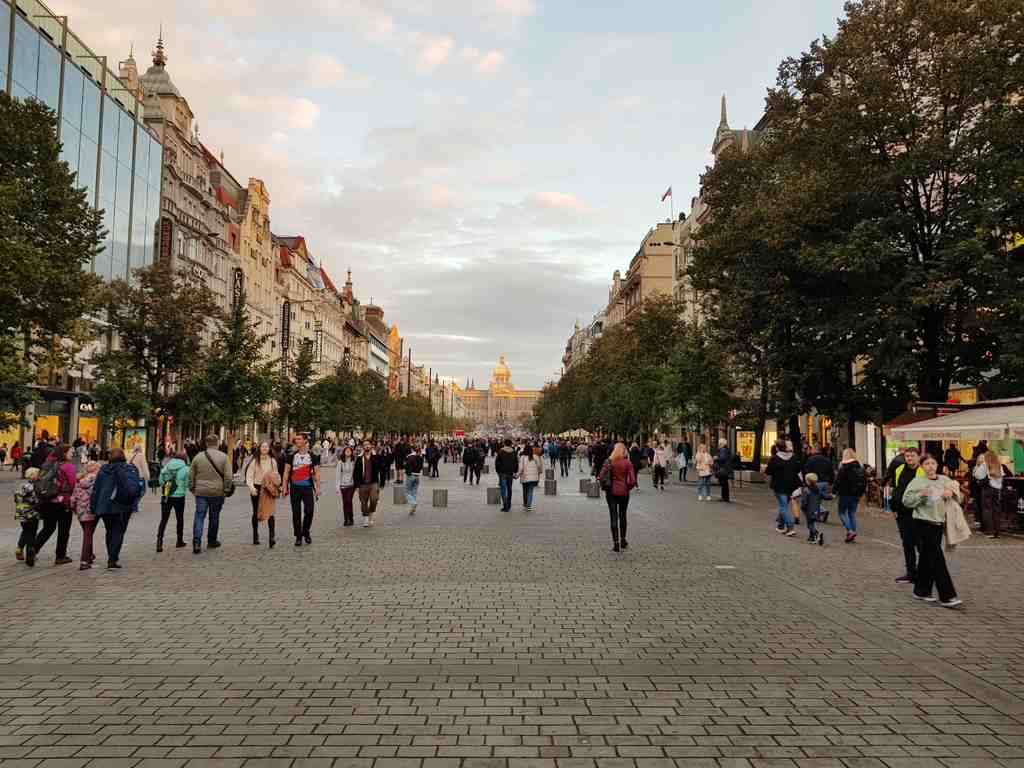
Look to your right to see a massive, sloping rectangular boulevard capped at the very top by a monumental stone building and a towering bronze statue of a man riding a horse.
Welcome to Wenceslas Square, or as the locals simply call it, Václavák. It is an enormous space, stretching seven hundred and fifty meters long and sixty meters wide, gently sloping down from the National Museum. Just as we discussed the fierce courage of the Prague uprising a short while ago, this square has served as the ultimate stage for the city's moments of greatest defiance, tragedy, and joy.
When King Charles the Fourth founded the New Town in 1348, he laid this area out as the city's primary horse market. For centuries, this was an unpaved, dusty, and loud expanse with a small stream flowing right down the middle. You would have found merchants haggling over livestock, weapons, and grain. It was not until the late nineteenth century that the space finally received proper paving stones and electric lighting, transforming from a rural market into a grand urban boulevard.
That towering bronze figure at the top is Saint Wenceslas, the spiritual protector of the Czech lands, surrounded by four other saints. At the base of the monument, an inscription reads, Saint Wenceslas, duke of the Czech land, our prince, do not let us or our descendants perish. It is a heavy, solemn plea, yet modern Praguer sensibilities have given it a slightly irreverent twist. If you ask a local where to meet up here, they will likely tell you to meet under the tail, meaning directly beneath the bronze rear end of the saint's horse.
This stretch of pavement is a magnet for modern history. In August 1968, Warsaw Pact tanks rolled up this incline. The soldiers opened fire with machine guns on the grand National Museum at the top, mistakenly believing the ornate structure was the national radio broadcast building. The following year, a university student named Jan Palach tragically set himself on fire near the museum to protest the ongoing military occupation.
Just a couple of months later, the Czechoslovak ice hockey team defeated the Soviet Union in the world championship. Tens of thousands of ecstatic fans flooded this square, viewing the sports victory as a sweet, symbolic revenge. During the celebration, a group of provocateurs smashed up the office of the Soviet airline Aeroflot. The communist regime immediately used this vandalism as the perfect excuse to crack down, ushering in an era of strict, oppressive political control known as normalization.
The government became so paranoid about citizens gathering here that they redesigned the square in the early nineteen eighties. After removing the tram lines, officials installed dense rows of hexagonal concrete planters around the statue, surrounded by chains with sharp upward spikes so no one could comfortably sit or hold a vigil. Locals mockingly called the ugly setup Štrougal's orchards, named after a prominent communist politician.
But those sharp chains could not hold back the tide. By November 1989, over one hundred thousand people packed this very space during the Velvet Revolution, peacefully ending decades of authoritarian rule.
This square has seen it all, from medieval horse traders to twentieth century tanks to victorious hockey fans. Let's move on to our next location.




