
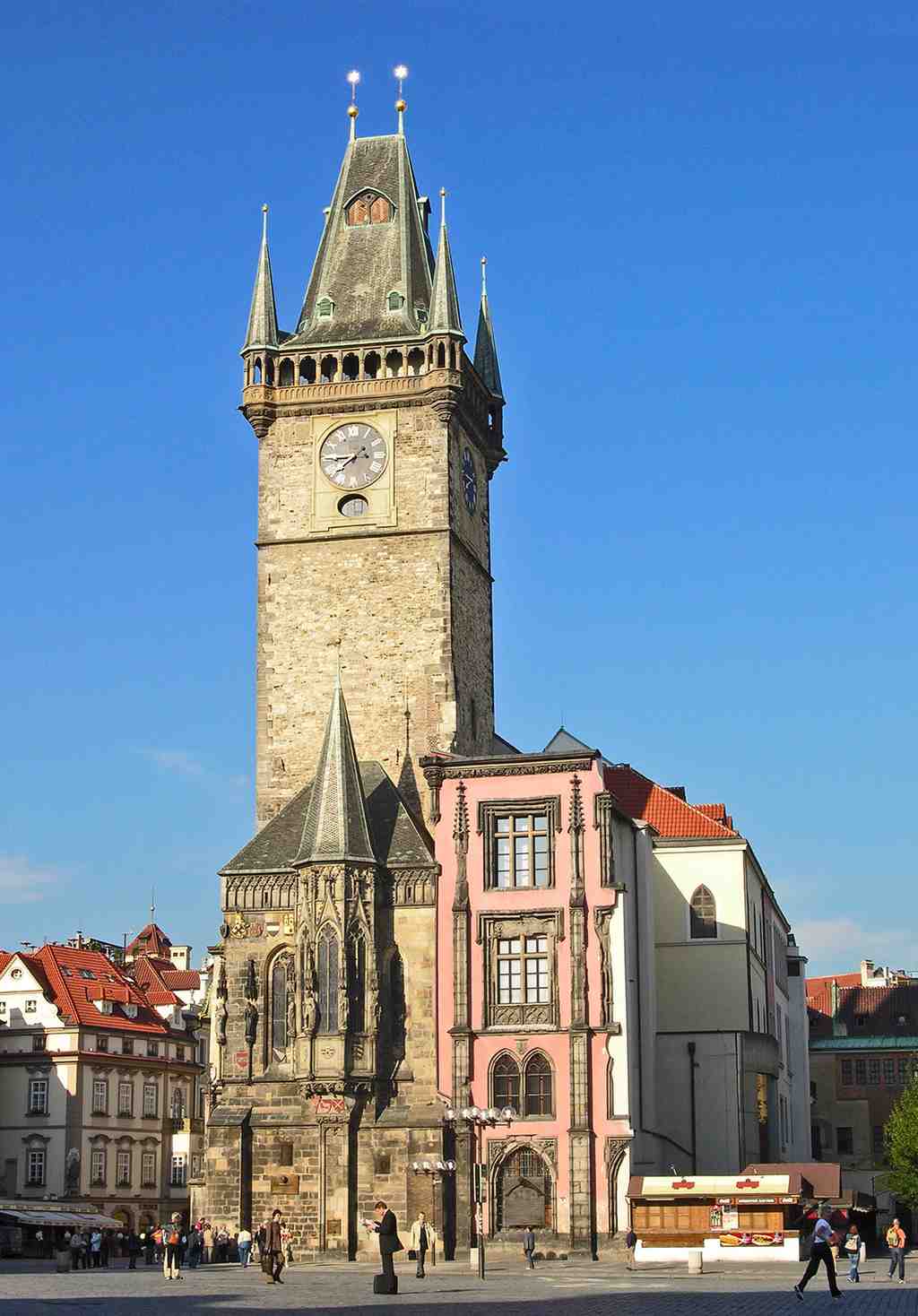
Look to your right for a towering square structure built from rough-hewn stone, topped with a dark pointed spire and flanked by a vibrant pink building attached to its side. It is quite a shift from the wide boulevards of Wenceslas Square we passed through a few minutes ago. This is the Old Town Hall, and if it looks less like a single, unified government building and more like a row of mismatched houses glued together, your eyes are not deceiving you.
When King John of Bohemia granted the citizens of Prague the right to establish their own town council in 1338, making it the very first town hall in the region, the town did not hire an architect to build a grand new palace. Instead, the local citizens pooled their funds from the Ungelt, a prosperous local trading and customs yard. They simply bought a pre-existing stone tower house from a wealthy merchant named Wolflin of Kamen. From there, the council took a highly practical approach to urban expansion. Whenever they needed more room over the centuries, they just bought the house next door. They acquired a neighboring merchant house to serve as a council hall. Later, a local furrier widow named Kačka bequeathed a house to the town in 1458. They eventually added the House at the Rooster in 1835 and the House at the Minute in 1896. They punched doors through the adjoining walls, slowly stitching the entire block into a single, sprawling administrative complex.
As you look up at the nearly seventy-meter tower, you will spot a projecting stone window extension known as an oriel window, which juts out from the facade like a small, suspended room. This forms part of the Gothic chapel, a style of architecture known for its pointed arches and intricate, soaring stone carvings. The chapel was consecrated in 1381 and has stood as the heart of this civic center ever since.
The building has served as the backdrop for both national pride and absolute devastation. In 1922, a tomb for the unknown soldier from the Battle of Zborov was established here, though it was removed in 1941 by the strict orders of a high-ranking Nazi official named Karl Hermann Frank. A few years later, during the Prague Uprising in May 1945, the hall served as a headquarters for the anti-Nazi resistance. On May 8, mere hours before the German forces officially surrendered, the building was subjected to heavy shelling. A massive fire tore through the complex, destroying the neo-Gothic eastern wing and burning up a large portion of the city archives. The heat was so intense that the ancient tower bell, originally cast in 1313, plummeted to the ground, shattered, and partially melted. Its warped bronze fragments are still kept in the city museum today as a somber reminder.
Rather than quickly rebuilding the lost wing, the city held a series of architectural competitions to design a replacement in 1947, 1963, and 1988. Every single time, the competitions either ended without a winner or the chosen designs were simply never built, leaving the space permanently vacant. Decades later, between 2017 and 2018, the city spent forty-eight million Czech crowns repairing the surviving stonework and roof to ensure the patchwork monument remains intact.
The resilience of this strange, assembled complex says a lot about the people who built it. Let's continue on our route.




