
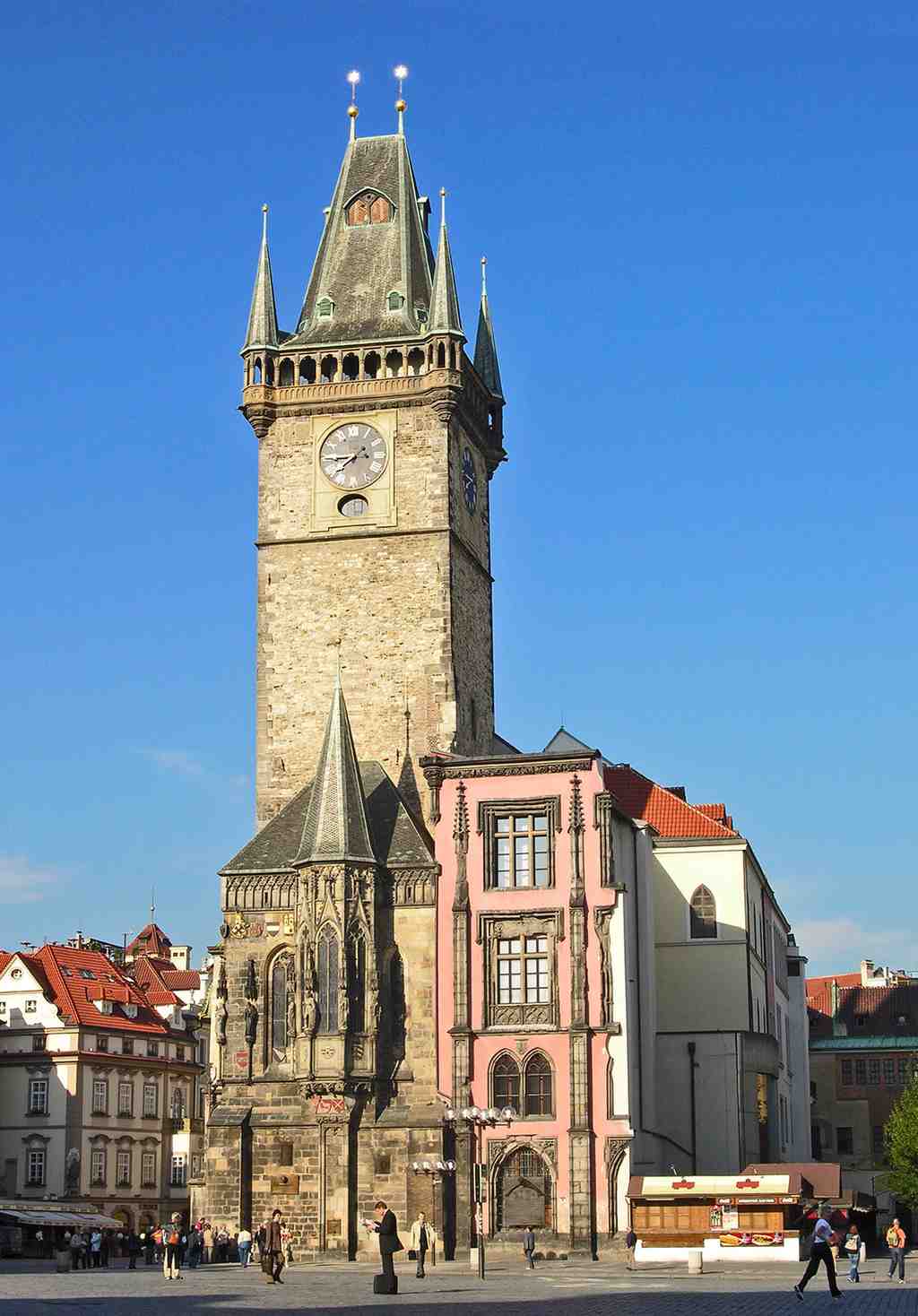
Look to your left at the massive beige stone tower rising high above the square, attached to a distinctive pink building with ornate dark windows.
You are standing before the Old Town Hall, but to call it a single "building" is actually a bit misleading. It is really more of an architectural Frankenstein’s monster, stitched together over centuries. Back in 1338, the city councillors decided they needed a headquarters. But rather than building something new from the ground up, they simply bought a large patrician house from a local clan called the Volflin family. As the city grew, the councillors played a real-life game of Monopoly, gradually buying up the neighboring properties-the Mikeš house, the Cockerel house, the "Minute" house-and knocking down walls to connect them all. That is why the architecture looks a bit disjointed; it is a row of separate lives forced to work together as one institution.
The most prominent feature is, of course, that massive square stone tower. It was finished in 1364 and stood as the tallest structure in the city throughout the Middle Ages. If you look at the dark, projecting bay window on the corner of the tower, you are looking at the Town Hall Chapel. It is a stunning piece of Gothic architecture. If you could float up there and inspect the stonework on the columns, you would see a repeating emblem: a kingfisher bird and the letter "E" inside a twisted wreath, technically known as a torse. These were the personal symbols of King Wenceslas IV, marking the work as a royal project. It was the King’s way of autographing the building.
Scan your eyes down to the facade of the buildings attached to the tower. You might spot a window from the 1520s bearing the Latin inscription "Praga caput regni," which translates to "Prague, the capital of the kingdom." It sits on a high cornice, supported by brackets and pilasters-those are flattened columns built into the wall for decoration rather than support. It is a bold declaration of the city's importance, etched right into the stone for everyone to see.
Inside this complex, the architecture is just as impressive, particularly in the old council chamber. It has a beautiful wooden coffered ceiling-meaning it has a grid of sunken panels-dating from around 1470. But my favorite detail is a bit darker. There is a wooden sculpture of a suffering Christ from the early 1400s, positioned right where the councillors sat. It bears the inscription "Judge justly, O Sons of Man." It was placed there intentionally as a heavy-handed warning to the politicians: do your job honestly, or face the consequences. Nothing like a little divine pressure to keep a city council meeting on track.
However, the building is not whole. If you look to the side, you will see a scar where a wing once stood-a result of the Second World War which we will investigate in the next stop.
When you are ready, let's step closer to look at that missing piece.




