
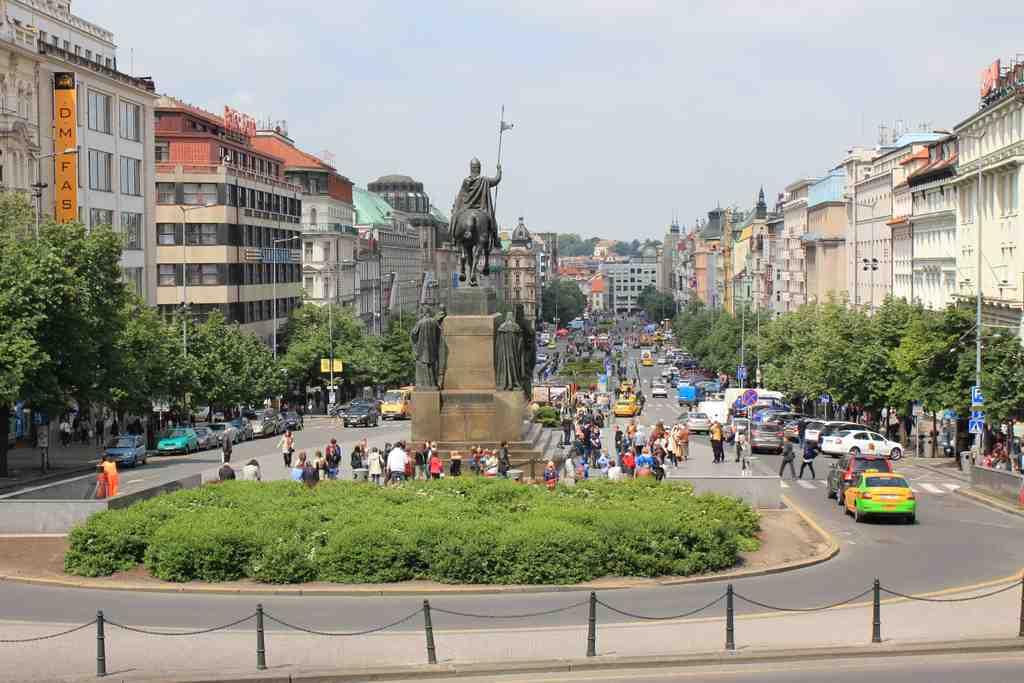
To spot Wenceslas Square, look straight ahead for a huge, bustling boulevard lined with grand buildings, colorful shopfronts, streams of people, and right at its heart, a statue of a knight on horseback towering above the crowd.
Alright, imagine you’re standing on the edge of history-or, in this case, a really busy boulevard! Wenceslas Square unfolds in front of you, so wide and long you might wonder if it was designed for giants as well as tourists. This isn’t your typical European square-it stretches out like a grand avenue, gently sloping upwards towards the majestic National Museum, which anchors one end like a stone crown. The sounds of car engines, footsteps, and hushed chatter swirl through the air, mixing with the occasional creak of a tram passing through.
Once upon a time, this spot wasn’t filled with shops or tourists snapping selfies but horses-yes, horses! In the Middle Ages, the area was known as the “Horse Market,” where locals brought steeds to buy and sell, right where the busy intersection now bustles. If you squint, maybe you can still picture townsfolk haggling over a fine chestnut mare, or maybe a particularly stubborn donkey causing a scene (and, knowing donkeys, probably refusing to move).
But Prague is a city where medieval markets become world stages! In 1848, inspired by the waves of revolution across Europe, the square swapped its clopping hooves for a new name: Saint Wenceslas Square, after the patron saint of Bohemia. Out went the horse traders and in came poets, patriots, and protesters. The transformation was championed by Karel Havlíček Borovský, a journalist with hair as wild as his ideas.
The two grandest features of the square are right before you: the Czech National Museum, proudly perched at the top, and the statue of Saint Wenceslas himself. Legend has it that if the statue ever rides away, Prague will face its darkest hour-though I’m sure Saint Wenceslas enjoys his front-row seat to all the action far too much to dash off!
This square saw it all: On October 28, 1918, crowds packed in so tightly they could barely move, as Alois Jirásek read the declaration of Czechoslovakia’s independence. Imagine the cheers, the tears, the flags waving-now that’s what I call a street party! And the excitement didn’t stop. In 1938, when Prague braced itself during the May Crisis, thousands flooded Wenceslas Square again, determined to defend their freedom from Nazi threats. Laughter, anger, shouting-every emotion echoed around the square’s stones.
Tragedy, too, left its mark. In 1969, student Jan Palach set himself ablaze right here to protest Soviet occupation, shocking the world and filling the square with silent grief and resolve. Yet, only a few months later, when Czechoslovakia’s hockey team bested the Soviet Union, 150,000 Czechs swarmed Wenceslas Square to celebrate victory-how’s that for emotional whiplash?
Wenceslas Square’s legacy gleams brightest during the Velvet Revolution in 1989, when enormous crowds assembled here in peaceful protest. Their brave spirit, their chant of “We have bare hands!”, and their jangling keys-a symbol that the locks of communism were being opened-still echo down the square every November. I guess you could say Wenceslas Square has always been the city’s open-air living room: a place where Prague’s heart beats loudest, in moments of joy, sorrow, and change.
If you look around, you might catch sight of art deco treasures like the Hotel Evropa, with its gilded façade silently judging everyone’s fashion choices, or the Koruna Palace, which has seen more shoe sales than a millipede family reunion. Inside the square’s famous Melantrich Building, legendary figures like Alexander Dubček and Václav Havel once addressed thousands from the balcony-talk about balcony views!
Even the underground buzzes with life. Metro lines crisscross below your feet, connecting the city’s heart to every corner. Above ground, you’ll spot a mix of families, protestors, late-night revelers, and-if you stick around for December-enchanting Christmas markets turning the square into a wonderland of lights and laughter.
And if you’re wondering about the construction-yes, there’s always something being rebuilt or improved. Since 2020, Wenceslas Square has been getting a facelift, with plans for smoother sidewalks, new tram lines, bike paths, and more trees. The construction noise can sometimes get lively but hey, a historic square has to keep up with the times.
So, as you stand here, you’re not just sightseeing; you’re treading the ground where centuries of Czech hopes, struggles, protests, and dreams all come together. Wenceslas Square isn’t just the busiest pedestrian spot in the country-it’s the living, breathing soul of Prague.
Ready to delve deeper into the features, art and architecture or the transport? Join me in the chat section for an enriching discussion.


