
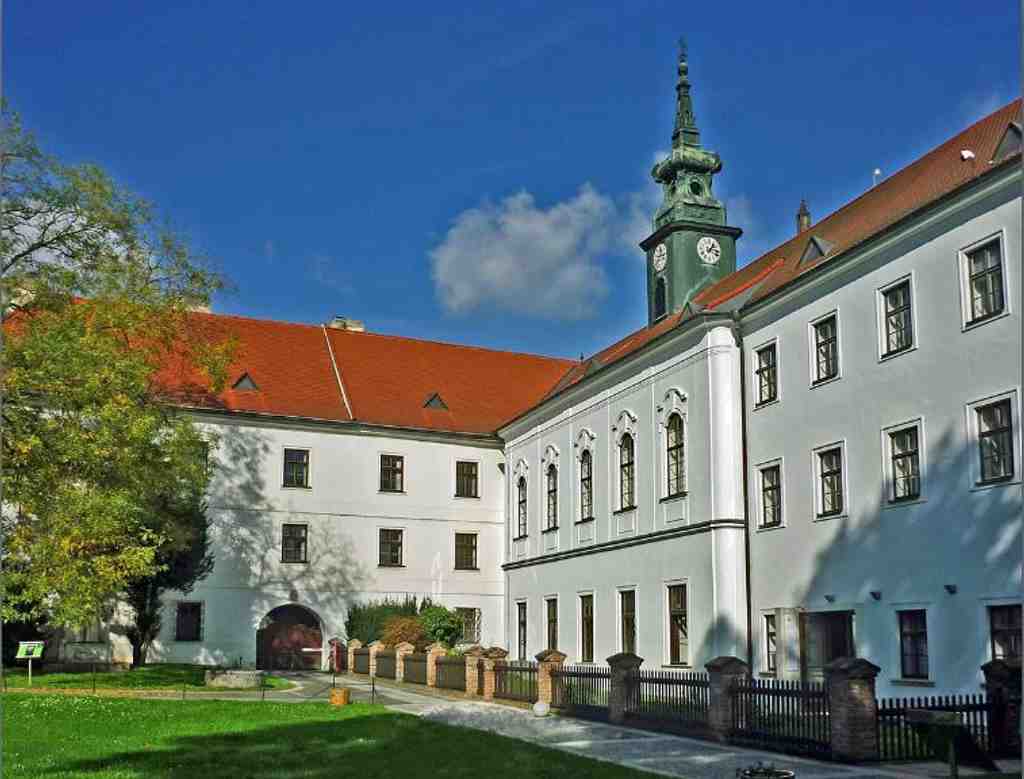
To spot the Old Brno Monastery, look for a grand, white-walled building with a red-tiled roof and a distinct clock tower rising above, just ahead of you past the small fenced garden and arched doorway.
Now, let’s step back in time and imagine what this place has witnessed over the centuries. If you stand still and close your eyes for a moment, you might almost hear distant footsteps on the ancient stone floors and the soft toll of the monastery bell beneath this blue sky.
The story of this monastery begins in the early 1300s with a royal widow-Eliška Rejčka. Picture her: a queen of both Bohemia and Poland, determined and clever, with dreams bigger than her crown. When her companion, the mighty Moravian governor Jindřich of Lipá, took a job in Brno in 1319, Eliška decided to create a legacy that would last through wars, fire, and centuries. She gifted her vast fortune to build this place in 1323 and brought in a group of Cistercian nuns-ladies from noble families, each with their own whispered family secrets and ambitions.
Back then, this area was more swampy brooks and winding roads than polished gardens. The gothic Basilica of the Assumption of the Virgin Mary nearby, built from rough, red bricks, was new and grand-its candles casting golden light across the faces of nuns at prayer. Under its floor lies Eliška herself, in a tomb marked by a crown and the letter "E." She shares her resting place with Jindřich. Imagine: two lovers whose stories became part of the very stones you’re standing on.
The monastery became wealthy, almost as rich as its founding queen, and the nuns turned it into a refuge. During storms of history-Hussite wars, Czech-Hungarian battles, and even the catastrophe of the Thirty Years’ War-the monastery was attacked, burned, rebuilt, and filled again with determined voices and the scent of fresh bread from the abbey kitchens.
As centuries marched by, the building grew and adapted. In 1333, a hospital was added-a place where the suffering of Brno could meet the mercy of the sisters. Whenever another disaster arrived, the monastery somehow bounced back, its halls sheltering not just nuns but the secrets and scars of the city.
All this changed in 1782, when Emperor Joseph II swept through the empire, closing monasteries that weren’t "useful enough." The Cistercian nuns left with heavy hearts, and their home was handed over to the Augustinians-a group with their own dramatic story. The Augustinians, who had started out across town at the Church of St. Thomas, packed up their treasures (including a piece of art called the Black Madonna), and settled here to continue their work.
Think of this: the monastery was briefly transformed by the emperor’s reforms, then flourished again, sheltering musicians, scientists, poets, and more. During the 1800s, a quiet genius named Gregor Mendel lived and worked here, growing peas and slowly uncovering the secrets of heredity that would change science forever. If you listen hard, maybe you can hear the soft snip of scissors as Brother Mendel clips a pea pod, hidden in the cloister gardens.
The famous composer Leoš Janáček grew up within these walls, his childhood echoing with Latin chants and organ music.
Today, the Old Brno Monastery still hums with life. Since 2023, it’s been celebrated as a national cultural monument, and inside you’ll find the Mendel Museum, where visitors from around the world come to whisper in amazement at the laboratory that started it all. Just imagine the swirl of cloaks, the swish of scientific papers, the arguments over dinner, and the laughter of children growing up beneath stained glass and ancient arches.
In all these years, the monastery has survived kings, emperors, and even skeptical scientists-so if you feel the urge to make a big change in your own life, remember: sometimes, the biggest legacies start with one determined person. Or maybe a few peas. Ready to keep exploring? Let’s see what stories the next stop will share!


