
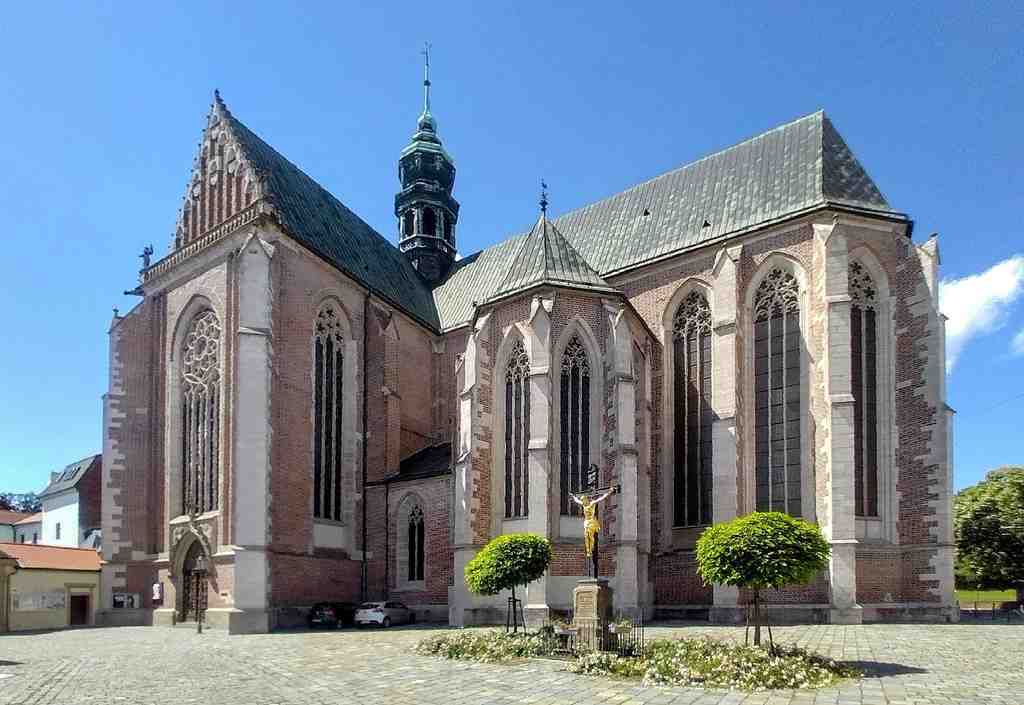
To spot the Basilica of the Assumption of the Virgin Mary, look for a grand, reddish-brick Gothic church with a dramatic steep roof and tall, pointed arched windows, just behind the trees across the parking lot in front of you.
Now let’s imagine you’re standing here in the middle of Staré Brno in the 1300s, and the air is thick with the sound of hammers on stone and the flutter of banners in the breeze. The story of this basilica starts with Queen Eliška Rejčka, a woman so legendary that even in her old age, she was making big decisions from the comfort of her seat at Špilberk Castle-a bit like running a city from your favorite armchair, only with more medieval drama.
Legend has it, Eliška couldn’t decide where to build a new monastery and church, so she did what any reasonable queen would do: she threw three banners from the Hladová Tower atop Špilberk Castle and waited to see where they’d land. The first one fluttered down right here, where you’re standing. Eliška took one look and declared it the chosen spot-talk about leaving things up to fate! The second banner, by the way, was swept away by the wind and vanished somewhere near Veveří… or perhaps it’s still out there, waiting for some lost tourist to find it.
Construction of this fabulous brick basilica began in 1323, and it quickly became the heart of a bustling Cistercian convent. Don’t be fooled by the church’s quiet strength; the design is anything but simple. If you could see through the roof, you’d notice the whole thing is shaped like a giant cross-symbolic and practical, all at once! While stone was all the rage in Gothic architecture, Eliška’s builders took a bold turn and went with unplastered red bricks, inspired by other great churches from as far away as Cologne and Hesse. The only stone is in the decorative details, making for a look that’s both sturdy and elegant.
Eliška herself was laid to rest beneath the altar of the Holy Cross, with the peaceful hush of prayers and candlelight all around. Fast forward to the reforms of Emperor Josef II in 1782, and the Cistercians were packed up and moved out, replaced by Augustinian friars. The basilica got a light baroque makeover courtesy of architect Mořic Grimm, but even with its new altars and ornate pulpit, the church never lost its medieval soul.
Picture stepping inside: dark, crisscrossed stone vaults rise above you, sunlight slants through stained glass, and the walls glow in soft colors-especially in the presbytery, where golden and blue skies are painted above, dotted with stylized suns and busy little angels. The main altar gleams-just imagine the shimmer coming from the famous silver altar, originally crafted for the famed Black Madonna. This stunning silver creation has been moved more times than a traveling circus, which you might say has left it a little dented, but still dazzling. The Black Madonna, brought here in 1356 by Emperor Charles IV, became the city’s special protector. When Swedes besieged Brno in 1645, the townsfolk saw the Madonna appear above, spreading her protective cloak-giving everyone just enough courage to turn the invaders away. Forget Wi-Fi or superhero movies, this was divine intervention, medieval style!
Take a look at the outside: those massive buttresses and delicate, flower-like details on the windows and doorways show off every century the basilica has stood here, watching over Brno through fires, wars, and celebrations. The southern face sports a big triangular shield with four coats of arms, marking the basilica’s royal connections to Moravia, Bohemia, Poland, and Carinthia-a sort of medieval family tree.
And not too far from where you’re standing, you’ll spot a strange sculpture made out of old beer tankards in the shape of a pea. That’s a tribute to Gregor Mendel, the abbot and scientist whose pea experiments changed the course of genetics. Yes, there’s a little geekiness hidden amongst all the Gothic drama.
So next time you see a banner waving in the breeze, remember-it just might be trying to choose the next great spot for Brno’s history. Until then, imagine the centuries of stories, prayers, and mystery that echo through those brick walls every single day.


