
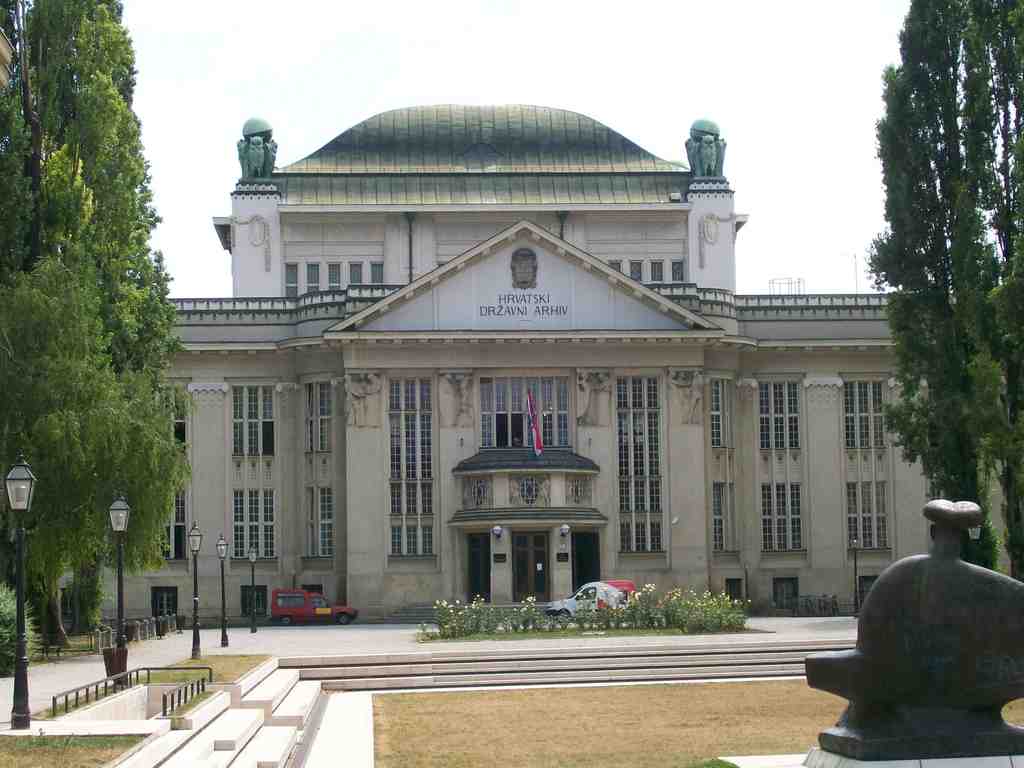
To spot the Croatian State Archives, look for a grand, light stone building with a domed green roof and two statues perched on either corner above a series of tall windows, right at the end of a peaceful tree-lined path.
Welcome, traveler! Right in front of you stands the Croatian State Archives - but don’t let this dignified building fool you; behind those tall glass windows lies the entire memory of Croatia, stacked up like the world’s most official game of Tetris. Imagine the goosebumps as you step closer, on the very ground where, for nearly a thousand years, Croatia’s most treasured secrets have been guarded. Hundreds of years ago, important documents were stashed away not in fancy vaults like today, but in good old-fashioned chests-yes, actual wooden treasure chests, guarded by medieval lords, bishops, and even the odd knight or two. You might even hear echoes of dusty parchment being rolled and sealed in candlelight, as if Croatia’s past is whispering right into your ear.
Picture the year 1643, the Croatian Parliament sits in heated debate, finally deciding that all royal privileges, laws, and musty papers need a safer, more dignified home-so, they pay the treasurer, Ivan Zakmardi, to build a special “privilege chest.” The first Croatian national archive was literally a fancy box! And where does this legendary chest go? Not in some grand hall, but in the sacristy of Zagreb Cathedral, next to the monks’ robes and church relics. It was, perhaps, the holiest filing cabinet in Europe. But soon enough, the Parliament demands, "Move that chest to the chamber in Markov Square!" - which, after 100 years, finally happens. Well, you know how bureaucracy can be.
Over many centuries, the Archives grew, gathering everything from royal scrolls to county records, noble family secrets, even the paperwork of monks whose monasteries vanished long ago. Try to imagine the slow creak of carriage wheels in 1849, as precious documents returned from Budapest-letters from the Zrinski counts, the powerful Fraknapan princes, and ancient Jesuits, all coming home like travelers at the end of a very long holiday. Of course, what one hand gives, the other sometimes takes-ban Khuen-Héderváry, famous for having the trickiest surname in Croatian politics, packed them off to Budapest again in 1885... only for them to shuffle back a few decades later, a game of international document ping-pong!
This proud building was finished in 1913, built specially to house both the Archives and the University Library. If these walls could talk, they’d share stories of scholars hunched over yellowed folios, of passionate historians discovering lost chapters of Croatia’s story, and maybe even of anxious staff, nervously fetching coffee before an important inspection.
Today, the Croatian State Archives is the heart and soul of the nation’s memory, carefully preserving everything from medieval scrolls to modern government files, all the way up to movie reels and photographs. So as you stand here, take a deep breath-this is where Croatia keeps its secrets, and where every page, every faded letter, still shapes the country’s tomorrow. Not bad for a place that started out as just a really important wooden box, wouldn’t you agree?




