
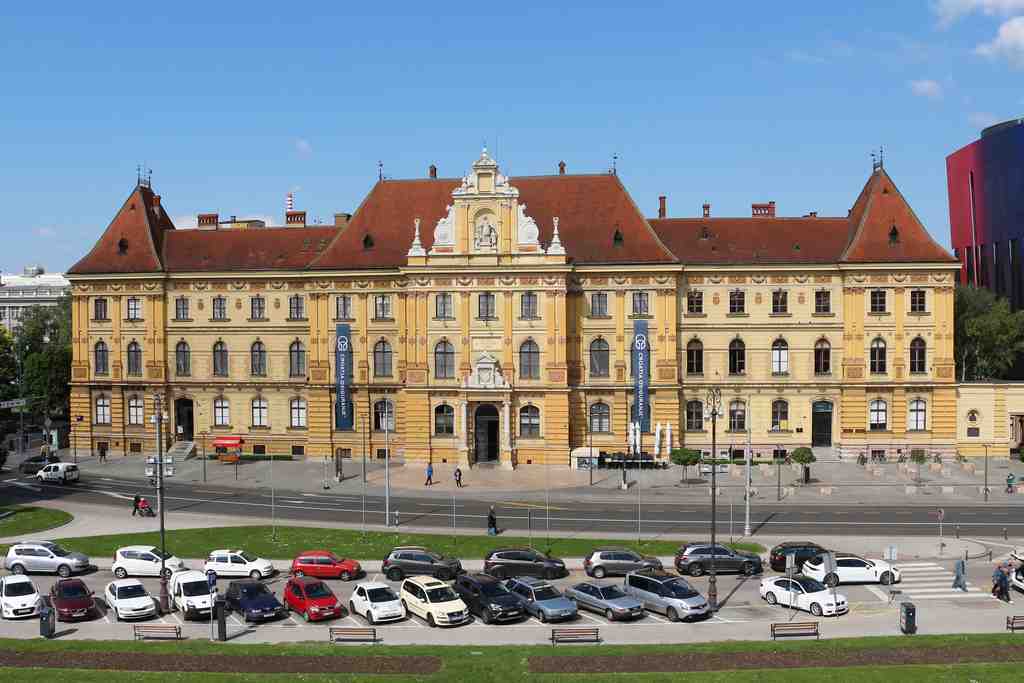
To spot the Museum of Arts and Crafts, look for a grand, yellow historicist palace with a stately central entrance and a reddish-brown tiled roof, standing proudly across the street with ornate architectural details and blue banners by its doors.
Ah, you’ve made it to one of Zagreb’s most enchanting grand dames! Imagine yourself standing here in the late 1800s-the streets bustling with horse-drawn carriages, craftsmen hauling mysterious bundles under their arms, and a gentle clatter of tools, as the scent of fresh paint and sawdust drifts in the air. The Museum of Arts and Crafts before you was born from an ambitious dream that started in 1880, spearheaded by Izidor Kršnjavi, a man with a remarkable moustache and even more remarkable ideas. He and the Arts Society decided it was time for Zagreb to embrace beauty in everyday life-picture that for a moment! They wanted to inspire craftspeople and artists to create objects not just for use, but for joy, and maybe a little bit of showing off to their neighbors.
Their inspiration? The English Arts and Crafts movement, which championed handmade artistry over soulless factory goods. Kršnjavi read the works of Gottfried Semper and thought, “Let’s not only preserve our crafts-let’s make everyday objects into masterpieces!” So, with the support of Bishop Josip Juraj Strossmayer-a name that pops up in Croatian history like a well-loved old friend-they began hunting for treasures. The first pieces were snatched up at an inheritance auction in Paris from the famed Catalan painter Mariano Fortuny. It sounds rather glamorous, doesn’t it? Fancy hats, elegant gestures, and the anxious bidding of collectors-one can almost hear the auctioneer’s rapid-fire French.
By 1888, architect Hermann Bollé (who must have had a flair for drama) unveiled this palatial building just for the museum and a crafts school-one of the first of its kind designed to merge education, creativity, and display. If walls could talk, these would whisper stories of apprentice woodcarvers and nervous students racing to sketch an ornate piece before lunchtime. The building’s style nods to German Renaissance, with all the turrets, flourishes, and bravado of a cake decorated by an enthusiastic pastry chef.
The museum had humble beginnings, debuting its first collection in a cramped space on Gajeva Street in 1882. But by 1909, every shiny new acquisition and cherished relic was finally home under this red-tiled roof. Fast forward to 1995, and the museum underwent a magical transformation, orchestrated by director Vladimir Maleković and architect Marijan Hržić-who made sure you could travel through history as you wandered from floor to floor, as breezily as taking three steps into three different centuries.
Now, the museum is a treasure chest, with three sprawling floors-more than 2,000 square meters-stuffed with about 3,000 splendid exhibits. But that’s only a small taste: the full trove is a mind-boggling 160,000 objects stretching from the 4th to the 20th century! You’ll find Gothic to Art Deco wonders, dazzling glass, intricate textiles, clocks stubbornly stuck at tea time, musical instruments that once serenaded ballroom dancers, and even quirky product designs that might make you scratch your head and smile.
Behind the scenes, the Collections Department keeps everything in tip-top shape-100,000 objects in 19 distinct collections, everything from architecture to painted leather, ivories, and even a famed collection belonging to Anka Gvozdanović. There are restoration workshops busting with experts: picture a “doctor” for every kind of art, patching up cracked ceramics or mending battered old books with a surgeon’s precision. Speaking of books, the museum’s library is a hidden world unto itself, still housed in its original 19th-century interior (designed by Bollé, naturally). Its 65,000 volumes include art history, rare print portfolios, antique catalogs, and more. Trade secrets and beautiful patterns wait on every shelf, the perfect resource for anyone hoping to bring a little extra magic into the world.
So, as you gaze up at this magnificent yellow palace, picture the generations of artisans, thinkers, and dreamers who passed through its doors-all united by a simple idea: to make the ordinary extraordinary. Now, that’s a little bit of magic, don’t you think?




