
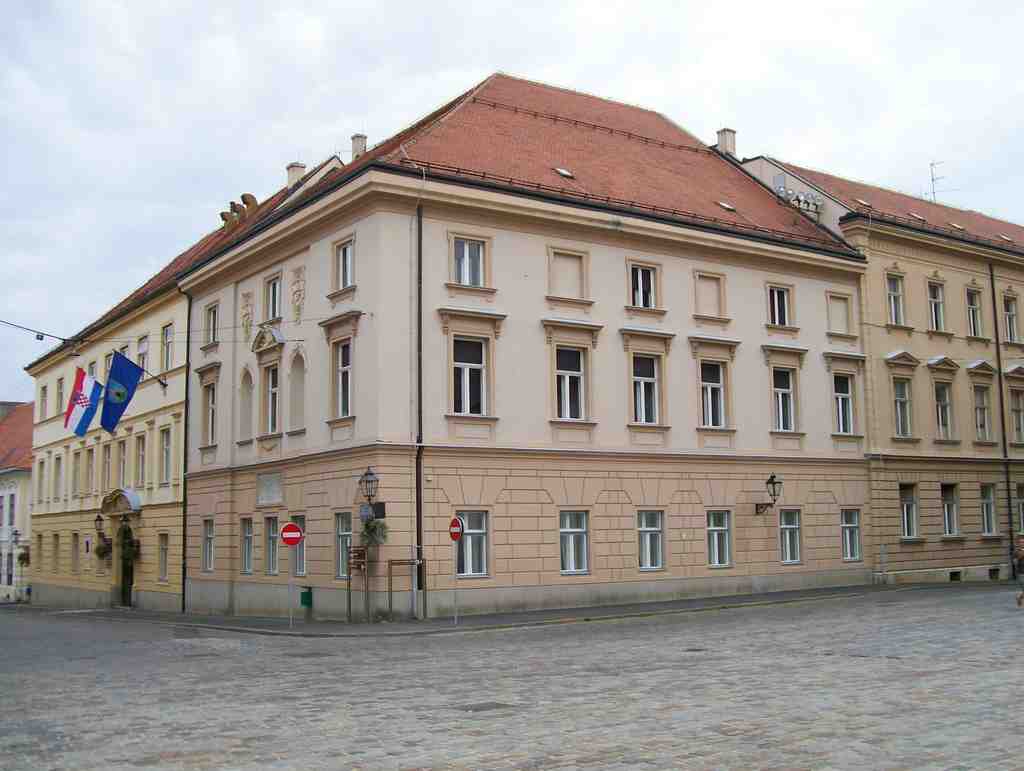
Directly in front of you stands a large, pale cream-colored building with a sloped red roof and a row of elegant rectangular windows - to spot the Old City Hall, just look for the building on the corner with two flags waving near its carved stone entrance.
Welcome to the Old City Hall of Zagreb-a place where the walls have just as many stories as the people who walked its halls, and probably twice as many secrets! Picture yourself standing here a few centuries ago, when the heavy wooden doors would swing open and the clatter of boots on cobblestones would echo through the square. This complex you see today is actually a marriage of three buildings, their fates forever tied together at the end of the 1800s, creating a home for the city’s most important decisions.
Way back in the 15th century, when knights still clanged through Zagreb, there stood a simple council house right on this very spot. But it didn’t stay simple for long: by 1614, Jakov Gasparini-one of the mightiest magistrates in Gradec-had it transformed into the town hall. Think of all the lively debates, heated arguments, and perhaps a few dramatic door slams that must’ve filled the air! By 1787, the building had enough rooms to host not only politicians, but also prisoners in its jails, and shopkeepers in two bustling shops-plus a kitchen for those all-important council snacks. Who says city business can happen on an empty stomach?
As Zagreb grew, so too did this hall’s ambitions. In 1803, the city purchased the next-door mansion from Count Adam Oršić. Soon after, something downright cinematic happened: Kristofor Stanković, a local merchant, won big at the Vienna lottery. (Imagine the excitement-one day you’re selling goods, the next you’re rich enough to build a theater!) With his winnings, Kristofor invested in a grand new stage for the city-a theater filled with music, laughter, and the promise of something remarkable.
By 1833, the cornerstone of the city theater was laid, and the neighborhood buzzed with excitement. The building initially had triple doors right where you’re standing, opening into a sparkling ballroom and a gallery that surely saw its share of swirling gowns and whispered intrigue. In that theater, for the very first time, the Croatian language echoed through the city-first in a patriotic song, then in the drama "Juran and Sofia," and finally in 1846 with the first-ever Croatian opera, "Love and Malice." Even the Croatian Parliament itself gathered in that ballroom, making history by declaring the Croatian language the official tongue of government right here in 1847.
But by the late 1800s, the curtain fell on performances here-the theater moved downtown to a newer, shinier stage. The city government took over, merging these buildings into one big City Hall. They transformed that grand old ballroom into a chamber where the assembly could argue, vote, and occasionally nap through long debates (at least, I imagine so). Little by little, new stories grew within its walls: in the early 1900s, the city added more rooms for offices; in World War II, the attic was turned into working space; and by the 1970s, parts of the building were lovingly restored, with the halls echoing once again in grand style.
Old City Hall is not just offices and meeting rooms-downstairs, you’ll find the Kristofor Stanković Art Gallery, where Zagreb’s cultural heartbeat still ticks strong. And if you look closely at the walls, you’ll spot two special plaques: one celebrates big moments in Croatian history, and the other features the legendary inventor Nikola Tesla. In 1892, Tesla himself stood in these halls, promising to help electrify Zagreb-though, in classic city council style, the politicians passed on his idea and chose someone else’s plan. Oh, what could have been!
Whether it’s council sessions, wedding vows, or the echo of a centuries-old opera, the Old City Hall has seen it all. So, as you stand here in the shadow of its walls, let your imagination wander-who knows what spirited debate, love story, or lottery-winning miracle might unfold next?




