
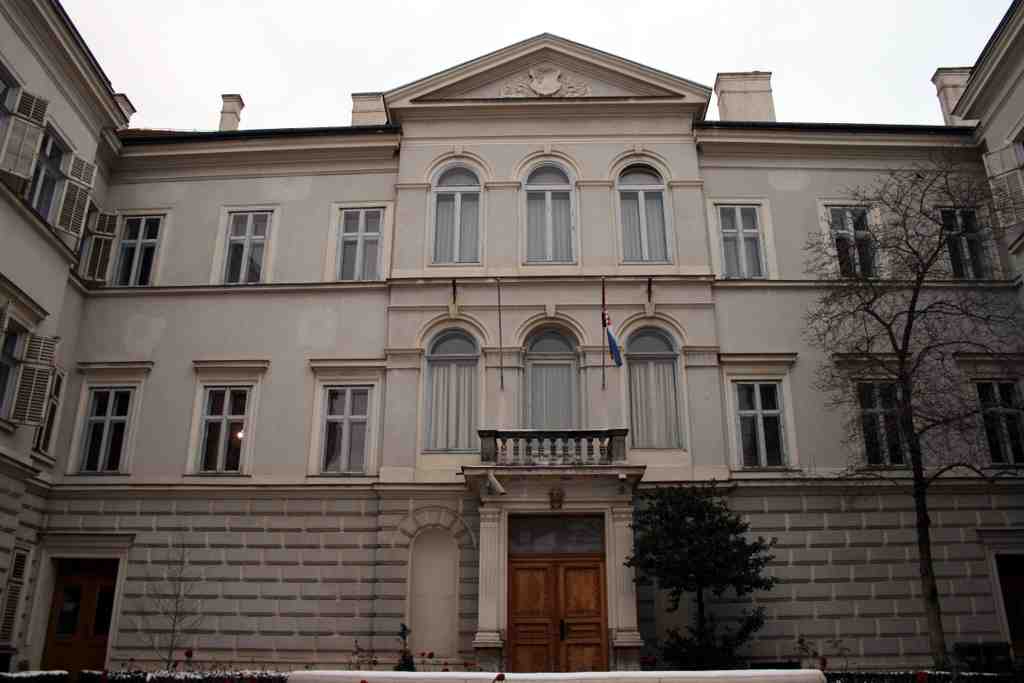
To spot the Croatian Institute of History, look straight ahead for an elegant pale building with tall arched windows, grand wooden doors, and a small balcony flying the Croatian flag right above the main entrance.
Alright, traveler, welcome to a building where the past lives and breathes, and where secrets of Croatian history are dusted off daily-no, not by ancient ghosts, but by some of the country’s most passionate historians! This stately palace on Opatička Street has seen quite a lot since it was first built in 1840 for the noble Vojkffy-Paravić family. Now, if you look closely, you might just imagine horse-drawn carriages rolling down the street, stopping outside that grand door as Zagreb’s upper town buzzed with whispers of politics and fortunes.
But its journey didn’t stop there-by the late 19th century, this palace became the home for the Department of Worship and Education. And then came Iso Kršnjavi, who had a vision: to fill these halls with echoes of the past and the spirit of learning. He enlisted architect Hermann Bolle, and soon the palace transformed, blending classic shapes with a flair for drama that would make any Renaissance painter proud. As you stand here, imagine the click of chisels and the scratch of paintbrushes, as artists like Ivan Tišov, Vlaho Bukovac, Oton Iveković, and their skilled friends brought classical myths, national legends, and great minds to life across the walls and ceilings.
Peek towards the windows and picture the inside-there’s a Golden Hall so bright and grand they had to name it after precious metal, where sunlight dances across gilded frames and walls tell stories of Croatian kings and teachers. There’s a room in Pompeian red, with gods, warriors, and poets swirling through the paint, making you feel as if you’ve stepped into ancient Greece or Rome-pretty good for a place in Zagreb, right? And don’t forget the Renaissance Room, where portraits of Homer, Dante, Shakespeare, and Goethe are locked in literary debate across the ages.
The staircase is a true small gallery of the muses, each one inspiring you with the spirit of art, science, or poetry as you ascend. Over here, the muses aren’t shy-you’ll spot Apollo playing his lyre, Euterpe with her double flute, and Urania reading the stars. Don’t worry if you suddenly feel like writing a poem or solving a mystery-it’s just their magic working on you!
Now, as for the Institute itself, this isn’t just a museum. Since 1961, it’s been the heart of Croatian historical research, going through quite a few name changes as it grew. It first focused on workers’ movements, back in the days when the city’s political winds were a little more, shall we say, revolutionary. Franjo Tuđman, a name you might know, was its first director. As Croatia changed, so did the Institute, broadening its gaze to every chapter of history-medieval knights, baroque thinkers, and the dramas of the 20th century.
Inside, teams of historians are always on the hunt for the next big discovery. Their specialties? Everything from the early medieval period to the latest modern events-and even the Latin roots that connect Croatia to the world. Don’t be surprised if you hear the buzz of eager researchers, or the clatter of keyboards as discoveries make their way into books and journals.
Speaking of books, the Institute’s publishing legacy is impressive. Since 1994, they’ve released close to a hundred scholarly works, and they run three journals-including one just for English-speaking history enthusiasts. They’re always guiding the next generation, and sometimes their ornate halls host musical concerts, letting the past ring out in classical notes.
So, as you stand in front of this noble façade, imagine centuries of thinkers, artists, and historians mingling in the air-sometimes arguing, sometimes laughing, and always seeking to answer the biggest question of all: What really happened? And why does it matter? If these walls could talk, I bet they’d ask you to come inside and join the conversation! Ready for the next chapter in our Zagreb adventure?




