
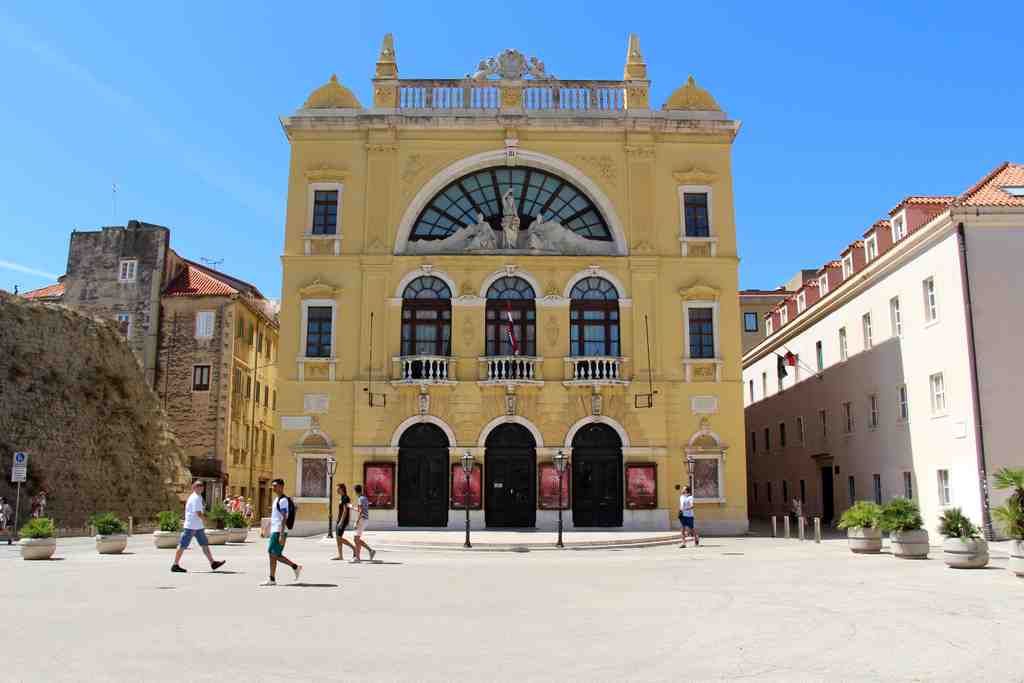
You’re looking for a grand, sunny-yellow building right ahead, topped with statues and classic columns, with three big arched windows and a row of small white stone balusters running across its balcony-just look for the most theatrical façade in the neighborhood!
Now, picture yourself here in Split, sometime back in 1893-the city was buzzing, a fresh new theatre was about to open its doors. You can almost hear the swish of silk skirts and the excited chatter of people gathering by this very building-back then, this theatre could seat a thousand, when Split had only sixteen thousand souls in total! It was designed by two local architects, Vecchietti and Bezić, who seemed determined to outdo every other theatre in Southeast Europe. At the time it opened, this place was not just big-it was the biggest in the region, a true giant by local standards! If you stood here in those days, you might have caught a whiff of freshly cut wood or wet paint coming from inside, the place alive with anticipation, its fancy interior decorated by a trio of renowned artists: Scomparini, Cozzi, and Varvodić.
In its early days, it wasn’t local actors gracing the stage, but traveling troupes-most of them Italian-filling the air with song, laughter, and the occasional dramatic gasp. Imagine people marveling at the performances, the applause bouncing off the grand walls. Almost thirty years passed before Split earned its own professional troupe. In 1920, the theatre was revamped and renamed the Dalmatian National Theatre, ready to become something the entire city could call its own.
Now, the script gets dramatic! In 1928, the theatre was merged with Sarajevo’s National Theatre under a cumbersome new title-and as if the paperwork wasn’t enough excitement, the authorities decided to disband the actors’ ensemble. Cue a dramatic silence-and then, the music swells! Artist Ivo Tijardović and his friends simply refused to let the show end. They formed their own society, singing opera and operettas well into the 1930s, making sure creativity flourished even without official approval. That’s real Dalmatian spirit for you!
But wait, there was even more drama ahead. In 1940, the theatre was reborn yet again-this time, not just as a venue for drama, but also for opera and ballet. The city could finally feel proud: Split now had a true cultural powerhouse. But war has a knack for interrupting things just when they get good. In 1941, during World War II, the theatre fell silent as Split found itself under Italian occupation. The beautiful building closed its doors, its halls echoing with memories of music and applause.
Still, like any good story, this one had a triumphant comeback. When the war ended, the theatre sprang back into life-on July 1st, 1945, the people of Split watched its rebirth, their hearts likely pounding as the stage lights flickered on again.
But even then, fate wasn’t quite done. In 1970, fire swept through the building-imagine flames licking up those yellow walls, the smell of smoke on the breeze, the city holding its breath. Performers scattered to other venues, but the spirit of the theatre refused to die. After a long ten-year wait-and I mean, even Croatian grandmothers were probably counting the days-the rebuilt theatre finally opened again in 1980!
Today, standing here, you might still catch that contagious energy-every year, HNK Split puts on some 300 performances and welcomes 120,000 theatre lovers. Between the famous Splitsko ljeto-a summer festival that turns the city into a stage-and the Marulićevi dani, which celebrates Croatia’s greatest playwrights, this yellow beauty is where Split goes when it wants to dream, to laugh, and to remember it is always, at heart, a city of performers. Now, shall we take our seats? The show must go on!




