
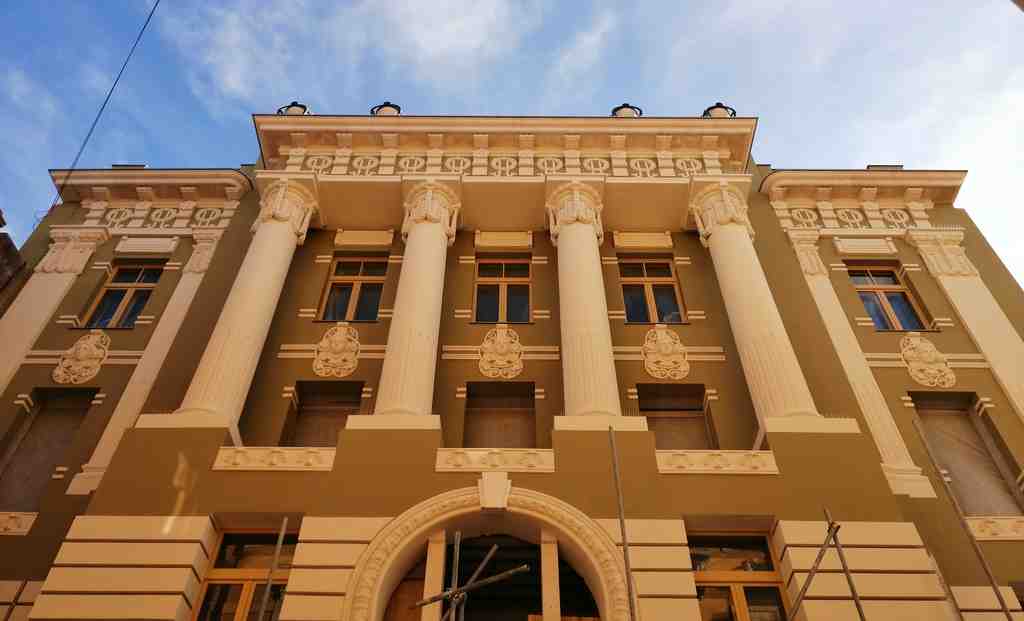
To spot the Croatian House, just lift your eyes to this elegant building with grand cream-colored columns and decorative faces above the windows-standing tall right in front of you on Kamilo Tončić-Sorinj street.
Now, standing in front of this eye-catching Art Nouveau masterpiece, close your eyes for a moment and imagine Split bubbling with energy at the turn of the 20th century. The year is 1908, and the Croatian House bursts onto the scene, designed by Kamilo Tončić pl. Sorinj, whose name is still written on this very street. When this building opened, some people loved its daring curves and whimsical faces, and others thought, “Are we in Vienna now?” But no matter which side they took, everyone agreed: this was something new for Split.
The Croatian House was born out of a dream shared by the town’s most passionate thinkers, gymnasts, readers, and even firefighters! The local Croatian Falcon group-think of them as athletic nationalists in feathers, if falcons wore tights-launched the idea back in 1896. The plan: create a true gathering hub for all the city’s Croatian cultural and sports societies. The goal was bold, too: unite Dalmatia with the rest of Croatia, make the Croatian language the heart of town, and foster a spirit of national pride. Can you picture the lively debates echoing through the newly finished halls? The shuffle of papers, the stomping of determined boots, and plenty of singing, too.
The Croatian House quickly became the main stage for the city’s rising artists, ambitious musicians, and those ever-eager gymnasts. Before the din of World War I swept over Europe, the building was alive with the sounds of orchestras, choirs, and even the First Dalmatian Art Exhibition-a shimmering moment that fueled the founding of the Croatian Artistic Society Medulić and planted the seeds for a grand Gallery of Fine Arts. Oh, and don’t forget: just a few years later, in 1911, the iconic football club HNK Hajduk was born right here! Not to be outdone, the rowers of VK Gusar and sailors of JK Jadran also called this place their birthplace-a real sporting triple threat.
But the world would change, and so would Croatian House. After World War I, the air around here began to feel heavy. New rulers, new rules, and national groups were thrown off balance. In 1929, under a new dictatorship, all clubs with “Croatian” in their name suddenly found themselves persona non grata. The Croatian Sokol? Gone, with a last proud group photo and a rousing performance of the Croatian national anthem. After that, the halls echoed with the voices of Sokol groups loyal to the new Yugoslav state. They even set up a puppet theater in 1933-imagine, on this very stage, wooden marionettes putting on shows for awestruck post-war children!
World War II tossed another wrench into the works. During the 1942 Italian occupation, the elaborate Art Nouveau decorations-masks, garlands, and flourishes-were stripped from the façade and great hall. After the dust settled, the former Croatian House became the “Home of Youth.” It was a bit like musical chairs in the decades that followed. Ballerinas rehearsed upstairs, blind associations met in cozy rooms, football legends trained for winter matches, and high-spirited students clattered through the building. For a while, the mighty “Partizan” athletic club made the big hall their headquarters.
But Split never forgets its roots. In 2005, inspired artists and city officials launched an ambitious plan to return the Croatian House to its full Art Nouveau glory. Restoration began in 2017, and by 2019, that stunning façade you see now was ready to dazzle the city again. By December 2020, music soared once more from these elegant halls as the Croatian House reopened, brighter and prouder than ever-a grand reopening nearly 120 years in the making!
So as you look up at those ornate faces and stately columns, realize you’re standing in front of a building that’s not just a landmark, but a living, breathing piece of Split’s soul. When you walk by, let history whisper in your ear-and maybe give a little wave to the ghosts of artists, athletes, and dreamers past!




