
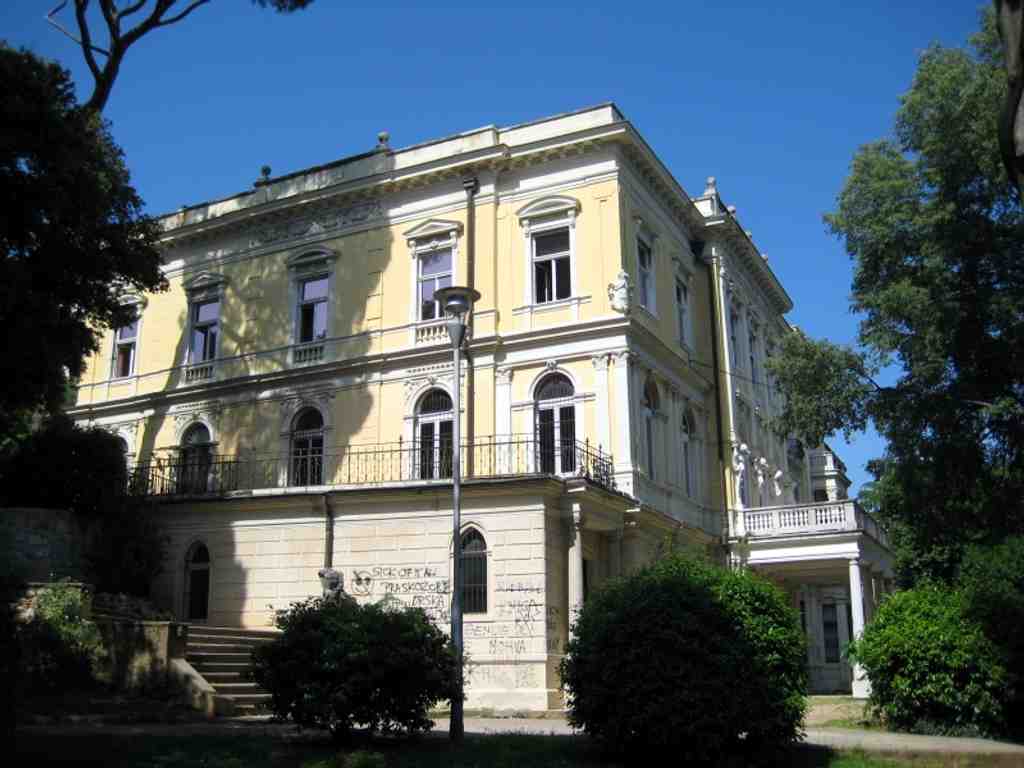
Right in front of you, you’ll spot a grand pale-yellow building with arched windows and elegant decorative details, nestled among lush greenery-just look for the stately mansion with iron railings and an air of quiet authority.
Now, let’s step into the story of the State Archives in Rijeka! Imagine standing here back in the late 19th century; the soft crunch of gravel beneath your shoes, the scent of exotic flowers drifting from the fantastic park surrounding this mansion, and the elegant whispers of history in the wind. This impressive villa was originally the residence of Archduke Joseph, a relative of the famous Emperor Franz Joseph I, who, after a royal family quarrel, chose Rijeka as his place of exile. Talk about family drama! Instead of sulking, he took this 17th-century patrician’s villa and gave it a grand facelift in 1895, following the designs of Rafael Culotti. Rijeka gained not just a residence but one of its most elegant palaces, brimming with that refined flair of historicism.
Fast forward a few decades-the world outside was changing rapidly. Within these walls, however, an entirely new adventure was unfolding: the safeguarding of the region’s entire written memory! The Archives started their official mission here in 1926 as the Royal State Archives in Rijeka. Cue the parade of languages: Latin, Italian, Croatian, German, Hungarian-you name it! The scribes of history left their marks in everything from gothic and humanistic scripts to the curly delights of Glagolitic letters. Rijeka sat under shifting rule after shifting rule, each leaving behind courts, schools, armies, and more-generously donating their paperwork, whether they liked it or not!
As the Second World War approached, the reach of the Archives expanded like a detective’s magnifying glass, peering into even more corners of the region-Kvarner, parts of Istria, Slovenian Karst, and bits and pieces annexed or liberated as borders changed. After 1945, Rijeka was reunited with Croatia, and the Archives found itself with new neighbors-stories from Cres, Lošinj, Krk, and the far reaches of eastern Istria started filling the shelves. In fact, the collection grew so fast, the staff probably had to dodge rolling scrolls and avalanche-prone paperwork more than once!
But wait-it gets even busier! The institution’s name changed nearly as often as the weather: from Royal Archives to State Archives, to Historical Archive, to finally, the State Archives in Rijeka. This building, holding more than 7000 meters of documents in over 1000 collections, is practically bursting at the seams. Some documents are older than the city walls-the oldest from 1201-while others document marriages and town statutes dating back to the 1400s. If only paper could talk! Actually, it would probably whisper, “Please, no more boxes!”
Today, you’ll find reading rooms, a lecture hall, and even a representative exhibition salon in what was once the palace salon. Want to guess what connects this archive to the industrial side of Rijeka? In 2000, the archives expanded into former factories, turning old leather workshops and machine plants into treasure vaults for historical documents. These are among the first examples in the city of industry reborn as culture-proof that in Rijeka, the past is never thrown away, just carefully filed!
So, as you look up at this villa, try to imagine a staircase full of dignitaries, a park blooming with rare plants, and rooms echoing with the secrets of centuries. Here, every document, every faded page, is a puzzle piece of Kvarner, Gorski Kotar, Istria, and beyond-a reminder that history isn’t just kept here, it’s alive. And if you hear a distant sneeze inside, it’s probably just a centuries-old scribe shaking off the dust of time!


