
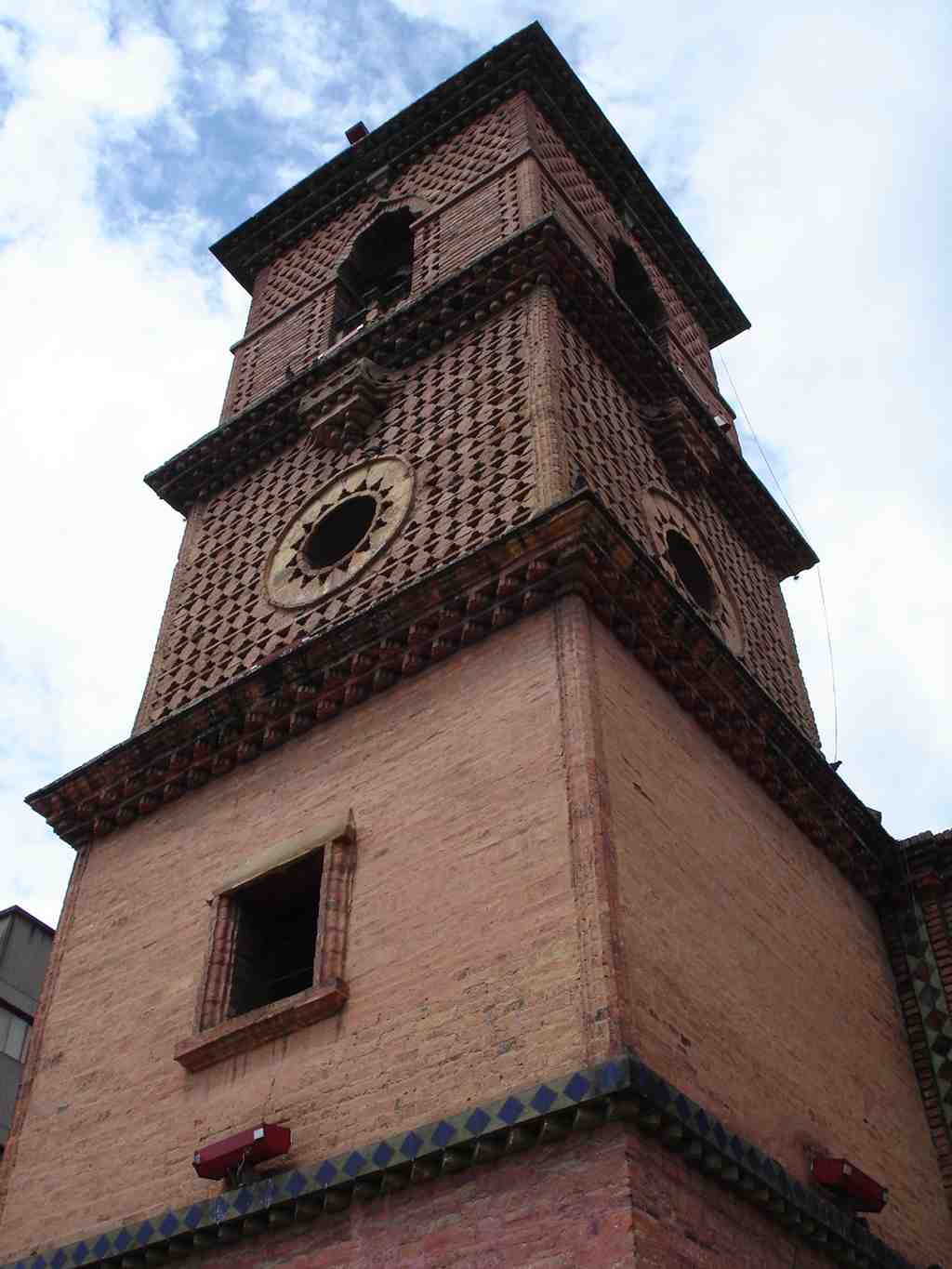
Look just ahead and lift your eyes-what you’ll spot is a tall, reddish brick tower with intricate geometric patterns and a striking dome at the very top, standing like a quiet sentinel next to the religious complex.
Welcome to the mysterious and dazzling Cali Mudejar Tower, a structure that’s got more stories than a library and more style than a peacock! Imagine you’re standing here in the late 1700s: Cali is smaller, the church next door is fresh and new, but there’s something missing-no bell tower. No dramatic call to prayer, no way for the city to be told it’s time for celebration, mourning, or maybe, you know, lunchtime. So the people of Cali decided, “Let’s build something unforgettable!” But here’s where the tale gets tangled. Grab your detective hat, because the truth about who designed and built this tower is as mysterious as a magician’s trick.
Some say a Spanish architect named Pablo brought the plans from faraway Sevilla, using memories of Moors and minarets as inspiration. Others whisper it was a freed Moor named Pedro Umbas, once enslaved to a local priest and gifted the tools of his trade upon earning his freedom. Pedro, said to have a flair for dramatic lines and dazzling detail, may have poured his soul into these bricks, channeling a bit of Seville, a bit of Córdoba, and a lot of imagination right into Cali’s heart. Oh, and the plot thickens! One letter mentions a builder named Antonio Idrobo shifting loads of brick and “amarillo de Castilla” pigment from a local hacienda-if you glance inside or study the outside, see if you can spot those golden-yellow tinges. Another version stars Ignacio Camacho, a mulatto slave working on another church, and Antonio García, master designer of religious buildings around Colombia. Honestly, if you stacked all the legends as high as this tower, you’d have your own bell tower!
Now, let’s take a closer look. The Cali Mudejar Tower isn’t just a pile of bricks stacked up to ring the noon bell-it’s an architectural adventure. Its design features elements borrowed straight from North Africa and southern Spain: its square base stands solid, no platform required, and its walls gently tilt inward-just like the old minarets that once dotted cities across Muslim Africa. The brickwork climaxes in patterns almost hypnotic, and at each level, the details change-square windows framed in stone and brick, a band of tiny trapezoidal bricks swirling in geometric harmony, and higher up, round “eyeball” windows shaped like fifteen-pointed stars. Blink and you might feel like you’ve just traveled to a Moorish fairy tale.
The crowning glory is the campanario-the belfry-where lacy arches and elegant curves echo the style of Córdoba’s great mosque, and the very top is capped with a semi-spherical dome clad in glossy ceramic tiles, all topped off with a delicate iron cross. Stand here long enough and you’ll almost expect to hear echoes of distant muezzins or the laughter of the workers who laid each brick with sweat and maybe a little hope for immortality.
Time marched on, and the tower saw change after change. Artists and painters came along, borrowing, experimenting, and sometimes just trying to outdo each other for the sake of style. In one renovation, the geometric patterns got covered with plaster-imagine painting over a masterpiece just because you’re changing the curtains! Then, around 1936, artist Luis Acuña raised the parapets, tinkered with the windows, and added mosaics to the dome’s base, leaning even harder into its exotic, “oriental” vibe. Once, the whole tower might have gleamed ochre-yellow or blinding white, but Acuña gave it the now-famous pale red hue to make sure no one missed it against the Cali skyline.
In every brick, there’s a story-of freedom, creativity, and a whole lot of mystery. Some people say ghosts of the original builders come to check on their work during odd nights, making sure no one has snuck in another coat of plaster. So, next time you’re here, give a wink or a tip of your hat-you might just be saying “hello” to history itself!


