
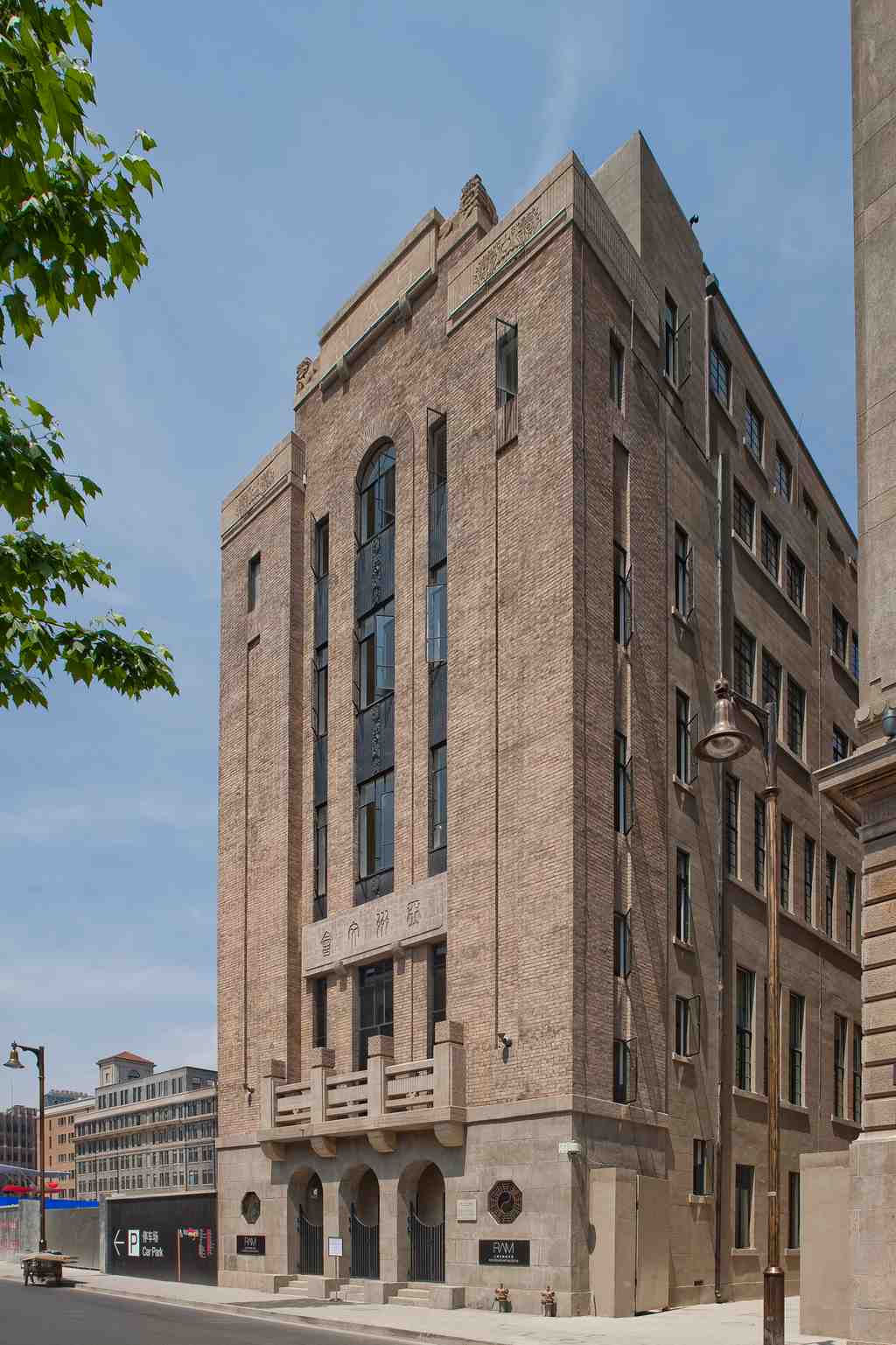
To spot the Rockbund Art Museum, just look for a tall, art deco building made from light brown bricks with a strong vertical presence and elegant geometric details, right on the corner ahead of you.
Ah, here we are at the Rockbund Art Museum! Take a good look at its striking façade, towering above the quiet street as if it's ready to burst into song-or maybe burst into a modern dance, since this place is all about contemporary art. But the story behind this sharp-looking building is as rich as a chocolate cake at a birthday party, and every bit as layered.
Travel back with me to the early 1930s, when Shanghai wasn’t just a city, but a mix of cultures, languages, and a dash of jazzy fun. This building first rose in 1933, right where the Suzhou Creek meets the mighty Huangpu River-an area now called “the Source of the Bund.” Here, in the midst of all those ships and old Shanghai bustle, the Royal Asiatic Society decided to create a hub of knowledge, bringing together a museum, a library, and a lecture hall. If you can imagine the city’s buzz back then-rickshaws clattering along, businessmen in suits tipping their hats, and scholars with stacks of books-it might just feel like you’re on a movie set.
People from across the world flocked here-over 7,000 visits a month at its peak!-to marvel at ancient artifacts, natural wonders, and scientific breakthroughs. It was unique in China at the time, not just for its size but for its ambition to blend scholarly research, cultural exchange, and public education. Imagine standing here seventy or eighty years ago, maybe listening in on an excited British explorer talking about a fossil, or catching a whiff of something strange from the natural specimens inside. And what a collection they had: relationships with the British Museum, New York's Metropolitan, and the Musée Guimet in France brought treasures and minds from everywhere.
All this made the Royal Asiatic Society building the largest Oriental Studies center in Asia, and a place for anyone-curious local, traveling scholar, or gossip-hunting journalist-to dive into an astonishing collection. If these walls could talk, they’d probably have an accent by now.
But every grand stage sees a change of scene. In 1952, the Society closed its doors, leaving behind a treasure trove: over 20,000 natural specimens, more than 6,000 historical artifacts, and at least 14,000 rare books and manuscripts. These precious pieces of history were parceled out to what became the heart of Shanghai’s top museums-the Shanghai Museum, Natural History Museum, and the Bibliotheca Zi-Ka-Wei. You could say the legacy of this building is scattered all across Shanghai like sprinkles from a cinnamon bun-sweetening the whole city.
Fast forward to 2005. The district was ready for a new chapter. In came the developers, but instead of flattening the past, they decided to dust it off and showcase it. Enter David Chipperfield, a British architect renowned for his restoration work in places like Berlin. Armed with blueprints and a minimalist touch, he kept the building’s proud Art Deco style and its Chinese touches-sort of like giving it a stylish haircut but not shaving off its character.
Now, you see the museum reimagined for the present: glassed-in rooftop terraces, open plazas at ground level, and a stunning skylight linking the upper floors. Inside, everything is fresh, clean, and just waiting for some art to splash a bit of color on it. The galleries don’t keep a permanent collection, so whenever you duck inside, you’re in for a surprise-one day a show from superstar Cai Guo-Qiang, another day, a whimsical work by Zeng Fanzhi.
So whether you love art museums, old languages, or just good stories, the Rockbund Art Museum stands as an open invitation from every era of Shanghai’s whirlwind past. And just think: the next time you see a crowd lingering here, maybe they’re not waiting for art at all, but for the end of the tour-so they can run to the rooftop, catch the breeze, and feel like they’ve walked back through nearly a century of Shanghai’s magic.


