
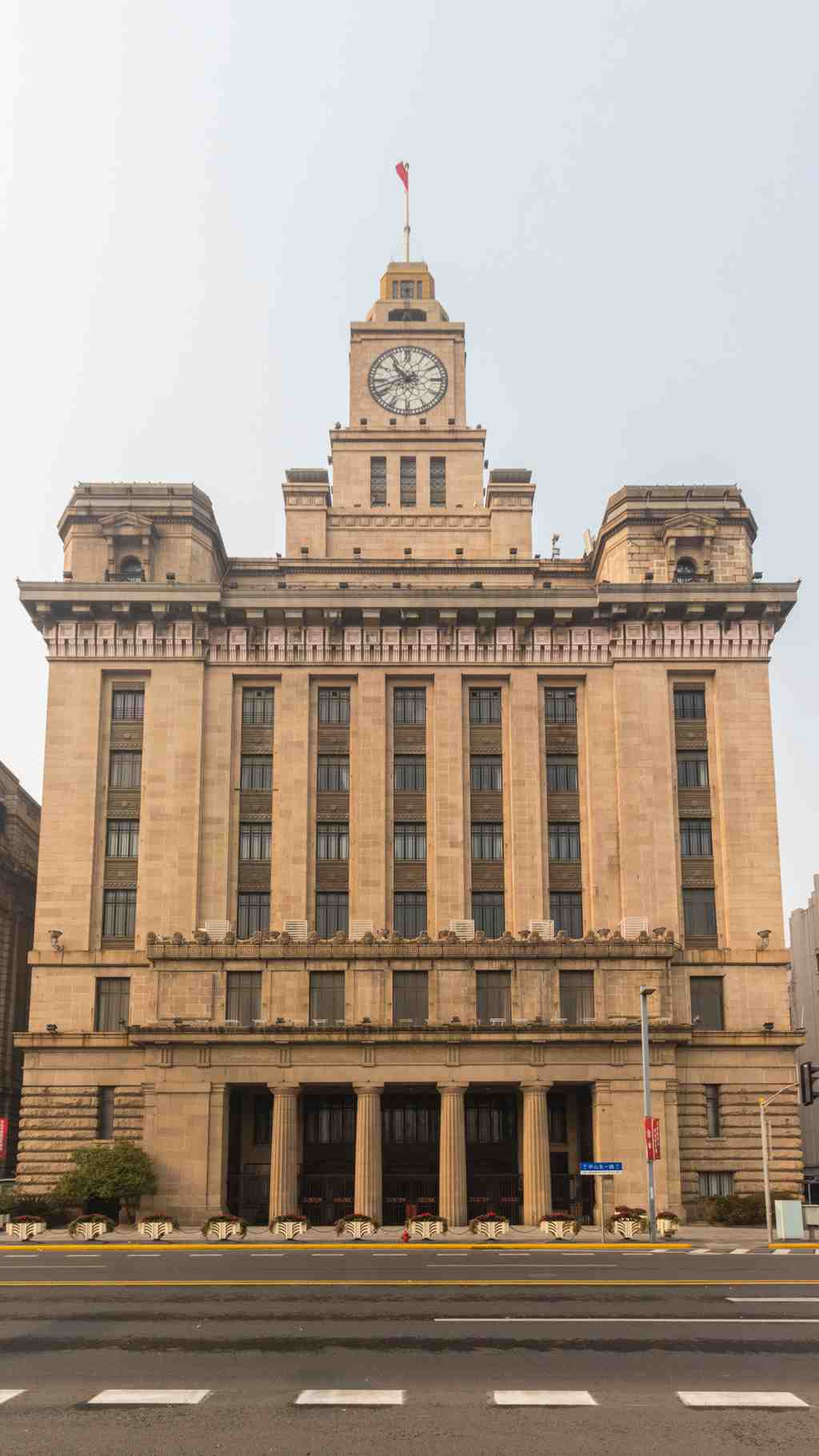
Look ahead and you’ll spot the Jiang Customs Building by its tall stone clock tower, crowned with a Chinese flag, and its grand entrance marked by four towering pillars right in the middle of the Bund.
Let’s imagine you’re a foreign ship’s captain in the late 1800s, steering through the Huangpu River mist at dawn. You’re tired, your ship’s clock is suspiciously fast-or is it slow? But suddenly, looming through the haze, you see the highest building in Shanghai: the Jiang Customs Building, its clock tower rising like a guardian above all. You steer straight for that stone giant, drawn by the famous chime that every ship around the world trusted to set their watches right.
But let’s back up, way back-right to the year 1685! The early Customs House was more of a humble office managing international trade. Flash forward to 1843, after the Treaty of Nanjing, and the Qing government decides, “Right-Shanghai is now a treaty port! Let's build something that won’t collapse when a seagull lands on it.” So the Customs House first went up on this very spot in 1846.
What’s almost comical is that the Jiang Customs Building kept reinventing itself. It started off in the 1840s as a series of offices with traditional Chinese roofs and huge flagpoles. Then the French, British, and Americans all wanted in on the fun (and the taxes). By the late 1800s, the Customs Hall morphed into a bizarre mashup: imagine a Western cathedral with lion statues and a spiky lightning rod. Local legend says the contractor, a Pudong-born mason named Yang Sisheng, became the Steve Jobs of 19th-century Shanghai buildings. If bricks had WiFi back then, Yang would have invented it.
By the 1920s, though, Shanghai had become a true world city. The Customs building needed a makeover-something worthy of a city obsessed with the future. So, in 1925, the old structure got bulldozed. They shipped in granite all the way from Suzhou. Out came a new style, a bold blend of Greek columns and streamlined modern design. Look up at those four massive columns-Doric style, if you want to get architectural about it. The highlight: that clock tower, rising like a beacon above the granite, visible for miles both day and night. It made this building the tallest on the Bund in the 1920s!
Inside, it was lavish, with mosaic floors, grand lobbies, and a ceiling with eight vibrant pictures of historic sailing ships, all assembled from dazzling pieces of colored tile. There were even crystal chandeliers and, in the early days, a water fountain sparkling under the lights. Ten elevators, six staircases, nearly 400 rooms... talk about customs duty!
But let’s not forget the clock. When the 1927 tower was finished, everyone in Shanghai stopped in their tracks-literally. The clock, made by top British craftsmen, was Asia’s biggest and the world’s third-largest at the time. Getting all six tons of it up there was the show of the year. Crowds gathered with mouths open as workers hauled the massive clock case up 72 meters-imagine the suspense as the ropes creaked and everyone held their breath, staring up at the sky, wondering if lunch would land on their heads.
And here’s the quirky reason for that clock: it wasn’t just a pretty face. In those days, every ship captain and customs official argued about exact time-because in Shanghai, time meant taxes! Whatever the customs clock said, that was the official stopwatch for all shipping business. So, when this clock struck twelve, tariffs and paperwork started fresh. Of course, hearing the famous Westminster chimes meant you also had less time for a nap.
This building has weathered wild times. In the days of the Cultural Revolution, energetic Red Guards rushed in, changing the music and even turning the clock face into a sunflower pattern. The bell that once played Westminster chimes shifted to patriotic tunes-even today, sometimes it’s an old revolutionary song, played over modern speakers for a new era.
So as you stand on the Bund, listen closely for the echo of that powerful bell. Imagine the ships, the crowds, the bustle of paperwork and cargo on the river docks. The Jiang Customs Building isn’t just stone and steel: it’s the heart that once kept Shanghai ticking, to the very second. And if you’re ever late, well, now you know who to blame!


