
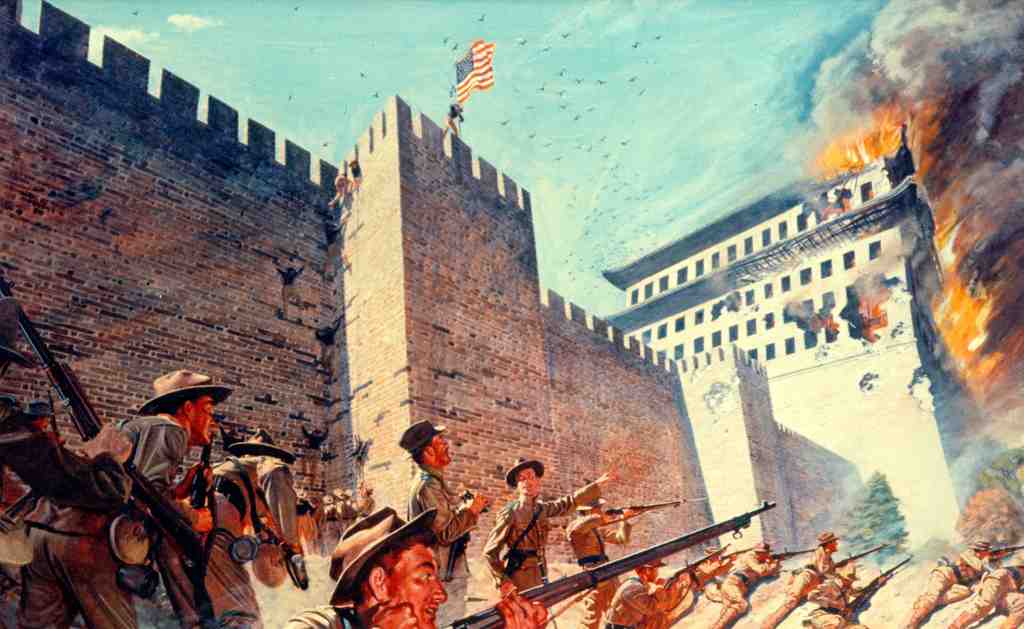
Just ahead of you, you’ll spot the iconic old city wall-its sturdy bricks standing tall even today, as if bracing for what’s to come-and if you look up, imagine that very spot crawling with determined soldiers, desperate refugees, and the chaos of smoke and flames from a century ago.
Now, let’s step back into the summer of 1900, and trust me, it was anything but uneventful here. Picture the Legation Quarter, a bustling 2-mile-long zone reserved for foreign diplomats and their families, wedged right inside the heart of old Beijing. It was a patchwork of embassies from nations like Britain, America, Germany, Japan, and more-each with their own guards, flags, and secrets. But there was trouble brewing-big trouble. For decades, foreigners had forced China to sign unequal treaties, chipping away at the country’s pride and sovereignty. Locals were frustrated and angry, and eventually, all that steam boiled over into a movement known as the Boxers. These were not your regular martial artists-they believed that with the right rituals, swords, and a bit of bravado, they’d be immune to bullets! (And I struggle to get through a Monday without caffeine.)
By 1900, the Boxers, calling for “Support the Qing! Destroy the Foreigner!” swept into the capital, burning churches, attacking anyone seen as too close to the West-even targeting fellow Chinese who had embraced Christianity. The air was thick with the smell of smoke and fear, and rumors buzzed through the narrow lanes. It wasn’t long before nearly 900 foreigners and almost 3,000 Chinese Christians packed into the Legation Quarter, barricading themselves like a scene from a wild action flick-except this one came with horses, ancient cannons, and a lot of rationed rice.
The Chinese imperial government was in a bind. Some officials scoffed at the Boxers, while others secretly rooted for them. Then, after a foreign assault on the coastal Taku Forts, Empress Dowager Cixi herself joined Team Boxer, and things really heated up. Foreign soldiers from eight nations manned defensive lines, and everyone-including 79 foreign children-held their breath. If you’d been here at night you’d have heard rifle fire, cannons roaring, and the unsettling pop of fireworks meant to keep the defenders awake (as if anyone could have napped through that).
Fierce fighting broke out along these walls-the British, Americans, French, Italians, Germans, Japanese, and Russians all holding their ground, often in impossible conditions. On the very wall you see before you, American Marines and German soldiers teamed up to hold off waves of attackers. The defenders were so low on proper weapons they constructed makeshift artillery from scrap-nicknaming one such invention “Betsy the International Cannon.” It was like an episode of “MacGyver,” but with higher stakes.
Some days, the defenders resorted to eating horse meat and musty rice while chaos raged outside. Water was always precious, and the Christians sheltered here-especially Chinese converts-struggled and starved, their fate tied to the outcome of a siege that felt like it might never end. Truces came and went faster than a Beijing taxi-at one point, the Empress sent supplies as a gesture of goodwill, the next, the wall was under assault again.
By July, the siege became truly desperate. Flame-lit nights, mining operations under the walls, explosives shaking the ground-every sense on red alert. The Boxers and the Qing troops came within a hair’s breadth of crushing the Legation defenders. The wall you’re next to now? Holding it was the difference between life and death. Soldiers on both sides faced daily terror. “The men all feel they are in a trap, and simply await the hour of execution,” one American captain wrote. It was as real as suspense gets-no popcorn needed.
But then came the twist: at dawn on August 14, 1900, the rescue army-soldiers from Britain, America, Japan, France, and Russia-stormed the city. The Americans even climbed these walls instead of fighting through the gates! By afternoon, the siege lifted. You can almost hear the cheer from exhausted survivors and the clip-clop of cavalry through ash-choked streets.
After the siege, the Legation Quarter became a symbol of survival, but also of the bitter cost of foreign intervention. Mark Twain himself later criticized what happened here. And despite the suffering, the city didn’t fall apart-though the Boxer movement faded swiftly, the memory of these days lingered on in every scorched brick.
So as you stand here, picture this place not just as another spot on your walking tour, but as the set of a dramatic showdown-one that changed the course of history, shaped international politics, and left behind stories of fear, courage, and the bizarre belief that you could dodge bullets with the right dance moves. A little reminder: when you’re up against the wall, creativity-and a reliable rice supply-can save your life!
Yearning to grasp further insights on the legation quarter, rising tensions or the dilemma of the chinese government? Dive into the chat section below and ask away.




