
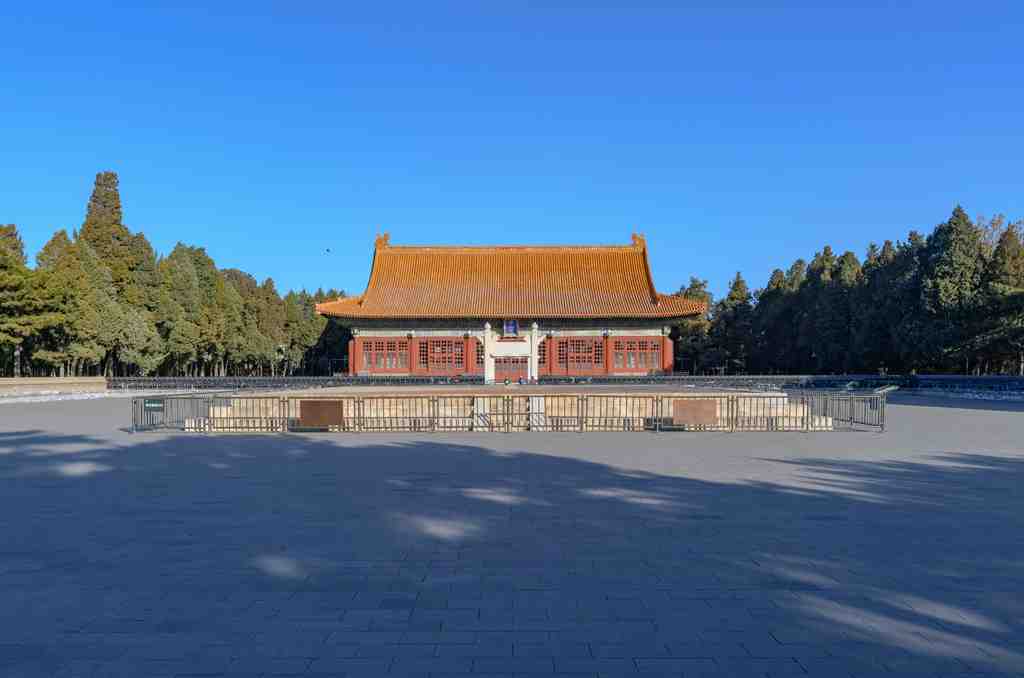
To spot the landmark, look straight ahead for a striking rectangular building with red walls and a bright golden roof sitting behind a multi-tiered stone altar, surrounded by lush, ancient trees-it’s hard to miss!
Welcome to Beijing Shejitan, or the Altar of Earth and Harvests! Right now, you’re standing in front of a place where, long ago, emperors would have shown up in their very finest robes-you know, those silk outfits with more dragons embroidered on them than a child’s doodle pad at nap time. This is no ordinary temple; it’s the last remaining altar in China built purely for worshipping the earth and the harvest gods-talk about VIP access! Way back in the day, the emperor didn’t just wave to the crowds and wish for good weather-he had to come here and make things official with rituals to the gods of soil and grains, asking for bumper harvests and peace across his vast kingdom. The simple folks of old Beijing must have held their breath as solemn processions wound through what is now a leafy park. But guess what? The Shejitan was only built as you see it today in 1420, when Emperor Yongle decided that the emperor’s job description should include farming consultant-if only he’d had a garden gnome for advice!
Imagine the drama before this: in other cities, like Nanjing, the gods of earth (for land and country) and the gods of harvests (for the grains) were given separate addresses and their own altars-like roommates who just couldn’t get along. But in 1377, the mighty Ming founder Zhu Yuanzhang declared, “Enough! Let’s bring these gods together-one altar, fewer delivery costs for the sacrificial offerings!” So, in Beijing, a grand altar was put up on the site where temples had stood since the Tang and Liao dynasties. Over the centuries, the temple survived fire, war, and perhaps more than a few grumpy officials.
Fast forward to the 20th century, and this exclusive imperial grounds becomes something truly radical-a park open to everyone! In 1914, Beijing Shejitan became one of the first royal gardens the public could walk through, breathe in the scent of old cypress trees, and maybe grab a picnic. But hold on-the plot thickens! In 1925, when the revolutionary Sun Yat-sen passed away, his casket was actually placed in the grand hall you see to the north-picture hundreds visiting to pay their respects to the “Father of Modern China” surrounded by those same golden eaves. By 1928, the park changed its name to Zhongshan Park to honor him, and for a while, students even checked out library books here-proving you can have a history of emperors, peasants, and bookworms, all in one place.
But that’s not all-did you know this altar is paved in five different colored soils? Yellow in the middle (for the center), blue for the east, red for the south, white for the west, and black for the north-never mind color coding your closet, try color coding your entire altar! Each patch represents one of the five elements, embodying the emperor’s control over all the land and its people. Stand here and you might just sense the weight of tiny mysteries-the “Jiangshan Stone” or “Country Stone” once stood on the altar as a guardian, though it vanished after the last dynasty. During the Cultural Revolution, the colored earth was swapped out for nothing but yellow soil-cotton was even grown here for a short time. But thanks to careful restoration, the five colors returned, and these ancient stones and tiles have kept Beijing’s very long memory alive.
So, as you look at those bright red walls and elegant rooftops, imagine centuries of rituals, revolutions, and restorations-all swirling together right beneath your feet. You’re standing at the heartbeat of Beijing’s history, where old emperors prayed for grain, revolutionaries honored their heroes, and now, you can just enjoy the peace and shade under the trees. Not a bad place to stop and daydream a little, right?




