
Chã dAreia Audio Tour: Echoes of Heritage on the Plateau Trail
Discover the vibrant heart of Praia, Chã d’Areia on this captivating tour! Explore the stunning Praia Cape Verde Temple, a serene oasis blending modern architecture with spiritual tranquility. Marvel at the historic Pro-Cathedral of Our Lady of Grace, a beautiful emblem of Portuguese heritage and colonial charm. Immerse yourself in the rich culture and history of Cape Verde as you stroll through lively streets, uncovering hidden gems and local stories. This tour promises a perfect blend of history, architecture, and authentic island vibes!
Tour preview
About this tour
- scheduleDuration 90–110 minsGo at your own pace
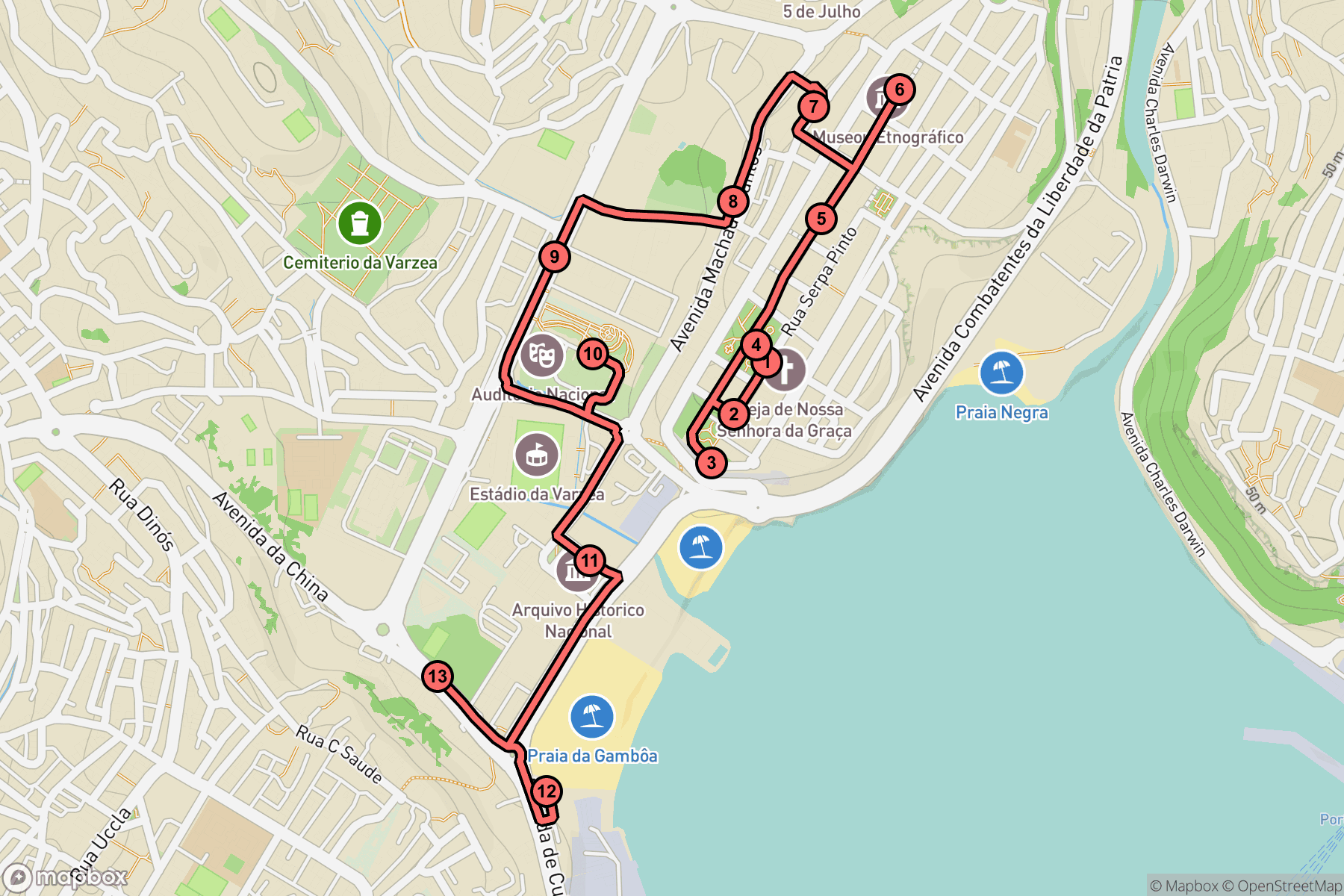
- straighten3.6 km walking routeFollow the guided path
- location_onLocationPraia, Cape Verde
- wifi_offWorks offlineDownload once, use anywhere
- all_inclusiveLifetime accessReplay anytime, forever
- location_onStarts at Pro-Cathedral of Our Lady of Grace, Praia
Stops on this tour
lock_open 3 free previews · 10 unlock with purchase
Look for a large, white, neoclassical church with a tall bell tower-just peek through the trees in the direction of Praça Alexandre Albuquerque and you can’t miss it! Welcome to…Read moreShow less
Look for a large, white, neoclassical church with a tall bell tower-just peek through the trees in the direction of Praça Alexandre Albuquerque and you can’t miss it! Welcome to the Pro-Cathedral of Our Lady of Grace! Imagine yourself back in the late 1800s, when this part of Praia was bustling with builders, all hammering and sawing away to create this elegant church. Its tall white walls and grand entrance, right here on the square, have stood for over a century, watching as history unfolded all around. With its neoclassical style, it almost feels like the church dressed up for a royal ball every day! Can you hear that bell at the top of the tower? If it rings while you’re here, you’ll know you’re in the right spot. This church isn't just a pretty face; it’s the seat of Cape Verde’s oldest Roman Catholic diocese, which was created way back in 1533. These walls have felt countless joyful whispers, nervous prayers, and maybe even a few secret giggles from children hoping the priest wouldn’t notice them sneaking a sweet. Today, Cardinal Arlindo Gomes Furtado looks after it. So, as you stand here, just imagine all those footsteps that have passed through-each one adding to the living story of Praia.
Open dedicated page →The Presidential Palace stands proudly ahead, a pastel yellow two-story building with elegant white columns and a decorative gate-just look past the iron fence under the shade of…Read moreShow less
The Presidential Palace stands proudly ahead, a pastel yellow two-story building with elegant white columns and a decorative gate-just look past the iron fence under the shade of large trees. Imagine it’s 1894 and the streets are filled with the sound of horse-drawn carriages as this magnificent palace rises on Rua Serpa Pinto. The air is thick with a salty breeze from the nearby ocean, and whispers float through the Plateau district about the grand home being built for the Portuguese governor. The neoclassical style, with its tall windows and classical lines, is meant to impress, almost as if the governor is waiting for royalty to pop by for tea at any moment-preferably with scones, but hey, this is Cape Verde! Years pass, and the building witnesses the ups and downs of colonial rule, the sway of palm trees in storms, and mustachioed officials rushing in and out. Then 1975 arrives, and the air crackles with the excitement of independence. The Portuguese pack their bags, and suddenly this palace isn’t just a fancy house anymore-it’s the heart of the new Cape Verdean presidency. These walls have heard secrets of leaders, the echo of national anthems practiced nervously, and maybe, just maybe, the laughter of someone hiding from the summer heat inside those cool stone corridors. What tales the palace could tell, if only it could talk!
Open dedicated page →To spot the Monumento de Diogo Gomes, look for a tall, greenish-bronze statue of a man in a heavy cloak, holding a sword confidently at his side and gazing out over the city-it's…Read moreShow less
To spot the Monumento de Diogo Gomes, look for a tall, greenish-bronze statue of a man in a heavy cloak, holding a sword confidently at his side and gazing out over the city-it's standing boldly on a stone pedestal near the edge, just before the beach comes into view. Now, as you stand before this impressive figure, imagine the year is 1460 and salty Atlantic winds whip at your coat. That’s exactly how Diogo Gomes would’ve felt as he first set eyes on this shore-except, instead of holding a smartphone, he was gripping the helm of a sturdy wooden ship. Diogo Gomes, the Portuguese navigator, wasn’t exactly your average tourist. Sent by the Prince of Portugal, he sailed into unknown waters and-voila!-discovered the very island you’re standing on. The statue, crafted with flair by Joaquim Correia in 1956, stands 3.3 meters tall on a nearly 2-meter pedestal, like a bronze superhero watching over the historic Plateau and the sparkling Gamboa beach below. Some say he’s still on the lookout for his lost compass! So next time you lose your way, remember-you’re in good company with a legendary explorer who made history right here.
Open dedicated page →
Show 10 more stopsShow fewer stopsexpand_moreexpand_less
Directly ahead, you’ll spot an open plaza shaded by green trees, lush gardens, and a white stone monument peeking out in the middle of neatly trimmed paths-just look for the…Read moreShow less
Directly ahead, you’ll spot an open plaza shaded by green trees, lush gardens, and a white stone monument peeking out in the middle of neatly trimmed paths-just look for the cluster of benches and bronze busts in the heart of the square. Welcome to Praça Alexandre Albuquerque, the historical heart and social living room of Praia! Imagine taking a stroll here back in the 1800s-carriages rattling past, townsfolk pausing beneath the trees for a chat (or to swap a bit of juicy gossip), with grand old houses watching over every corner. This square is named after Caetano Alexandre de Almeida e Albuquerque, whose name takes almost as long to say as it does to walk around the plaza! In 1876, it became his namesake, but before that, it was simply called Praça do Pelourinho. Today, the square buzzes with life-look around at the regal Pro-Cathedral of Our Lady of Grace, the Palace of Justice, and cozy townhouses that have seen the centuries spin by. In the center, two bronze busts of Alexandre Albuquerque and Serpa Pinto keep a watchful eye on everyone, never blinking even on the hottest days. As you stand here, listen for the echoes of deals being made at the banks, laughter tumbling out of city hall, and maybe even a distant whisper from history itself, wondering who will write the next chapter of this lively city. Don’t forget to watch your step-those bronze busts are known to keep secrets from the curious feet of explorers like you!
Open dedicated page →Straight ahead, you'll spot the Plateau by its elegant colonial buildings, pastel colors, and grand iron gates, rising slightly above the cobblestone streets-just look for the…Read moreShow less
Straight ahead, you'll spot the Plateau by its elegant colonial buildings, pastel colors, and grand iron gates, rising slightly above the cobblestone streets-just look for the broad open area with stately architecture and lively city life. Now, take a breath and imagine yourself standing right in the very heart of Praia’s history-Plateau! This high ground, perched just 37 meters above the bustling port, was once the city’s secret weapon against pirates. Close your eyes for a second and picture the 16th century: salty sea air, heavy footsteps on cobblestones, and somewhere in the distance, the shouts of villagers keeping watch for threat from the ocean. Life here wasn’t just about defense though-it was about building a city strong enough to become Cape Verde's capital. As the years ticked by, this very spot was buzzing with decisions that shaped the country’s future-a grid of streets, grand mansions, and all those lovely pastel facades every way you turn. By 1770, Plateau had outsmarted the old capital, Cidade Velha, and claimed its crown as the colonial seat-imagine the celebration (and maybe a jealous glare or two from the neighbors). The funny thing is, the name “Plateau” actually comes from French, because this place is literally raised up like a neatly set cake on a platter! If you listen closely, you might sense the echoes of important moments: heated political debates bouncing off the Presidential Palace, laughter spilling from local music clubs, and shopkeepers sweeping their corners every morning. And don’t forget, you’re surrounded by history at every step-cathedrals, museums, even the national post office, all packed into this small plateau. Since 2016, it’s been seeking World Heritage status-one day, this spot may be as famous as its stories. So before you walk away, take a good look around at the tree-lined squares and sunlight bouncing off old walls, and know you’re not just sightseeing-you’re time-traveling through the beating heart of Praia.
Open dedicated page →Look for a charming, dark-pink building with a pair of round windows near the ground and a big, sky-blue door right in the middle-if you spot some pretty white balconies and the…Read moreShow less
Look for a charming, dark-pink building with a pair of round windows near the ground and a big, sky-blue door right in the middle-if you spot some pretty white balconies and the number 45 above the door, you’ve found the Museu Etnográfico da Praia! Now, let’s imagine you’re stepping back in time as you stand on this cobbled street in the Plateau, the historic heart of Praia. Picture this building in the 19th century-long before it showed off its “museum” sign. Maybe you hear the clip-clop of horses on the stones, or the chatter of locals swapping stories as they pass by. Inside, it now shelters a treasure chest of Cape Verdean culture. Opened in 1997, this cozy museum feels almost like a time machine. Once you’re inside, it’s as if you’re invited to a lively family reunion spanning generations-around you are old cooking pots, woven baskets, and musical instruments that have echoed through Cape Verdean homes for centuries. Gaze at the intricate craftsmanship and you might imagine the laughter of children playing, or the scent of cachupa bubbling in a kitchen. There’s humor in how some of these traditional outfits seem just as ready for a party as modern fashion! The story of this place is stitched together from thousands of daily moments, keeping the mystery and soul of Cape Verde alive. So, as you stand here, feel the heartbeat of history rumble under your feet-and hey, if you hear a whisper from the past, don’t be surprised. You’re in the right place!
Open dedicated page →Look ahead and you’ll spot Praia sprawling across the land, with the deep blue bay on your right, rugged coastlines curling around, and a tangle of city streets and neighborhoods…Read moreShow less
Look ahead and you’ll spot Praia sprawling across the land, with the deep blue bay on your right, rugged coastlines curling around, and a tangle of city streets and neighborhoods climbing over the plateaus and valleys - all beneath drifting ocean clouds. Alright, you’re standing right at the heart of dynamic Praia, and let me tell you, this city has more stories packed into its plateaus and valleys than a suitcase at the airport! Imagine it’s the year 1615. The Atlantic breeze is salty, the cliffs rise above a hidden bay, and settlers are building the first shacks and storehouses in what would become Praia de Santa Maria. Back then, this spot was a smugglers’ dream-ships would sneak into the bay, dropping off cargo to dodge taxes in Ribeira Grande, the old capital up north. But oh, how things changed! Word spread: the plateau here was perfect for building, with winds to cool the sun and cliffs to spy ships far out at sea. People from Ribeira Grande, tired of pirates and political drama, packed up and moved here. With every year, more folks arrived-not just for better business, but to escape the old city’s troubles. By 1770, Praia had snatched the title of capital, and you could almost hear the sigh of relief…and maybe a cheer or two. Now, as the centuries passed, Praia didn’t just sit idly on its hill! Fast forward to the late 19th century, and you’ll find the Plateau area bustling. Imagine horse-drawn carriages clattering along Avenida Amílcar Cabral. The grand Presidential Palace was built, stately and elegant-back then the fancy residence for the Portuguese governor. The city was suddenly all about chandeliers and formal dinners, but one thing remained unchanged: the Plateau was the place to see and be seen. But here comes the twist! Until independence, the fancy Plateau was more like the “city proper,” and the outlying neighborhoods-called achadas-were left to grow messy and wild, like a garden left to its own devices. Only after independence did people admit, “Hey, the city is a lot bigger than just this hill!” Suddenly, Praia exploded-well, not literally-with people from every Cape Verdean island pouring in. In just thirty years, the population quadrupled! The Plateau stayed the soul of the city, but now places like Achada de Santo António or Palmarejo became new centers for homes, schools, and businesses, each with their own flavor. Praia is a city of many faces and sounds. Early morning, fishermen haul in their catch at the port, their voices rising above the creak of boats. Tropic sun heats the markets, where fruit sellers wave mangoes and papayas, and you might catch the scent of coffee beans-the same beans once exported from this very harbor. Cafés mix traditional rhythms with modern beats, as Cape Verdeans blend island customs with cosmopolitan flair. The city’s districts are as varied as a box of chocolates. Whether you’re wandering the leafy roads of Prainha, peeking at grand government buildings in Plateau, or heading down to Quebra Canela for fresh fish and a seaside view, you’re tasting a little bit of the whole country. Fun fact: the Plateau isn’t even the biggest or most populated zone anymore-that honor goes to Achada Grande and Achada de Santo António. But ask any local, and they’ll tell you: the Plateau is still the city’s heart and mind. And let’s not forget the weather! Praia has a desert climate, but the ocean breezes are like the city’s personal air conditioner. Rain is so rare it’s almost an event-the kind where people look up from their phones and wonder if someone accidentally turned on a sprinkler. Schools blossom throughout the city. The very first school in Cape Verde opened right here, later followed by the proud Liceu Nacional. Today, universities like the University of Cape Verde and Jean Piaget push young minds to dream bigger. By night, the city comes alive with laughter, music, and culture. Theatres, museums, the grand Palácio da Cultura-Praia loves a good party, and the annual music festival at Gamboa Beach is legendary. And if you decide to stroll along Avenida Andrade Corvo or through the old colonial streets, who knows? You just might feel the pulse of history-like a drumbeat echoing up the hills and down to the sea. So as you stand here, listen closely. Praia tells its story in every gust of wind, every café and corner, every crowded street and quiet overlook. A city built on cliffs, fueled by hope, and always moving forward-one wave, one song, and one bustling market at a time. Seeking more information about the areas, geography or the demography? Ask away in the chat section and I'll fill you in.
Open dedicated page →It wasn’t long before adventure turned to ambition. By 1462, the Portuguese founded their very first town, Ribeira Grande (which today is named Cidade Velha), over on the south…Read moreShow less
It wasn’t long before adventure turned to ambition. By 1462, the Portuguese founded their very first town, Ribeira Grande (which today is named Cidade Velha), over on the south coast of Santiago. This sleepy settlement quickly became the hottest stopover on trade routes linking Africa, Brazil, and even the Caribbean. Picture bustling docks, the clang of anchor chains, and merchants shouting prices as ships came and went, filled with spices, textiles, and sadly, enslaved Africans. Life in Cape Verde became tied to the great tides of Atlantic trade. Now, here comes an interesting twist-Manuel I of Portugal, always thinking two steps ahead (or perhaps just looking for a place to send people), exiled thousands of conversos, Jews forced to convert to Christianity, out here between 1492 and 1497. Many of them became traders and formed close-knit communities, often intermarrying with African families. These clever free-lance traders were called lançados-quite literally “the thrown ones.” They may have felt tossed out, but they established deep-rooted ties with local communities and gave rise to new Cape Verdean cultures, blending European and African customs. But let’s not skip over the action-pirates were the rock stars of the high seas! The riches of Ribeira Grande brought not just traders, but some notorious houseguests too: pirates like Francis Drake in 1585 and Jacques Cassard in 1712. You can almost hear the warning bells and the panic as locals rushed to defend their home. In an effort to stop the raids, Crown ordered the massive Forte Real de São Filipe to be built in 1587. Despite this, Ribeira Grande’s golden days began to fade, and the capital eventually moved right here to Praia in 1770. But life on Cape Verde was never easy. The islanders faced erupting volcanoes like Pico do Fogo-which, in 1680, blanketed Fogo in ash and sent families fleeing to safer shores. Then came whaling ships from North America in the late 1700s-they’d dock in Brava for food and water, and hired local men as sailors. Cape Verdeans became a part of faraway communities like New Bedford, Massachusetts-a little slice of “sodade” abroad. The 19th century brought changes, too. The city of Mindelo boomed as a coal depot after 1838, and the beautiful Plateau of Praia, where you stand, was redesigned with elegant colonial mansions and palm-lined streets. In 1876, slavery was finally abolished here-though the scars of those centuries lingered. The 20th century was full of challenges. Famines struck due to harsh droughts-two especially terrible ones in the 1940s killed tens of thousands. Many Cape Verdeans had to leave, some heading to work the cocoa plantations in Portuguese São Tomé and Príncipe, others sailing off to new beginnings. Now, here’s where the plot thickens-Cape Verde’s struggle for independence. While the nearby region of Guinea-Bissau fought for freedom, Cape Verde managed to negotiate independence, thanks to the efforts of leaders like Amílcar and Luís Cabral and the peaceful Carnation Revolution in Portugal in 1974. So, in July 1975, right here in Praia, Portugal handed over power, and Cape Verde was born as a free nation. So, take a moment-imagine centuries of sailors, traders, and freedom fighters all leaving their mark where you stand. From pirates to pioneers, from hardship to hope, Portuguese Cape Verde’s story is like one of those epic tales-full of mystery, adventure, and just a touch of sea salt. And if you think that’s impressive, just wait till you see what’s coming up next on our journey!
Open dedicated page →Now, imagine we’re back on October 7, 2018-a day buzzing with excitement for the members of the Church of Jesus Christ of Latter-day Saints in Cape Verde. They hear the…Read moreShow less
Now, imagine we’re back on October 7, 2018-a day buzzing with excitement for the members of the Church of Jesus Christ of Latter-day Saints in Cape Verde. They hear the announcement: A temple will be built right here in Praia! For the first time ever, Cape Verde would host a sacred temple-a sort of spiritual home base. By the end of that day, this tiny country was keeping pretty impressive company; President Russell M. Nelson also announced 11 other temples, and the running total reached a whopping 201 worldwide. That’s more temples than the number of excuses I come up with to not exercise! Ground was officially broken on May 4, 2019. Paul V. Johnson, the president of the church’s Europe Area, picked up a shovel and, with a grin, kicked off construction. I like to think there was probably some nervous excitement in the air-after all, starting a sacred project of this scale is a bit like planting a seed and waiting to see just how beautiful it'll grow. The temple itself is a study in Cape Verdean simplicity and strength, blending gently with its surroundings. It’s just one story, with clean lines and an elegant end tower. The stone, moleanos limestone shipped all the way from Portugal, gleams in the sunshine, while ripe gardens and shade trees offer visitors a sense of tranquility. If you wander the paths around the 4.46-acre plot, you’ll catch the scent of flowering shrubs-let’s hope you have a good sense of direction, or you’ll get lost trying to find the meetinghouse next door! Inside, the design is full of symbolism, honoring the heritage and spirit of Praia. There’s one instruction room, one sealing room, and a peaceful baptistry. In classic “Cape Verdean efficiency,” the instruction and sealing rooms are actually convertible-swapping functions as needed-just like a convertible sofa, but far more meaningful! When the temple was completed, the public was invited in for an open house in 2022. Over 10,000 curious visitors flocked through the doors before the building was finally dedicated in a moving ceremony by Neil L. Andersen on June 19, 2022. Temple presidents serve three years at a time, with Roberto F. Oliveira and Eliana Oliveira first in charge, and now Adriano F. Lopes and Teresinha Da Cruz Lopes at the helm. Today, members enter for sacred worship, seeing this place as a house of the Lord. And while you might be hoping to peek inside, remember-like a magician’s hat, only those with the right invitation get to see the true wonders within! Eager to learn more about the design and architecture, temple presidents or the admittance? Simply drop your inquiries in the chat section and I'll provide the details you need.
Open dedicated page →To spot the Biblioteca Nacional de Cabo Verde, just look for a long, low, modern building with a patterned facade, palm trees out front, and a cluster of cars parked along the…Read moreShow less
To spot the Biblioteca Nacional de Cabo Verde, just look for a long, low, modern building with a patterned facade, palm trees out front, and a cluster of cars parked along the entrance facing the street ahead. Welcome to a very special place in Praia-where the treasure isn’t gold but stories! The National Library of Cape Verde might look peaceful now, but imagine the echoes of history inside these walls. In the days of old, late in the 19th century, book-lovers had to huddle in little libraries spread around the colony: the capital, Praia, had a library and a museum, and Mindelo on another island got its own in 1880. But after Cape Verde gained its independence in 1975, a new chapter began. Suddenly, books were everywhere-special libraries popped up in ministries, banks, and schools in the wild 1980s, each one a little fortress of knowledge. But here’s the twist: it was only in 1999 that this national library you’re standing in front of became the official guardian of all those stories. With help from a grand Lusophone project-imagine book shipments, new furniture, fresh paint everywhere, and an eager parade of Cape Verdean librarians-this place became both the country’s literary vault and Praia’s public reading room. If you listen closely, you can almost hear the soft shuffle of pages being turned, the gentle debate of students, and librarians solemnly whispering, “Shh, this is where Cape Verde’s memories live.” Come on, let’s see what other stories Praia has in store!
Open dedicated page →To spot the Arquivo Histórico Nacional, look straight ahead for a pale blue, two-story building with a reddish roof and tall arched windows, framed by a row of palm trees waving…Read moreShow less
To spot the Arquivo Histórico Nacional, look straight ahead for a pale blue, two-story building with a reddish roof and tall arched windows, framed by a row of palm trees waving gently like they’re greeting new visitors. Now, as you stand here, imagine yourself stepping into a real-life time capsule. The cool ocean breeze mixes with the scent of old paper and secrets, all swirling around this grand old building. It was first built in 1878 as the customs house-back when ships with salt-stained sails would dock and bring goods from faraway lands. You can almost hear the clatter of boots and shouts of traders echoing from the past, can’t you? But here’s where it gets really interesting: in 1988, the government decided that this was the perfect place to become the guardian of Cape Verde’s memories. They turned it into the national archive, and now it’s packed, I mean really packed, with about 6,000 meters of books and records. Inside, if these walls could talk, they’d whisper about political intrigue, brave church leaders, and the not-so-glamorous paperwork of running an island nation. For a while, the name was even changed to Arquivo Nacional de Cabo Verde-fancy, right? If you squint, you might just see a ghostly archivist dashing around, arms full of dusty tomes, desperate to find that one lost document. So, next time you walk past, give a little nod-this building knows all the best stories, and, luckily, it’s keeping them safe for us all.
Open dedicated page →To spot Chã de Areia, just look ahead to the wide, sandy beach that curves gently along the water’s edge, bordered by a main road lined with vibrant trees and pastel-colored…Read moreShow less
To spot Chã de Areia, just look ahead to the wide, sandy beach that curves gently along the water’s edge, bordered by a main road lined with vibrant trees and pastel-colored buildings, with the busy city spreading out on the hills in the background. Now, as you stand here with the Atlantic breeze brushing your face and the soft crunch of sand beneath your feet, imagine this spot before it ever hosted summer festivals or heard laughter echoing from the shore. Chã de Areia was once just a quiet subdivision of Praia, a small community of less than 300 souls mingling among hills and old customs buildings. But don’t let its calm looks fool you-this place can party! Every May, Gamboa beach shakes off its restful air and throws on its dancing shoes for the Festival de Gamboa. For three days straight, music pulses through the salty air, people dance barefoot in the sand, and the entire island seems to sing along. If you squint toward the old pier, you might even see the ghosts of traders and fishermen, drawn by the spicy smell of cachupa wafting from food stands and the infectious laughter of festival-goers. And tucked away by the avenue and waves lies the former customs house-now home to the Cape Verdean National Archives, as if history itself wanted the best oceanfront seat! So, take a deep breath, listen for the distant echo of drums, and let Chã de Areia remind you that even the quietest corners of a city can hide the wildest stories.
Open dedicated page →Look for a large, angular orange-and-beige building with lots of glass windows and a main entrance right above a short flight of stairs-just across the street and up from the…Read moreShow less
Look for a large, angular orange-and-beige building with lots of glass windows and a main entrance right above a short flight of stairs-just across the street and up from the sidewalk. Welcome to the dynamic heart of Praia’s sports scene-the Gimnodesportivo Vavá Duarte! Now, as you stand here with this lively building directly in front of you, take a deep breath and imagine the echoes of sneakers squeaking, balls bouncing, and crowds roaring inside these walls. This isn’t just any sports arena-it’s where Cape Verde’s best basketball, volleyball, and futsal teams have all made history, drama, and the occasional slam dunk that even had the pigeons outside applauding. Back in the day, Vavá Duarte himself-a legend in Cape Verdean sports and founder of the Lapaloma club-put his mark on the courts here, proving you could dribble and shoot your way into national fame, and maybe break a sweat or two. Today, about 2,000 fans can pack into the stadium, making every basket, spike, and kick echo across Gamboa and the nearby Plateau. In fact, if you wandered up to those hills, you’d get a panoramic view of this architectural powerhouse-so don’t forget to wave to the imaginary fans up there! Walking past the sturdy entrance on Avenida de Cuba, you’re not just entering a building, you’re stepping into a living memory bank of Cape Verdean sports glory. The place is home to the fierce local basketball rivalry-think ABC, Black Panthers, Desportivo da Praia, Lapaloma, and Seven Stars-all teams that have made opponents tremble at the sound of their sneakers. Even teams from further out, like ADESBA, Delta, and Unidos do Norte, battle it out right here, sometimes turning the court into a hurricane of energy. Of course, it’s not just about basketball. This is the headquarters for the main basketball, volleyball, futsal, and even athletics federations-so if you hear a whistle blow, don’t be surprised if it’s a referee debating whether it’s a double-dribble or a dance-off! If you think this place has seen a few epic moments, you’d be right. In 2015, after a nail-biting victory in the national basketball championships, ADESBA made history here by heading to the African basketball championships. Some of those heated, heart-pounding continental games were played right inside these orange walls, giving Praia fans even more reasons to lose their voices cheering. Surrounding the arena, the neighborhood buzzes too. To the north you’ve got Estádio da Várzea, to the east is Praia da Gamboa, and in every direction you’ll find cafés, bus stops, and, if you believe the stories, the occasional athlete sprinting home after practice just because they missed the last minibus. So, take a look around, feel the buzz of competition in the air, and imagine the next big championship-who knows, maybe you’ve got a slam dunk left in you before the tour is done!
Open dedicated page →
Frequently asked questions
How do I start the tour?
After purchase, download the AudaTours app and enter your redemption code. The tour will be ready to start immediately - just tap play and follow the GPS-guided route.
Do I need internet during the tour?
No! Download the tour before you start and enjoy it fully offline. Only the chat feature requires internet. We recommend downloading on WiFi to save mobile data.
Is this a guided group tour?
No - this is a self-guided audio tour. You explore independently at your own pace, with audio narration playing through your phone. No tour guide, no group, no schedule.
How long does the tour take?
Most tours take 60–90 minutes to complete, but you control the pace entirely. Pause, skip stops, or take breaks whenever you want.
What if I can't finish the tour today?
No problem! Tours have lifetime access. Pause and resume whenever you like - tomorrow, next week, or next year. Your progress is saved.
What languages are available?
All tours are available in 50+ languages. Select your preferred language when redeeming your code. Note: language cannot be changed after tour generation.
Where do I access the tour after purchase?
Download the free AudaTours app from the App Store or Google Play. Enter your redemption code (sent via email) and the tour will appear in your library, ready to download and start.
If you don't enjoy the tour, we'll refund your purchase. Contact us at [email protected]
Checkout securely with 




