
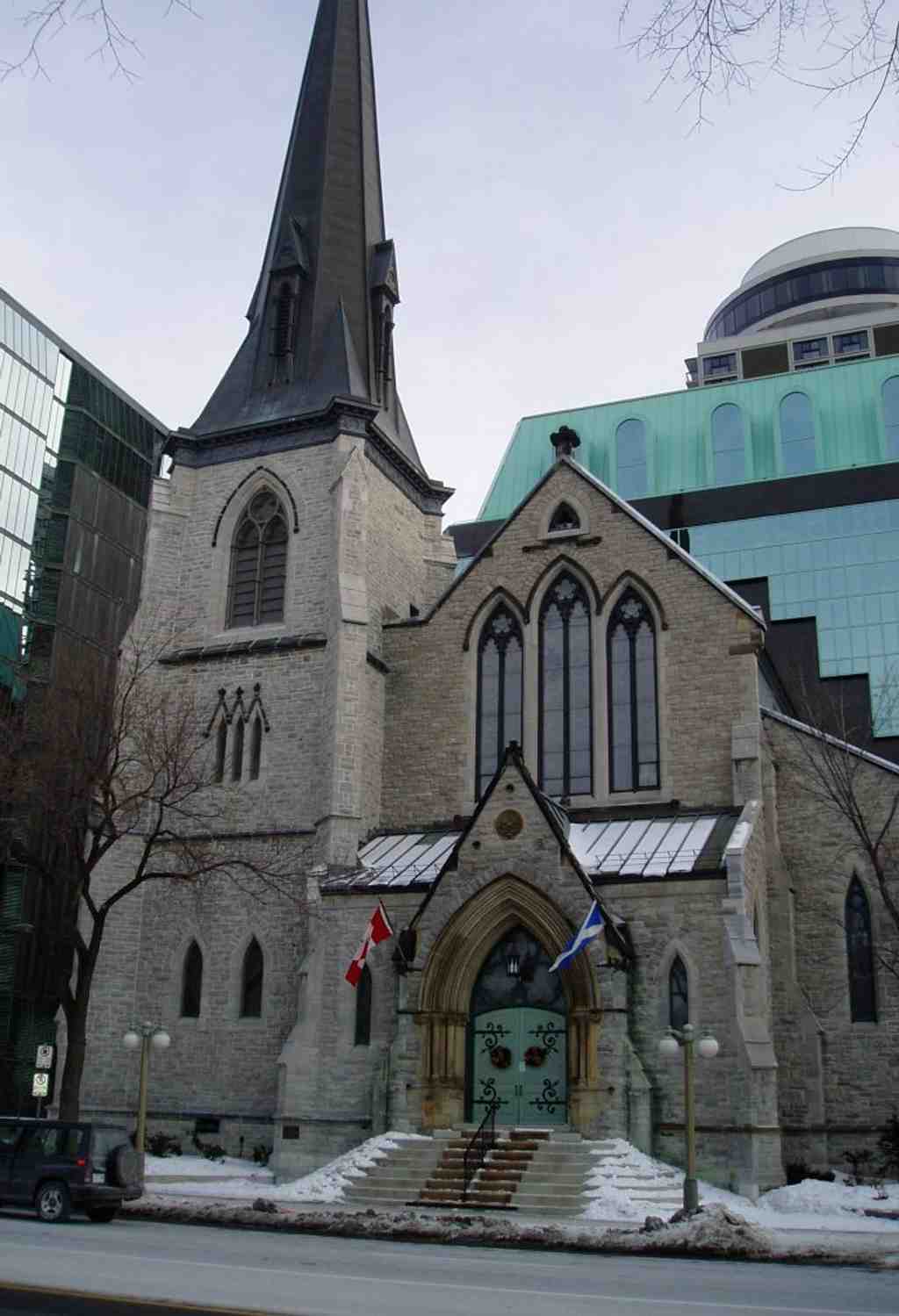
To spot St. Andrew’s Presbyterian Church, just look ahead for the striking stone building with twin arched windows and an impressive black spire-the one flying both the Canadian and Scottish flags above its pointed, mint-green door.
You’re standing before Ottawa’s oldest Presbyterian congregation, and I hope you’re ready for a story that’s as layered as the frosting on a wedding cake-minus the calories, of course. Imagine it: It’s 1827, and the city doesn’t even have an Anglican church yet. Thanks to Nicholas Sparks-not the romance novelist, but the generous landowner-this spot was donated for the Scottish and Irish workers sweating away on the Rideau Canal to come together and build a spiritual home that opened its doors in 1828. The land? Bought for just 200 pounds sterling. I’d say, “What a steal!” but don’t try it in front of the police station.
The laughter and the sound of hammers and saws must have filled the air as these canal labourers built the first church during their rare spare moments. With their strong arms and stronger faith, they shaped not just the church, but eventually the whole neighborhood-the Glebe-which still bears the mark of those early days thanks to a huge land grant that started right here.
But a congregation isn’t just wood and stone-St. Andrew’s holds stories of joy and heartbreak. In the 1840s, with changing winds in the Church of Scotland, some families split away to form Knox Free Church-so much drama, it could’ve been a reality TV show, “Presbyterians of Bytown.” Then came a tragic chapter: Reverend William Durie caught typhus while caring for sick immigrants and passed away, a quiet hero in the city’s rough early years.
With time, the church grew-a new stone manse, an extended sanctuary, and in 1872, the building here today rose like a Gothic dream courtesy of William Tutin Thomas, right amid all the construction noise and clang of Wellington Street. It’s not just impressive on the outside: the inside holds gleaming plaques and stained glass windows honoring those who fought and fell in both World Wars. During the Great War, the congregation became a hub of hope and grief, with Reverend A. M. Gordon heading overseas to serve. Names like Brigadier General William St Pierre Hughes and Matron Margaret H. Smith echo in these halls, honored by well-worn memorials.
Now, let’s fast-forward a bit-because St. Andrew's loved a good plot twist. In the 1920s, there was Presbyterian drama of epic proportions, with votes over whether to join the new United Church of Canada. Spoiler alert: they stayed Presbyterian, but some members left-never a dull moment, eh?
During the Second World War, Canadian hospitality took center stage when none other than Princess Juliana of the Netherlands found refuge in Ottawa. She felt so at home that her family donated a lectern, emblazoned with the Dutch Royal Coat of Arms, still gracing the sanctuary. Princess Margriet was even baptized here, adding a royal sparkle to Ottawa’s church history.
St. Andrew’s ties to Canadian history run deep. Prime Minister Mackenzie King sat in these pews, and when Lord Tweedsmuir-aka famed author John Buchan-passed away, his funeral was held in this very sanctuary. Faith has blended with leadership and literature right here!
But the church had to keep up with the times, too. When fires and the march of progress made changes inevitable, St. Andrew’s built new rooms, rented land, and let modern offices snuggle up to its stony walls, so today, Department of Justice employees might share a hallway with church staff…hopefully no one confuses the coffee machines.
With over 175 years-and counting-of ministry, St. Andrew’s has thrived on resilience and reinvention. Its current minister, Dr. Karen Dimock, followed her own winding road from Scotland to Canada (with a pit stop in neuroscience!) to lead the community. Through war and peace, celebration and sorrow, this church has shaped, sheltered, and inspired generations of Ottawans.
So as you gaze up at those soaring arches and listen for echoes of century-old hymns, remember: you’re not just looking at a building, but at a living patchwork quilt of stories, stitched together by faith, community, sacrifice, and just a touch of Presbyterian stubbornness-plus a whole lot of heart.




