
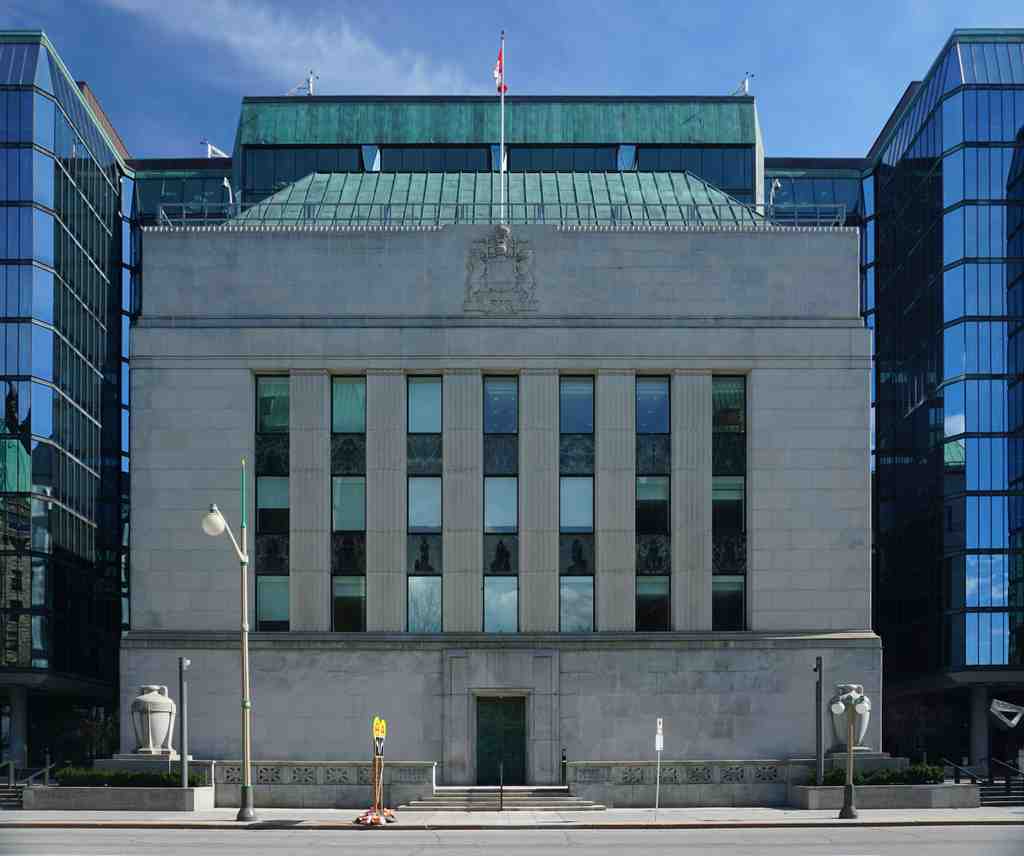
Look ahead for a stately stone building with tall, narrow windows, a greenish copper roof, and a Canadian flag waving proudly at its summit, flanked by modern glass towers-this is the Bank of Canada.
Welcome, intrepid explorer! You’re now standing before the mighty Bank of Canada, also known in French as the Banque du Canada-which, for nearly a century, has been the silent force that keeps the rhythm of Canada’s economy going strong. Take a deep breath of that crisp Ottawa air, gaze up at those solemn, classical columns, and imagine the hundreds of big financial decisions that have echoed through these walls.
The story of this building isn’t just about dollars and cents… it’s about power, crisis, and a few surprises along the way! Picture the early 1930s: Great Depression shadows loom, banks teeter, and Canada is tangled in a web of influence that stretches all the way to New York. Who would dare to tame the wild Canadian dollar? Cue Prime Minister R.B. Bennett, who thought maybe, just maybe, Canada needed its own financial superhero-a central bank-so he rounded up a cast that included a Scottish lord, bank directors, and Canadian policymakers. If you listen closely, you can almost hear anxious debates bouncing down Wellington Street!
The Bank of Canada was born from these stormy times in 1934, not as a simple government department, but as a Crown corporation. That means it’s owned by the government, but with enough distance that it wouldn’t become a political toy-think of it like a referee who also prints the tickets for the big game! Its mission was-and still is-to keep the economy stable, control inflation, and, most dramatically, create every Canadian banknote you’ve ever tucked into your wallet. (By the way, since 1935, the very first year the bank opened its vaults, a local company-Canadian Bank Note Company-has been crafting your cash.)
Before the Bank of Canada, believe it or not, it was the Bank of Montreal who acted as the government’s banker. But the wild swings of the economy and the magnetic pull of American banks convinced Canada it was time to strike out on its own. The new Bank of Canada opened its doors on March 11, 1935, nervously clutching its fresh charter and a mandate to protect Canadians from boom and bust. Only a few years later, it became a full-fledged crown corporation, led by a government-appointed governor and a hand-picked board (all of whom swore an oath of “fidelity and secrecy”-which sounds much more cloak-and-dagger than most bank board meetings!).
World War II brought its own drama, as the bank helped organize Canada’s war finances, sold Victory Bonds, and kept the money flowing. After the war? Its powers expanded, and it launched the forerunner of the Business Development Bank to help Canadians rebuild and grow. Every era brought a new twist-like the late 1940s, when the Bank of Canada became the only institution in the country allowed to mint legal-tender banknotes. If you’re a Sherlock Holmes fan, you might get a thrill knowing the signatures of the bank’s leaders are on every note, a tiny piece of officialdom traveling from coast to coast to coast.
In peacetime, the Bank of Canada tackles rough waters of a different kind-inflation, recession, booms, and the odd financial storm. In the 1990s, the bank squeezed inflation and kept interest rates famously low, even as the rest of the world zigged and zagged. Fast forward to the 2008 financial crisis-the central bank leapt into action, buying assets, expanding credit, and keeping the machine humming. No gold bars moved by hand anymore, but you can imagine the digital “ka-ching!” of billions moving through computers.
When the COVID-19 pandemic hit, this place became ground zero for economic survival. Never before had the bank shoved so much new money into the system-some critics called it risky, but desperate times call for innovative (and sometimes controversial) measures! These strategies aren’t just chosen from a shelf. The bank's toolkit includes “forward guidance” (like an economic crystal ball), “quantitative easing” (a fancy way to pick up a bunch of financial assets), and-for the brave-negative interest rates!
Inside, an army of economists, scientists, and researchers work not just on counting coins but on predicting the economy’s next surprise. And if you’ve ever admired a snazzy new polymer bill-with clear windows and hidden holograms-thank the Bank of Canada’s dedicated team of currency wizards. Collaborating with other central banks around the world, they make sure your money is tough to fake and easy to trust.
But hey, not everyone agrees with every move the bank makes. From politicians to everyday folks, the Bank of Canada has had its share of critics. Some say it’s too cautious. Others say it’s too bold. Debate about the bank’s choices, especially after the pandemic, rages on-proof that the heartbeat of Canada’s economy is still very much alive behind these silent stone walls.
So, next time you pull a Canadian banknote from your pocket, give it a wink. The Bank of Canada has likely lost sleep making sure it’s worth every penny! Let’s tip our hats to this gatekeeper of Canadian fortunes before we wander on to see what adventures await us at the next landmark!
For a more comprehensive understanding of the roles and responsibilities, type of government institution or the bank of canada's balance sheet, engage with me in the chat section below.




