
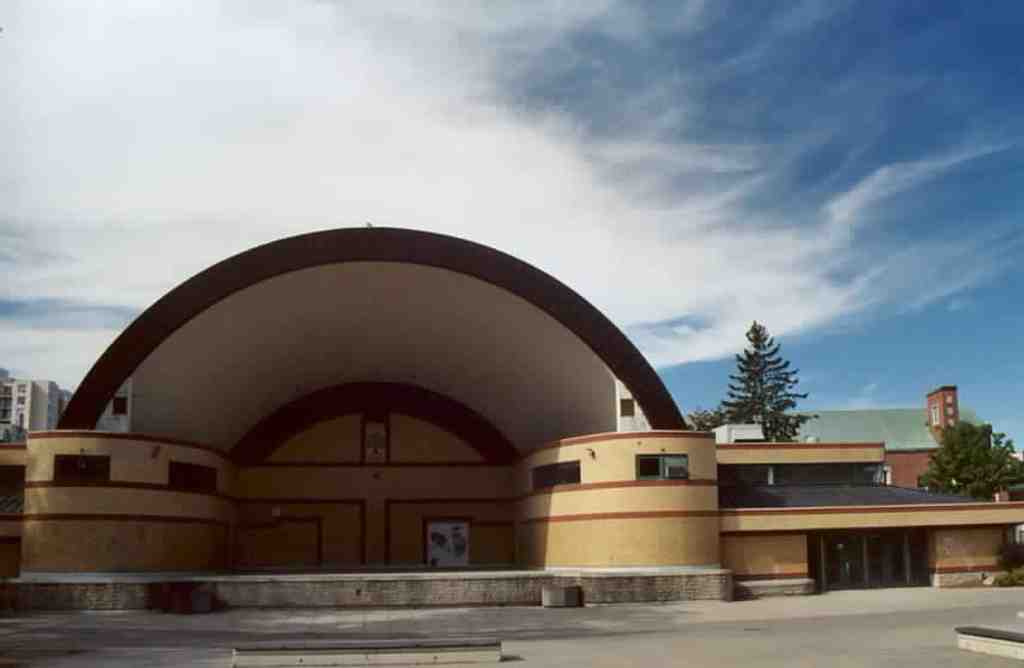
Right ahead you’ll spot the impressive, half-dome bandshell-its broad, curved roof and sandy yellow walls make it stand out right in the heart of the park.
As you’re standing here, let yourself drift back in time and imagine the land beneath your feet as it once was: a busy British garrison, the clatter of boots and the snap of a cricket bat echoing through the dusty grounds. Victoria Park wasn't always lush lawns and festival music! In the 1830s, this patch of green buzzed with military life, growing even busier during the Upper Canada Rebellion. Tents, barracks, and stern-faced soldiers dotted the field, keeping a wary watch on a young Canada. But here’s a twist: when the British marched off to train for the Crimean War in 1853, these same buildings became a life-saving hideaway for escaped slaves journeying north along the Underground Railroad. Imagine for a moment the hopeful whispers and cautious footsteps in the quiet of night, as new arrivals found safety just steps from where you are standing.
The British troops came back in 1861, convinced that the violence of the American Civil War might spill over the border. But the winds of history were changing. By 1874, the city claimed the land and named it for Queen Victoria, and with a stroke of a pen, a military zone became a park for the people.
Picture Charles H. Miller, the American landscape architect, imagining winding paths and great lawns for weekend strollers, inspired by his own adventures at mighty expositions in Philadelphia. Some say a local botanist’s exciting stories from his American travels nudged the city to hire Miller-proof that even parks can benefit from a little gossip!
But wait, Victoria Park isn’t just calm strolls and leisure. During the Boer War, both World Wars, and even the Conscription Crisis of 1944, the park filled again with the sound of military boots-and a few heated arguments too.
Lift your eyes and you’ll find cannons from the Crimean War, a somber Boer War statue, a bold Sherman tank named “Holy Roller,” and even a replica cenotaph to honor those lost. And while the fountains and lilyponds of the past are gone, the spirit of gathering lives on. Today, the park bursts with music, laughter, and tasty aromas during Sunfest, Rib-Fest, and a rainbow of other festivals-plus some of Canada’s greenest, cleanest eco-parties, with clever waste stations helping keep things tidy.
If winter’s your season, imagine a sparkling ice rink and twinkling lights wrapping every tree, the sounds of distant carols and the crunch of skating blades filling the cold air. Every February, you might even spot a snow sculpture or two. And here’s a local secret: Victoria Park’s black squirrels! These bushy-tailed, jet-furred acrobats aren’t native, but were brought here in 1914-and became local celebrities in their own right. Some even went on to start new squirrel dynasties, all the way in Ohio!
Look around, and you’ll sense the layers of history and festival joy mingling in the breeze. So, keep your eyes peeled-you never know if you’ll catch a band playing, a squirrel “fishing,” or just a quiet moment that connects you to all those whose stories shaped this very spot.


