
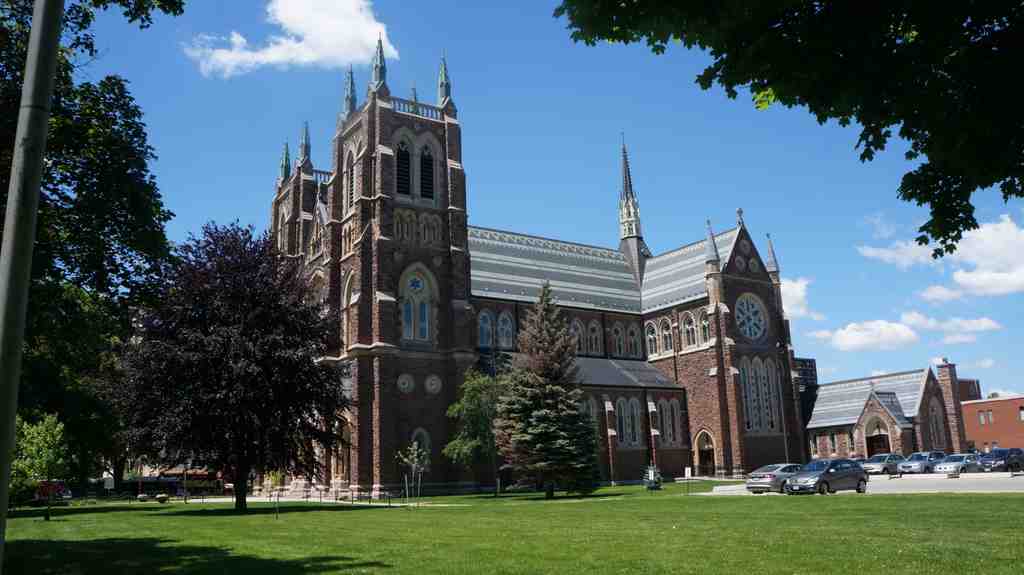
Right ahead, you’ll spot St. Peter’s Cathedral Basilica by its striking twin towers, pointed spires, and tall arched windows, all rising above the green lawn to your left.
Standing before this grand cathedral, imagine the bustling 1800s when local Catholics gathered in a humble log church not far from where you’re standing. Back then, the church was so small, it held just 180 people-enough to fill a noisy coffee shop. Disaster struck twice-first in 1845 when a raging fire tore through much of the town, and then again in 1850 when another blaze left only memories and ashes. But resilience is the name of the game here! With bricks, hard work, and more than a few prayers, the parish built a larger church, this time right at the spot you’re at now, thanks to a generous land grant from the Crown.
As London grew, so did the church’s ambition. Bishop Walsh wanted a true monument-something as grand as the faith of its people. Enter Joseph Connolly, a master of Gothic Revival, whose vision brought towering spires, dizzying arches, and enough stained glass to make the sunlight dance even on cloudy days. Construction filled the air from 1880 to 1885 with the clang of hammers and hopeful chatter. By 1889 the first radiant stained glass adorned the cathedral, but it took until 1926 to finish the dazzling interior and to install the magnificent Casavant organ.
In 1958, the ornate twin towers and the Lady Chapel were added, making the church even more impressive-talk about a makeover! Just a few years later, it was declared a basilica by Pope John XXIII, a true upgrade. When you walk by today, take in those intricate details-each stone a survivor, every window a witness to fiery trials, grand dreams, and a community always ready to rise. And just imagine-it all began with a little log building and a whole lot of determination.


