
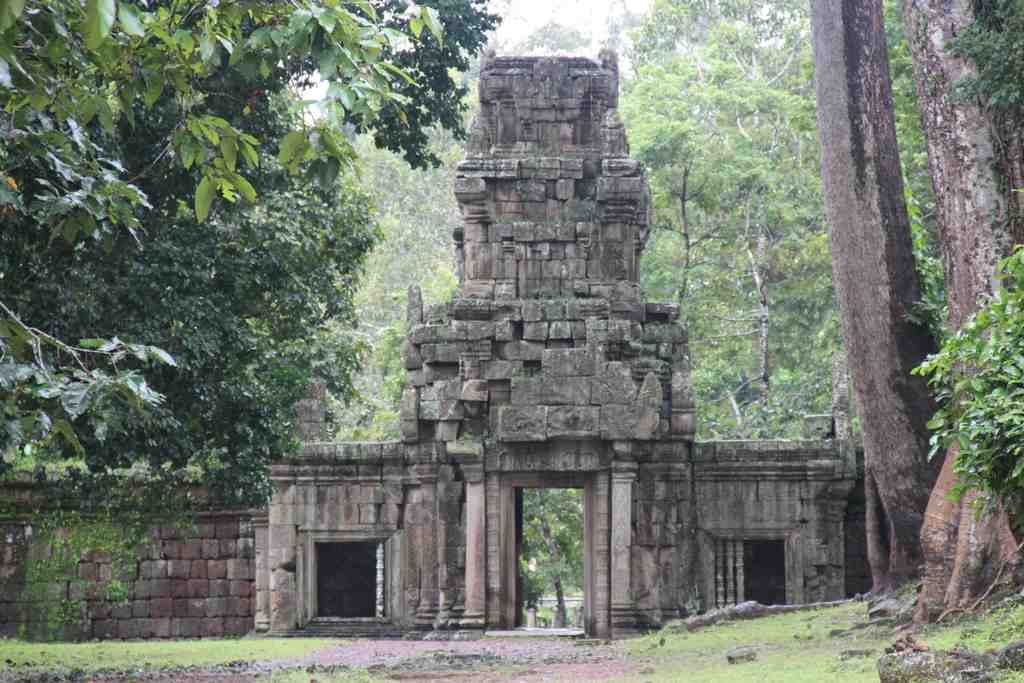
Siem Reap Audio Tour: Unveiling the Legends and Landmarks
A golden mountain rises above the jungle in Siem Reap, a silent witness to empires lost and legends reborn. This self-guided audio tour invites you beyond the postcard views and into the shadowy corners of Angkor’s ancient heart, where secrets are carved in stone and every path leads to a new revelation. Why did restoration teams spend over half a century piecing together the Baphuon—stone by numbered stone? Who settled life-or-death disputes inside the mysterious towers of Prasat Suor Prat? And could those stately Khleangs really have been storerooms, or did they once shelter whispered plots and royal intrigue? Follow twisting corridors and weathered halls as the stories of rebellion, renovation, and forgotten splendor unfold step by step. Expect lost glory, living myth, and sudden drama around every moss-cloaked corner. Start walking now and let Siem Reap’s silent towers draw you deeper into history’s most extraordinary puzzle.
Tour preview
About this tour
- scheduleDuration 70–90 minsGo at your own pace
- straighten3.2 km walking routeFollow the guided path
- location_on
- wifi_offWorks offlineDownload once, use anywhere
- all_inclusiveLifetime accessReplay anytime, forever
- location_onStarts at Baphuon
Stops on this tour
lock_open 3 free previews · 7 unlock with purchase
First of all, did you know that the Baphuon wasn't always a Buddhist temple? Nope, it was originally dedicated to the mighty god Shiva. Talk about a major makeover! It was later…Read moreShow less
First of all, did you know that the Baphuon wasn't always a Buddhist temple? Nope, it was originally dedicated to the mighty god Shiva. Talk about a major makeover! It was later converted into a Theravada Buddhist temple. I guess it decided to try out a new belief system, you know, shake things up a bit. Now, here's something mind-blowing. The dating of this temple has caused quite a debate among scholars. But thanks to some fancy French scientists and their Carbon-14 method, we now know that it was built by Suryavarman I, a ruler who didn't have a temple dedicated to him before. Yep, they found iron crampons embedded in the structure that date back to the 11th century. That's some impressive detective work, if you ask me. The Baphuon is a towering temple, standing about 34 meters tall without its missing tower. Can you imagine how impressive it must have been back in the day? Even Zhou Daguan, a late 13th-century envoy, was blown away by its sheer awesomeness. He called it the "Tower of Bronze" and was impressed by its many chambers. I bet the Baphuon was the talk of the town! Unfortunately, the temple fell into disrepair over the years and suffered from the Khmer Rouge regime. But fear not, because restoration efforts took place, turning it into the largest 3D jigsaw puzzle in the world. Can you imagine that? They had to dismantle the temple piece by piece, label everything, and then put it all back together. It took 51 years of hard work, but in 2011, the Baphuon was finally restored and reopened. Talk about dedication! Well, my friend, that's the story of the Baphuon. Isn't it incredible how this temple went from being a Hindu temple to a Buddhist one and then survived so much to shine once again? Now, let's move onto our next stop, shall we?
Open dedicated page →Now, you may be wondering, what were these towers used for? Well, the local belief is quite entertaining. They say that these towers were used to support a high wire for…Read moreShow less
Now, you may be wondering, what were these towers used for? Well, the local belief is quite entertaining. They say that these towers were used to support a high wire for acrobatics during royal festivals. Can you imagine that? Tightrope dancers gracefully walking between the towers, defying gravity for their performance. It's like a mini circus right here in Angkor Thom! But hold on to your hats because we have some historical records by Zhou Daguan that say something different. According to him, these towers were actually used to settle disputes among the Angkorian people. Talk about an unconventional courtroom! So, whether it's acrobatics or dispute settling, these towers have quite the interesting history. And guess what? Some of the towers underwent reconstruction between 2001 and 2005 by a team from Japan and APSARA, the organization responsible for safeguarding Angkor. They made sure that the N1 tower and N2 antechamber were safe and sound, saving them from collapse. Now, feel free to explore these magnificent towers and let your imagination run wild with visions of tightrope walkers and court hearings. Enjoy!
Open dedicated page →So, what's the deal with the Khleangs? Well, they're kind of like the cool siblings of the Prasat Suor Prat. They're two buildings that sit pretty on the east side of the Royal…Read moreShow less
So, what's the deal with the Khleangs? Well, they're kind of like the cool siblings of the Prasat Suor Prat. They're two buildings that sit pretty on the east side of the Royal Square in Angkor Thom, Cambodia. And guess what? These buildings have a bit of mystery surrounding them because nobody really knows what they were used for. Now that's a secret worth exploring! One thing we do know is that these Khleangs were built at different times. The northern one, also known as the North Khleang, was built under the rule of King Jayaviravarman. The southern one, called the South Khleang, was built by his successor, Suryavarman I. Talk about some sibling rivalry, huh? Now, if you take a closer look at these buildings, you'll notice they have a unique style, known as the Khleang style. This style is all about simplicity, with lintels sporting a central kala design. And let's not forget that they have given their name to the style - talk about leaving a legacy! But wait, here's the funny part - "Khleang" actually means "storeroom" in Khmer. Can you imagine these majestic buildings being used to just store stuff? Nah, I don't buy it either. Some experts believe they might have been reception areas or even housing for fancy noble folks and ambassadors. Imagine having your own Khleang as a guesthouse! Oh, and did I mention that the North Khleang was built in wood and then later rebuilt in stone? These buildings have seen some serious renovations, my friend! It's like they wanted to make sure they looked their best for centuries to come. So, take a moment to admire the Khleangs from a distance, standing tall among the Prasat Suor Prat. They may not be the flashiest attraction up close, but boy, do they know how to make an impression from afar! Alrighty, my friend, we're almost done with our tour of Angkor Thom. Our next and final stop is the grand Terrace of the Elephants. Let's hop back on our imaginary tuk-tuk and head over there!
Open dedicated page →
Show 7 more stopsShow fewer stopsexpand_moreexpand_less
Alrighty, folks! Welcome to stop number 7, Preah Pithu! Get ready to explore a group of five temples that, although not designed as a group originally, still have a lot to offer.…Read moreShow less
Alrighty, folks! Welcome to stop number 7, Preah Pithu! Get ready to explore a group of five temples that, although not designed as a group originally, still have a lot to offer. Even in their ruined state, these temples have some pretty impressive carvings and a peaceful, semi-wooded setting. Located in Angkor Thom, just northeast of the famous Bayon temple, these temples may be close to each other, but they weren't all built at the same time. Two of them were built in the same period, while the others were separate. So, there's no apparent order to this temple mash-up! Now, let's meet these temples individually. We've got T, U, V, W, and X. "X" is our cool Buddhist temple, but it's actually unfinished and probably the latest addition to the group. The other four are Hindu temples. Although these temples may be in bad shape, with the upper levels all ruined, their carvings are still quite interesting. And hey, the site is pretty peaceful and not too crowded, so that's a plus! Oh, and let's not forget the moat! Well, when it's not dry, that is. Some of these temples are surrounded by a moat that adds an extra touch of allure. It's like a big, watery hug around the temple. How nice! Wait, did I mention that these temples were cleaned not once, but twice? Yep, Jean Commaille was the first to give them a good scrub in 1908, and then Henri Marchal took over from 1918 to 1920. Gotta keep those temples looking spiffy! Now, let's dive into the details of each temple. Temple "T" has a sandstone enclosure and a main axis with two gopuras. Inside, there's a sanctuary with a large linga on its pedestal. You'll find fragments of the western door lintel on the ground that show a stylized depiction of the "Churning of the Sea of Milk" - sounds like a fancy milkshake, doesn't it? The walls are full of lovely devatas and floral motifs, all done in the Bayon style. Moving on to temple "U," it's similar to "T" but smaller and simpler. No gopura for this one! The west door lintel shows the Trimurti, with Shiva having a dance-off atop a kala-head, sandwiched between Vishnu and Brahma. So much talent in one carving! Now, temple "X" sits on a large terrace, about a hundred meters east of temple "U." You can easily reach it if the moat isn't full of water. It's got a similar design to the others, but it's larger and unfinished in terms of decorations. And guess what? "X" is our funky Buddhist temple! Sculpted Buddhas and Buddhist motifs can be found on the walls of the sanctuary chamber - it's like a mini-Buddha museum. Once we're outside the moat, we discover temple "V," which is oriented to the east. It has a double vestibule, no enclosure, and a long causeway on the west side that leads right into the northeast corner of the Royal Square. Inside the sanctuary chamber, there's a big ol' linga that measures 1.5 meters - now that's one mighty linga! Last but not least, we have temple "Y." This temple doesn't have a fancy basement or any stairways; it just stands proudly on an earthen platform, north of temple "V." It's kind of like the rebel of the group! And get this - it's dated between Angkor Wat and Bayon. Talk about being in the middle of two big popular kids! So, "Y" is oriented to the east and boasts a long mandapa as its entrance, along with a sanctuary chamber hosting a linga. This chamber may have mostly collapsed, but it's got two pretty remarkable half-frontons that depict the defeat of the asura Bana by Krishna and the three giant steps of Vamana. These carvings really give you a sense of the epic stories behind them! So there you have it, folks - the Preah Pithu group of temples. Even though they may not have been designed as a squad, they sure know how to make an impression! Ready to move on to our next stop? Let's go!
Open dedicated page →Welcome to Tep Pranam, my friend! This temple is home to a massive seated Buddha, made entirely of sandstone blocks. It's truly a sight to behold! What's interesting is that the…Read moreShow less
Welcome to Tep Pranam, my friend! This temple is home to a massive seated Buddha, made entirely of sandstone blocks. It's truly a sight to behold! What's interesting is that the interior of the Buddha statue is made up of recycled stone blocks. Talk about being resourceful, right? But that's not all! To get to this temple, you'll have to walk along a 75-meter-long causeway made of laterite. Don't worry, it's 8 meters wide, so there's plenty of room for you to strut your stuff! Once you reach the end of the causeway, you'll find a terrace with double sema, which are those fancy Buddhist boundary markers. They like to mark their territory, you know? Oh, I almost forgot to mention that the original building that housed the Buddha statue was made of wood. Sadly, it's long gone now. But hey, at least the cruciform foundation is still standing strong! Now, let's keep the adventure going and head to our next stop. Who's excited? I know I am!
Open dedicated page →One of the interesting things about Preah Palilay is its unique blend of Hindu and Buddhist elements. It's like a fusion restaurant, but for temples! The lack of foundation stele…Read moreShow less
One of the interesting things about Preah Palilay is its unique blend of Hindu and Buddhist elements. It's like a fusion restaurant, but for temples! The lack of foundation stele or inscriptions makes it a bit tricky to accurately date this temple, but hey, who needs labels, right? We'll just go with the flow. Some historians believe that this temple was built during the reign of Jayavarman VIII, but they can't quite figure out how the Buddhist imagery managed to survive the iconoclast fury of that time. It's like a temple magic trick! Maybe it was built in different periods, like a historical collage. The sanctuary in the first half of the 12th century, and the gopura, which is basically a fancy entrance, in the late 13th or early 14th century. You know what they say, "variety is the spice of temple building!" As we approach the temple, you'll notice a cross-shaped terrace with some mighty naga balustrades. These seven-headed snake-like creatures are guarding the eastern side. I don't know about you, but I feel safer with snake guards. We also have two decapitated dvarapalas, which are basically giant temple guardians. Looks like someone took their job a bit too seriously! Now, don't forget to take a moment to appreciate the causeway that connects the temple to the single sandstone gopura. It's a 33-meter-long path that's just begging to be Instagrammed. #TempleGoals! Inside the temple, you'll find a shrine housing a 3-meter-tall statue of Buddha, sitting on a lotus. It's like a little Buddha oasis within the temple. Talk about serenity! The gopura, with its three entrances, has some pretty interesting pediments. One of them shows "the offering of the animals in the forest of Parilyyaka." Quite the mouthful, I know. But hey, it's a big deal in the Buddha's life. There are also other pediments showing scenes like Sujata offering rice-milk to the Buddha-to-be and the subjugation of an elephant named Nalagiri. I guess even elephants need to learn some manners! As we explore further, you'll notice that the temple stands on a three-tiered basement, 6 meters high in total. That's like three really tall basketball players stacked on top of each other! The central chamber, which opens up to the four cardinal directions, is surrounded by classical ornamentations. Unfortunately, time hasn't been too kind to those ornaments, so you might have to use your imagination a bit. Think of it as a temple DIY restoration project! Now, if you look around, you'll see bits and pieces of pediments scattered around. Some are even taken away for safe-keeping. But don't worry, the ones that are still visible are quite impressive. You'll see Indra, the king of the gods, riding on his trusty elephant Airavata, and even a dramatic battle between the demoniac army of Mara. It's like an ancient action movie, but with stone actors! As a fun twist, there's now a Buddhist monastery near the temple. So don't be surprised if you come across some friendly monks during your visit. Remember, they're not part of the tour, but feel free to give them a friendly wave. Well, that's Preah Palilay for you! A temple that's full of surprises, mystery, and a little bit of temple time travel. So let's keep moving and explore more of this enchanting city together!
Open dedicated page →So, the Royal Palace was first built by King Suryavarman I and was used from the 11th to the late 16th century AD. Talk about a long-lasting crib! The area went through many…Read moreShow less
So, the Royal Palace was first built by King Suryavarman I and was used from the 11th to the late 16th century AD. Talk about a long-lasting crib! The area went through many changes and restorations during that time. Recently, excavations have revealed some hidden gems, like a 10th-century temple that was probably used as a residence by a minister named Yasovarman I. Can you imagine living in a temple? Talk about serious devotion to your work! Now, most of the royal palace buildings were made using perishable materials, because they weren't meant for religious purposes. We're talking about leaves, wood, and all that jazz. The actual palace was a rectangular shape and was surrounded by a 5-meter-high laterite wall. This wall stretched 246 meters along the north-south axis and 585 meters along the east-west axis, covering an area of over 14 hectares. That's a lot of space for some royal shenanigans! To enter the palace, there were five sandstone gopuras with steps. Two on the south, two on the north, and the largest one, facing east, was aligned with the Elephant Terrace and the Victory Gate. Talk about a grand entrance! And just to make things interesting, the ground inside the palace was 1.2 meters higher than outside, so they had to build double layers of stone on the entrances. Whoever said "the higher, the better" must've been a fan of this place! One of the highlights here is a massive pond, covering a whopping 5625 square meters. This pond was probably built by King Jayavarman VIII and was surrounded by sandstone. There are 13 tiers of steps that go down about 5.32 meters to the laterite paving. Can you imagine climbing all those steps? It's like a workout with a view! The walls of this palace are just fascinating. They're carved with all sorts of things. In the lower sections, you'll find depictions of marine life, and even heads of cows or horses. Then there are two rows of princes and naga princesses in the middle part, which is similar to the Terrace of the Leper King. And on top of all that, there are winged figures, male, and female guardian figures. It's like a smorgasbord of carvings! And speaking of ponds, there's also an 800 square meter sandstone pond near the east gopura. It's believed to have been part of the first palace. There's even a smaller pond and low terrace to the west of the Large Pond, and they're both connected by a laterite wall. The walls here are adorned with fascinating bas-reliefs of a procession of people, elephants, and horses. It's like a parade on a wall! Now, don't forget to check out the four small sanctuaries. These were constructed in the early phase, and you can tell by their floor level. They open to the west and are parallel to the southeastern part of the Royal Palace. Talk about a secret hideaway! That's the lowdown on the Royal Palace here in Angkor Thom. Stick with me, and we'll keep exploring more amazing sites in this ancient city!
Open dedicated page →Now, here's a fun fact for you: Legend has it that the king who built this temple, Suryavarman I, used to spend the first watch of every night here with a woman who represented a…Read moreShow less
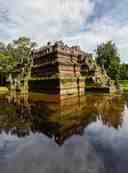
Now, here's a fun fact for you: Legend has it that the king who built this temple, Suryavarman I, used to spend the first watch of every night here with a woman who represented a Nāga. Talk about a royal date night, huh? Not even the queen was allowed to intrude during this time. If you ask me, it's good to have some alone time, but that's taking it to the next level! Speaking of legends, let's talk about the importance of the naga, the supreme landowner of Khmer land. If this mystical creature didn't show up for a night, it was said that the king's days were numbered. On the other hand, if the king himself didn't show up, well, let's just say calamity would strike his land. Talk about pressure! I hope they had a good alarm clock to make sure they both showed up. Now, just imagine how grand this temple must have looked back in the day. It was originally crowned with a golden pinnacle, shining bright like a star in the sky. Zhou Daguan, a traveler who visited here in 1297 CE, described it in his writings as a magnificent sight. So take a moment to soak it all in as you explore Phimeanakas. Imagine the king and the Nāga enjoying their nightly watch, and maybe even feel a little royal yourself. Don't worry, though, you don't have to spend the whole night here. We still have more amazing stops to discover together. So let's keep moving and head to our next adventure!
Open dedicated page →Ah, the Terrace of the Elephants! Welcome to the grand finale of our tour. Now, let me tell you about this magnificent landmark. Picture this: You're a victorious king,…Read moreShow less
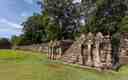
Ah, the Terrace of the Elephants! Welcome to the grand finale of our tour. Now, let me tell you about this magnificent landmark. Picture this: You're a victorious king, Jayavarman VII, returning from battle with your army. You're feeling pretty important and you need a platform to show off, right? Well, that's exactly what the Terrace of the Elephants was for! It was like the ultimate VIP balcony, attached to the palace of Phimeanakas. Now, here's the funny thing about this terrace - most of it has disappeared over time. It was mainly made of materials that didn't last, so all we have left are the foundation platforms. But fear not, my friends, because what remains is still stunning! The highlight of the terrace is its eastern face, where you'll find truly impressive carvings of elephants. Hence the name, Terrace of the Elephants! Those ancient Khmer people sure loved their elephants, didn't they? This enormous terrace stretches for a whopping 350 meters! Can you imagine the view from up there? It served as a fancy reviewing stand for all sorts of public ceremonies. It was also the base for the king's grand audience hall. Talk about a power move! Oh, and let's not forget about the outworks. There are five of them, three in the center and one at each end, extending towards the Central Square. The middle section of the retaining wall is decorated with majestic garuda and fierce lions. Towards the ends, you'll see the famous parade of elephants. Yup, complete with their Khmer Mahouts, the elephant trainers. So, my dear traveler, take a moment to soak in the grandeur of the Terrace of the Elephants. It's a place where kingly triumphs were celebrated, and history was made.
Open dedicated page →
Frequently asked questions
How do I start the tour?
After purchase, download the AudaTours app and enter your redemption code. The tour will be ready to start immediately - just tap play and follow the GPS-guided route.
Do I need internet during the tour?
No! Download the tour before you start and enjoy it fully offline. Only the chat feature requires internet. We recommend downloading on WiFi to save mobile data.
Is this a guided group tour?
No - this is a self-guided audio tour. You explore independently at your own pace, with audio narration playing through your phone. No tour guide, no group, no schedule.
How long does the tour take?
Most tours take 60–90 minutes to complete, but you control the pace entirely. Pause, skip stops, or take breaks whenever you want.
What if I can't finish the tour today?
No problem! Tours have lifetime access. Pause and resume whenever you like - tomorrow, next week, or next year. Your progress is saved.
What languages are available?
All tours are available in 50+ languages. Select your preferred language when redeeming your code. Note: language cannot be changed after tour generation.
Where do I access the tour after purchase?
Download the free AudaTours app from the App Store or Google Play. Enter your redemption code (sent via email) and the tour will appear in your library, ready to download and start.
If you don't enjoy the tour, we'll refund your purchase. Contact us at [email protected]
Checkout securely with 




