
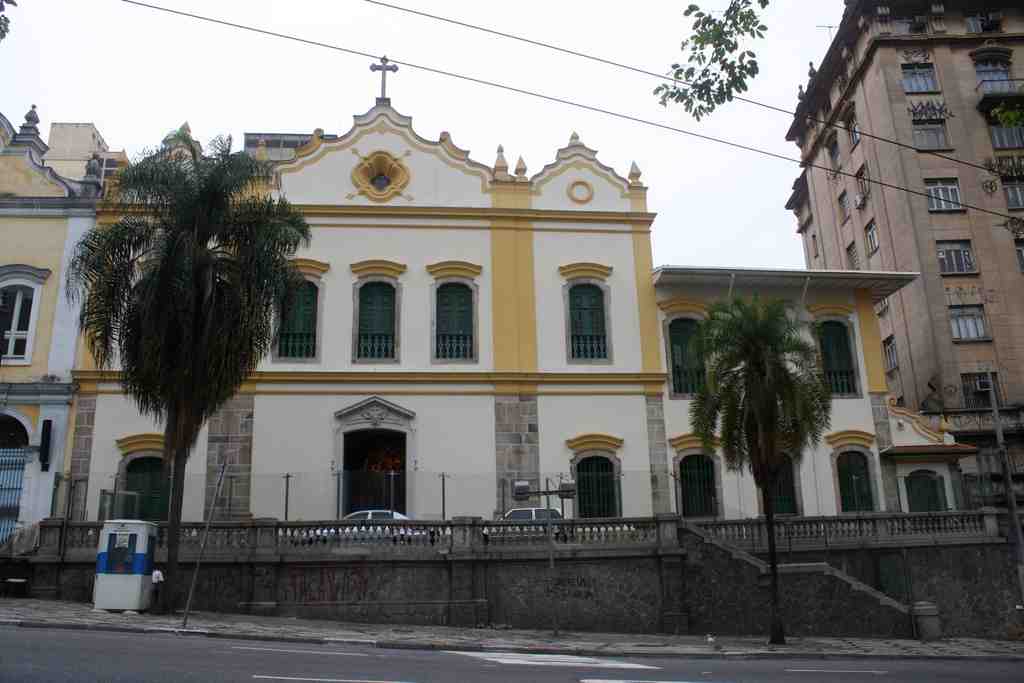
Looking ahead, you’ll spot a striking colonial facade with cream and yellow walls, green shuttered windows, and beautiful palm trees flanking the entrance-just look for the building with a large cross on top and those elegant baroque curves above the door.
Welcome to the Church of the Wounds of the Seraphic Father Saint Francis-a name so long, I hope you packed a snack before reading it! Now, imagine yourself in the heart of colonial São Paulo, back when this city was more farmland and forest than skyscrapers and samba. Here, in the peaceful Largo de São Francisco, this impressive church has stood since 1787, watching over the city as it grew from a tiny village where everyone probably knew each other’s business and possibly their chickens’ names.
This isn’t just any church. It’s the last surviving piece of eighteenth-century architecture in all of São Paulo’s center, making it a true time machine made from rammed earth, brick, and walls woven with bamboo-talk about eco-friendly before it was trendy. The church was built by an Afro-Brazilian architect, Joaquim Pinto de Oliveira, or Tebas, who began life as a slave but left behind a masterpiece of colonial design. Just picture Tebas up on the scaffold, guiding the construction while horses clopped down dusty streets and merchants haggled over coffee, gold, and-you guessed it-sugar.
Now, let’s rewind to the 1600s. The Franciscan friars were already setting up shop here, driven not just by faith but by the classic colonial urge to occupy, educate, and, of course, preach! By the 18th century, the Third Order of Saint Francis-a group of devout businessmen and prominent “good men”-decided their tiny chapel inside the Franciscan church was too small for their big ideas. So, like anyone who needs more closet space, they expanded, transforming their octagonal chapel into a cross-shaped church, still snug beside the original convent.
Step inside (in your imagination… or soon in reality!), and you’ll be greeted by light pouring through windows, dancing across centuries-old paintings and golden altars. There’s an altar dedicated to Saint Michael and a dazzling rococo altarpiece featuring Atlantean angels-yes, angelic bodybuilders!-propping up swirling columns. Overhead, an octagonal dome painted with Saint Francis soaring toward heaven on a flaming chariot, because saints clearly had the coolest rides.
But don’t be fooled by the calm. This church has seen drama! For many years, it was the final resting place of some of São Paulo’s most important citizens-from daring military men to society’s elite, all now resting quietly underfoot (so watch your step!). These hallowed halls also rang with the debates of powerful families and, more recently, classical music during live performances-can you imagine those grand notes filling the nave?
More recently, the church itself needed some TLC after all those centuries. Closed in 2007, its walls finally got some pampering-new roofs, polished altars, sparkling stained glass, and modern touches like elevators for accessibility. After seven years, it reopened in a celebration fit for the ages, proving this church knows how to make an entrance.
Today, tradition is still alive-masses are held every week, and on the eighth day of every month, a special mass venerates Saint Anthony of Categeró, a tradition over 300 years old. And if you’re a treasure hunter at heart, remember: during restorations, hidden artifacts and forgotten artwork were rediscovered, reminding everyone that this church still has secrets to share.
So, while you gaze up at the facade-yellow and white against the city’s bustle-listen for the echoes of merchants, friars, and faithful souls, all woven into the stones. Who knows? Maybe you’ll catch a whisper from centuries past, inviting you inside for your own chapter in this living history.




