
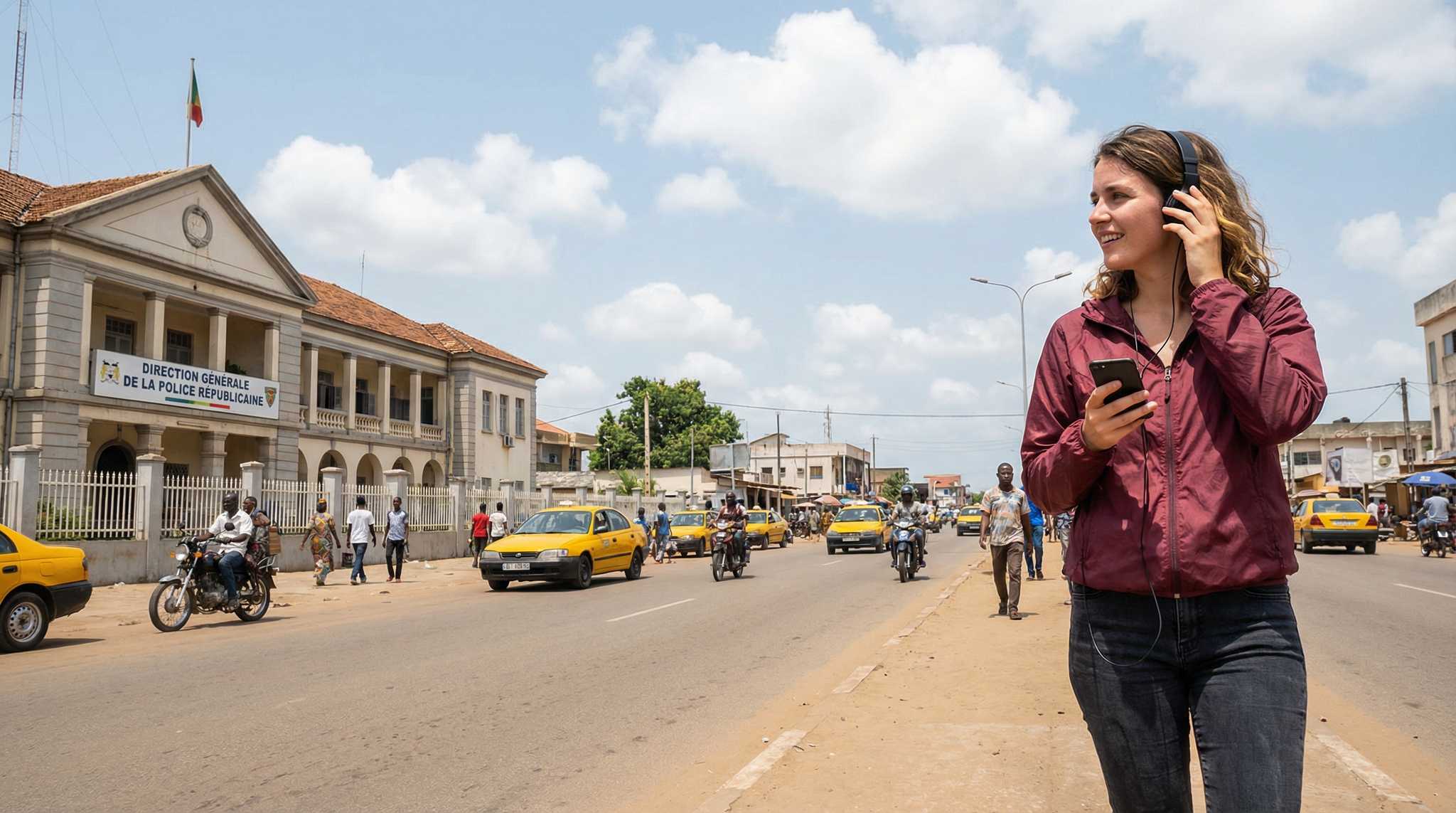
Cotonou Audio Tour: Between Digital Heritage and Colonial Secrets
Discover the vibrant heart of Cotonou on this captivating tour! Begin by exploring the majestic Cour Constitutionnelle du Bénin, a symbol of justice and democracy. Then, immerse yourself in the spirituality and impressive architecture of the Archidiocèse Catholique Romain de Cotonou. Next, dive into the dynamism of local innovation by visiting As World Tech, a true technological hub serving the future. This itinerary is rich in cultural, historical, and modern discoveries that will let you experience the unique soul of Cotonou!
Tour preview
About this tour
- scheduleDuration 40–60 minsGo at your own pace
- straighten5.0 km walking routeFollow the guided path
- location_on
- wifi_offWorks offlineDownload once, use anywhere
- all_inclusiveLifetime accessReplay anytime, forever
- location_onStarts at Beninese Digital Infrastructure Company
Stops on this tour
In front of you, spot this large, serious-looking rectangular building, surrounded by a colorful fence and a clearly visible sign « Ministère du Cadre de Vie et du Développement…Read moreShow less
In front of you, spot this large, serious-looking rectangular building, surrounded by a colorful fence and a clearly visible sign « Ministère du Cadre de Vie et du Développement Durable » just behind the trees and beneath the air conditioners hanging from the windows. Imagine a bustling morning in Cotonou a few years ago. The still-cool streets hum with honking, the city awakens, and in this building before you, things are buzzing! This is where the daily saga of Benin's environment is written - and believe me, it's not a book to be casually flipped through like an old newspaper! This institution was once called the Ministère de l’Environnement de l’Habitat et de l’Urbanisme. But then, on April 6, 2016, hold on tight… a magic wand, or rather a presidential decree: new name, new ambitions, and thus the famous Ministère du Cadre de Vie et du Développement Durable was born. A true metamorphosis, almost as many twists and turns as an episode of a Beninese TV series. Imagine all the country's brightest minds gathered here, their heads full of maps, plans, diagrams… but also dreams: how to make cities cleaner, how to preserve forests, how to protect rivers, and even how to give a little boost to turtles wanting to cross the beach without ending up in an Instagram selfie. Their mission? Think big: organize land use planning, fight pollution, protect ecosystems (including those of frogs and owls), keep the city clean - and add color to the daily lives of Beninese people. You might almost think only Batman is missing to save the city! Their tools are neither capes nor superpowers, but strategies: geomatics for mapping land, monitoring environmental policies, assisting local communities, and above all, creating standards so that everyone can live in harmony, without their house floating away with the first rain or disappearing under dust. It was also here, believe it or not, that the Projet d’urgence de gestion environnementale en milieu urbain came into being. A long name, but oh so necessary in a city like Cotonou where sometimes the rain likes to play tricks and turn streets into impromptu swimming pools! In this ministry, every day, teams must thwart the threat of pollution, monitor more or less straight constructions, keep lake banks spick and span, and establish dialogue - sometimes epic - with international organizations. They chase funding, attend summits, and defend the country's colors: a vibrant green, a breath of fresh air, and a lot of sweat on their brows. So, the next time you throw a piece of paper in a city bin, think of this hive of activity and all those who, here, orchestrate - sometimes discreetly, sometimes loudly - a softer, more beautiful, more sustainable… and sometimes frankly heroic!
Open dedicated page →To spot the Cour constitutionnelle, look to your right for this large, modern building with light walls and multiple blue windows, with its clean lines and imposing appearance:…Read moreShow less
To spot the Cour constitutionnelle, look to your right for this large, modern building with light walls and multiple blue windows, with its clean lines and imposing appearance: you really can't miss it! Now imagine yourself in front of this bastion of justice, the discreet theater of the Republic's great debates. Behind these smooth walls and polished windows, scenes as tense as in the best detective movies unfold, except here, the heroes wear robes and arm themselves with the law! The Cour constitutionnelle du Bénin is a bit like the silent sentinel of democracy, established here since 1993, following an epic national adventure full of twists and turns. Let's go back to 1990. Benin, thirsty for freedom, experienced an unprecedented effervescence: the famous Conférence des forces vives de la nation. Imagine lively debates, whispers filling the room, dreams of justice escaping through open windows... It was at the heart of this vibrant atmosphere that the idea of a modern Constitution was born, built to guarantee freedoms, separate powers, and prevent an overly greedy president from hogging all the power! The Court, created in 1993, embodies this dream come true. Three experienced magistrates, two sharp legal experts, and two eminent personalities, carefully chosen, gather here to form a jury that is both impressive and serious, but where, it is said, humor is not lacking during coffee breaks! Their mission? To ensure that no one plays with citizens' rights, to monitor the regularity of elections, and to arbitrate disputes between institutions like a referee overseeing a football match… but without the red cards, only the text of the law. Did you know? Even if you are not a president or a deputy, you too can appeal to the Court on issues affecting your fundamental freedoms. If one day you find that your rights are being curtailed a bit too much, hop, a file, and off you go on the adventure! It's a bit like having the democracy emergency button in your pocket. But, beware, the Court's history is not a long, quiet river. Sometimes, it renders decisions that have the effect of a thunderclap throughout the country. For example, the right to strike! Depending on the eras and its presidents - with two powerful women from the very first years, hats off! - the Court has blown hot and cold. Should the State guarantee the right to strike to everyone? Some presidents of the Court said yes, others said… “Yes, but not for everyone!” It's not easy to please everyone, but that's the magic of justice: each decision moves the great democratic puzzle forward a little more. There was also the Dangnivo case: the Court protected the right to a fair trial, deeming it unacceptable to leave someone languishing in prison for too long without judgment. A vibrant plea for human dignity, reminding everyone that even in the face of the most complex cases, the law must remain humane and just. The Court has known several prestigious presidents, including Élisabeth Pognon and Conceptia Ouinsou, pioneers at the head of this institution, whereas for a long time elsewhere, justice was reserved for gentlemen with big mustaches! Here, competence has no gender, but a lot of panache. Working here is not easy: it's impossible to hold other jobs or sit in government. The members of the Court must remain outside political storms, like immutable rocks amidst the currents of opinions. Finally, behind the somewhat cold facade of the building, imagine the breath of history, the great judicial decisions that have changed the daily lives of all Beninese people. And the next time you see a report on an election or a debate on a fundamental right, remember that many of these battles are fought right here, a few meters from you, in silence... or almost. So, ready to continue the stroll, budding citizen? Let's go, democracy doesn't wait!
Open dedicated page →


Show 10 more stopsShow fewer stopsexpand_moreexpand_less
Imagine Cotonou, a bustling city, just a few decades ago. Here, two forces held the reins: the Police nationale and the Gendarmerie nationale. It was, a bit like in a TV series,…Read moreShow less
Imagine Cotonou, a bustling city, just a few decades ago. Here, two forces held the reins: the Police nationale and the Gendarmerie nationale. It was, a bit like in a TV series, the era when, as soon as a cat wanted to cross the street, people wondered: “Who will intervene? The police or the gendarmerie?!” Suspense! But in 2017, a major turning point: all these forces merged and became the Police républicaine, a single force to ensure peace and security. Since then, everyone here is on deck: they protect people, property, monitor borders, even forests and fishing! Yes, no outlaw fish under their noses! More than a team, it's a family. Police officers and gendarmes, supervised by the Ministère de l’Intérieur, work together. In case of trouble, they are the first to intervene, sometimes with a rigor… worthy of Benin's best mothers. And modernity, they know it! Since 1962, they have been working hand in hand with Interpol. If you hear about an international operation in Cotonou, it's not surprising. A fun little fact: in February 2025, a new man took the reins - Kokou Brice Allowanou. He is the conductor of this great symphony of security, succeeding Soumaïla Yaya (who, for his part, had to hang up his uniform… but shhh, stories of changing bosses are like police secrets, they're not told out loud!) Before heading back into the streets of Cotonou, take a look at the uniforms: each button, each emblem, tells a piece of the country's history… and if one of them salutes you, don't forget the famous “Bonjour chef!”, it works every time!
Open dedicated page →To spot Xwlacodji in front of you, look carefully at this white monument in the center of the small garden, surrounded by four black cannons pointing in different directions,…Read moreShow less
To spot Xwlacodji in front of you, look carefully at this white monument in the center of the small garden, surrounded by four black cannons pointing in different directions, nestled under the welcoming shade of a large tree. Welcome to Xwlacodji, one of the neighborhoods at the heart of Cotonou's history! Imagine yourself nearly two hundred years ago, in 1830: no cars, no honking, just the sound of waves caressing the land, and a handful of brave fishermen ready to challenge the Atlantic Ocean. Here, on these lands, the first colonists, a bit clumsy on the sand but determined, met the Pedah and the Popo - experts of the sea! The colonists, a bit like someone trying to get into a dugout canoe without falling in, needed them to tame the waves and build the famous wharf. The Pedah and the Popo, therefore, settled here, giving this territory the name Xwlacodji. Xwlacodji means “on the land of the Xwla or Pla people.” The neighborhood then developed, and its sounds became those of a bustling market, barefoot children running, fishermen bringing in their nets, and later, alas, some less joyful sounds… Indeed, by attracting so many people, Xwlacodji found itself a bit overwhelmed: a lively suburb, but also a hub for trafficking, security wasn't always a party! Do you know what? Even the army tried to demolish the neighborhood in 2012, but Xwlacodji, like a clever old fisherman, didn't give in! Sometimes, life here is a bit like trying to row against the current… And then, more recently in 2019, bulldozers passed through, razing a large part of the neighborhood. Sad, yes, but the memories remain, immense and vibrant. Now, look around you and imagine all this past, the sea, the cries of joy and sometimes anger… And smile: here, they say Xwlacodji's heart is stronger than a fishing net, even if torn, it still catches beautiful stories!
Open dedicated page →Just in front of you, the Ministère de l’Industrie et du Commerce stands in a massive, multi-story beige building, recognizable by its many aligned windows and the large white…Read moreShow less
Just in front of you, the Ministère de l’Industrie et du Commerce stands in a massive, multi-story beige building, recognizable by its many aligned windows and the large white sign at the gate marked with an unmissable name; just look for the large square edifice on the main road, right next to the bustling Haie Vive roundabout. Welcome to the true beehive of Beninese commerce! When you stop here, imagine a whole ballet of civil servants, technicians, and advisors, each rushing through the corridors of this large block with its ochre facade. The air conditioners turning on and purring at each window are almost the soundtrack of Beninese efficiency in action! It is said here that no two days are alike at this ministry, because under its roof, all the secrets of the country's industry and trade are revealed. This institution, located on the airport road, even shares its building with the famous Ministry of Culture: suffice to say that here, they chat about fabrics, cocoa, and festivals during coffee breaks. But let's go back a few years, when this ministerial department gained prominence, tasked by the State with taking Benin to the next level: promoting factories, supervising traders, monitoring competition, and sending "Made in Benin" products to the four corners of the world. In short, it's the country's logistical brain - and believe me, things get heated in there! At the head of this hive is the minister: today Shadiya Alimatou Assouman, an iron fist in a velvet glove who, with her technical advisors as discreet as they are effective, orchestrates each mission. Around her: secret cells - well, almost secret - for public procurement control, a secretary who knows all the files, an inspector with a formidable nose for detecting the slightest weakness. And then, of course, the right-hand person for each strategic area. Open your ears wide and imagine four key departments where everyone is busy. First, the Direction du Développement industriel, chaired by Elie Santos, the boss of new factories and big ideas. He often dreams over cotton or pineapple statistics, concocting growth plans that make entrepreneurs tremble. He's nicknamed "Monsieur Révolution Industrielle" here, and no one really jokes with him - even if it's whispered that he almost transformed the entire ministry into a speciaaaal economic zone… one morning of great inspiration. Right next door, Marius Konssago Yargo oversees domestic trade. His mission? To ensure that rice, spices, and even the famous "wagassi" never run out in the markets. Every clash between a tomato vendor and a tax collector, every question of authorization, sooner or later passes through his office. It's said that he can name all the markets in Cotonou - and that when he sneezes, he triggers an emergency meeting on onion sales. The Direction de la Concurrence, chaired by Ms. Denise Degbedji Odoumbourou, acts a bit like the police of good deals: here, no room for cheating! Suspicion of label fraud or a pricing ambush? She's the one who shows up, armed with her commercial code and her alliances with consumer associations. A true "Sherlock Holmes of the grocery aisles"! Finally, the Direction du Commerce extérieur: here, Zéphiryn Pognon leads cross-border operations. He's the conductor of exports, the one who stamps files to send shea butter or cashews flying to Morocco, India, or China. His passion? Translating Beninese dreams into signatures on international contracts. But beware, all these people don't act alone! The ministry also relies on expert entities: the Agence de normalisation ensures quality, the famous Chambre de commerce arranges marriages between entrepreneurs, and the Structure de liaison OAPI manages intellectual property. A real puzzle of economic and commercial secret agents, where everyone knows that the slightest link can tip an entire sector. This ministry is a bit like the compass of modern Benin: it proposes laws to protect local producers, encourages consuming Beninese products, negotiates to attract capital… and dreams, above all, of a country where every product, whether woven or processed, proudly defends the national colors. Well, a hint of mystery to finish: some say that the best jokes about commerce in Cotonou circulate within its walls... but that will be for another visit! For a more complete understanding of the Direction du Développement industriel, the Direction du Commerce intérieur, or the Direction de la Concurrence, contact me in the chat section below.
Open dedicated page →In front of you is a modern, sleek storefront where large black letters « ASWORLDTECH » are placed on the ground, surrounded by connected glasses on display on white shelves; just…Read moreShow less
In front of you is a modern, sleek storefront where large black letters « ASWORLDTECH » are placed on the ground, surrounded by connected glasses on display on white shelves; just look to your right, right after the turquoise scooter, to spot this place. Now, settle in, open your eyes wide… and listen to this almost magical story! Imagine: Cotonou, a lively night in the heart of a nightclub. Richard Odjrado, a young entrepreneur full of ideas, has his phone stolen. Bad luck! But instead of crying over his fate or suspecting all the DJs in the city, he decides it's time to change things. It was there, in that atmosphere full of light and sound, that the idea for As World Tech germinated: why not invent an anti-theft watch? Just a short time later, in June 2021, As World Tech was born, like a Beninese-style technology superhero. The adventure begins with the famous As Watch, this smart watch that protects your phone like a lion protects its cubs. The people of Cotonou, intrigued, approach and discover: glasses that do more than protect from the sun, computers and phones that could make even science fiction fans dream, and a place where "accessory" no longer rhymes with "gadget," but with future. Here, they don't just manufacture objects - they manufacture a Beninese legend, carried by the Asuka Spirit brand, which aims to shine from the African continent to the ends of the planet. One day in September 2023, in the grand hall of the Azalaï hotel, the startup created a buzz by announcing "Bénin connecté." More than 120,000 students, 300,000 artisans, and a million public and private workers suddenly had the chance to buy a computer or HiTech accessories on credit, to dive into the future without breaking the bank. The promise: to make technology as common as a hot plate of rice at noon in Cotonou. As World Tech never works alone. Ministers, impressed like children in front of a dancing robot, support the initiative. Imagine them, in pressed suits, Asuka glasses on their noses, applauding local successes and innovations. And to top it all off, the company shines even brighter at the DSI Awards, where its name resonates as a promise of the future for all of digital Africa. So, in front of this storefront where every object tells a story, remember: As World Tech, it's a dream stolen in a nightclub that decided to never be taken again. And if you leave without wanting to try one of these anti-theft watches, it means you're already a superhero… or that you never dance!
Open dedicated page →To spot the CHU de la Mère et de l'Enfant Lagune, simply look up at the large white sign dominating the entrance, framed by two light-colored buildings and an alley bustling with…Read moreShow less
To spot the CHU de la Mère et de l'Enfant Lagune, simply look up at the large white sign dominating the entrance, framed by two light-colored buildings and an alley bustling with motorcycles, cars, and families from all over Cotonou. Imagine: you are here, right in front of a place where every day begins with the hope that a new life will come into being, where baby cries often resonate louder than the honking of zems outside! This hospital, formerly known as HOMEL, saw its history radically change in 2014, thanks to a presidential decree. As if by magic, it transformed from a hospital into a university hospital center, the famous CHU-mel you see there, in front of you. Here, maternity is not just a specialty; it's almost an adventure. Imagine doctors running through the corridors, midwives with eyes shining like fireflies, and in the air, the smell of medicines mixed with the sweet scent of anxiety and relief. But beware, here they don't just treat minor ailments and round bellies: every mother, every child becomes the story of a rediscovered smile or a small daily miracle. A secret: at CHU-mel, it seems babies don't wait for visiting hours to be born. Who knows, perhaps at the very moment I'm speaking to you, a new little citizen of Cotonou is uttering their first cry, right here, behind these modest white walls? So, ready to continue the visit, or do you feel like a midwife?
Open dedicated page →In front of you, it's impossible to miss this long wall covered in vibrant, colorful graffiti, where bright drawings and letters catch the eye right at the edge of the sidewalk…Read moreShow less
In front of you, it's impossible to miss this long wall covered in vibrant, colorful graffiti, where bright drawings and letters catch the eye right at the edge of the sidewalk and stretch as far as the eye can see. Ah, the Heritage Wall! A true local star, you could almost ask it for an autograph... But beware, this wall is not just a giant canvas: it's the entire history, memory, and soul of Benin spread out before your eyes. Imagine walking on the hot asphalt of the Dota neighborhood in Zongo, and suddenly, the gray of the city gives way to a visual fireworks display: over 940 meters of frescoes, an African record, the third longest wall in the world behind those in Dubai and Brazil! I told you Cotonou hid surprises... It all started in 2013, when Laurenson Djihouessi, a talented artist, tagged the first works, supported by the ASSART association. But this wall, a remnant of an era when trains of the former Organisation Commune Bénin Niger passed nearby - now Bénin Rail - was a bit forgotten, like an old story stored in the attic. Fortunately, the Effet Graff festival revived everything in 2021! Imagine the scene: 24 artists from Benin and elsewhere, armed with spray cans, in full effervescence, gathered from February 12 to 21, ready to pay tribute to those who left their mark on the country. Before your eyes, it's not just street art: here, you can meet the gaze of King Béhanzin, feel the strength of the Amazones, thrill before powerful symbols like the Récade or the Gèlèdé masks, and even spot Angélique Kidjo or Sagbohan Danialou. Each portrait is an open door to the history and emotions of a people. It's said that some evenings, the wall comes alive in the light of headlights, and that each character will whisper their secret to those who dare to listen... Well, it's probably a legend, but admit it, you want to believe it! Take the time to observe; let yourself be carried away by the colors, the faces, this giant fresco that unites past, present, and future. And if anyone ever asks you where the beating heart of Cotonou is, show them the Heritage Wall… But be careful not to leave your heart there, it would have trouble leaving!
Open dedicated page →






Frequently asked questions
How do I start the tour?
After purchase, download the AudaTours app and enter your redemption code. The tour will be ready to start immediately - just tap play and follow the GPS-guided route.
Do I need internet during the tour?
No! Download the tour before you start and enjoy it fully offline. Only the chat feature requires internet. We recommend downloading on WiFi to save mobile data.
Is this a guided group tour?
No - this is a self-guided audio tour. You explore independently at your own pace, with audio narration playing through your phone. No tour guide, no group, no schedule.
How long does the tour take?
Most tours take 60–90 minutes to complete, but you control the pace entirely. Pause, skip stops, or take breaks whenever you want.
What if I can't finish the tour today?
No problem! Tours have lifetime access. Pause and resume whenever you like - tomorrow, next week, or next year. Your progress is saved.
What languages are available?
All tours are available in 50+ languages. Select your preferred language when redeeming your code. Note: language cannot be changed after tour generation.
Where do I access the tour after purchase?
Download the free AudaTours app from the App Store or Google Play. Enter your redemption code (sent via email) and the tour will appear in your library, ready to download and start.
If you don't enjoy the tour, we'll refund your purchase. Contact us at [email protected]
Checkout securely with 


