
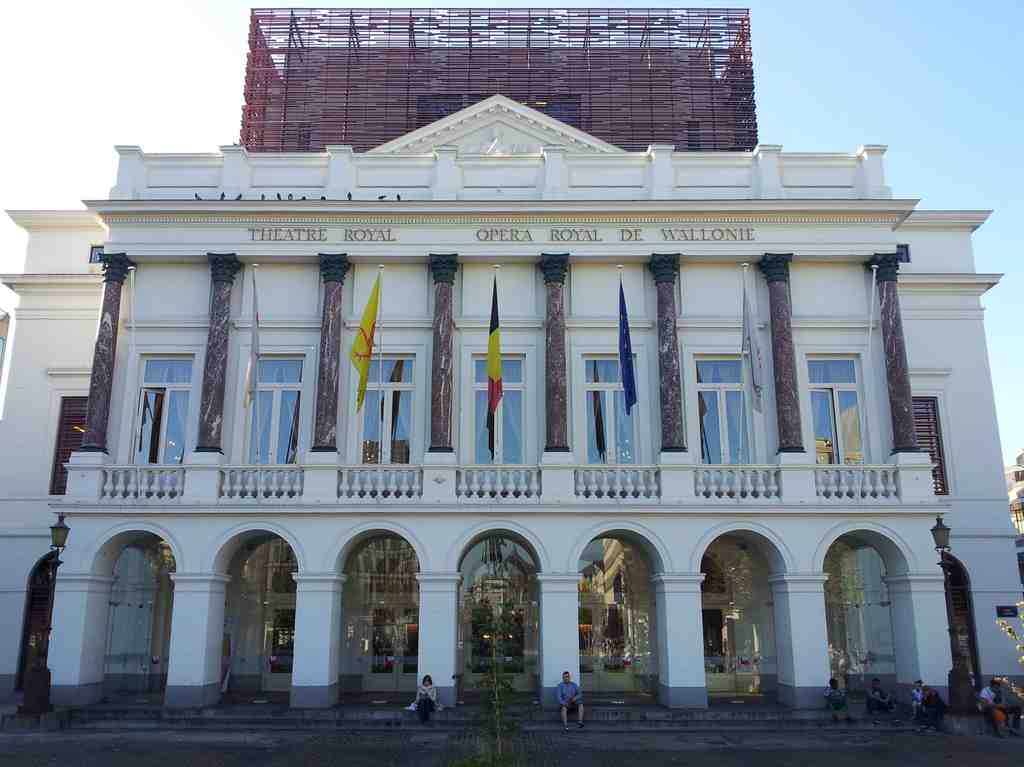
To spot the Opéra Royal de Wallonie, look for a stately white neoclassical building right in front of you, perfectly symmetrical, with tall marble columns across its facade, grand arched windows, and flags waving above its arcades.
Imagine standing here on the Place de l’Opéra in 1820, where carriages clatter by and expectant crowds gather, craning their necks to catch a glimpse of the city’s brand-new theatre. The Opéra Royal de Wallonie wasn’t just plopped here out of nowhere; in 1816, King William I of the Netherlands handed over the land and materials from an old Dominican convent to Liège, but only if they promised to build a theatre worthy of the city’s dreams. Mademoiselle Mars, a renowned actress of her day, laid the first stone on a July afternoon in 1818-no pressure, right? Thanks to architect Auguste Dukers, the result was this imposing, marble-clad neoclassical masterpiece, with a dramatic balustrade and stately arcades that seem to practically hum with anticipation.
The doors first opened on November 4th, 1820, and the scene was set for centuries of music, laughter, heartbreak, and (let’s be honest) at least a few over-the-top costumes. Originally, the theatre was just on loan from the city-sort of like borrowing your friend’s car, except with more chandeliers and less risk of spilling coffee on the seat. By 1854, the city officially owned it, and out front, the statue of André Grétry, Liège’s beloved composer, gazes over the square. Here’s something both touching and just a touch dramatic: his actual heart was buried in the base of that statue in 1842. Hey, musicians really do put their hearts into their work around here.
Fast-forward to 1861 and the theatre’s getting a makeover, courtesy of architect Julien-Étienne Rémont. Picture an extension that makes the building bigger and grander, and a hall glimmering with the opulence of the Second Empire, ready to seat over 1,500 eager listeners.
But it’s not all standing ovations. In August 1914, the opera was requisitioned by the German army during World War I. Just imagine: velvet seats swapped for straw bedding, the scent of perfume replaced with, well, something a lot less glamorous. For five long years, the opera was silent, except for the restless noises of soldiers taking shelter in the dark. It took until October 1919 for music and applause to fill the air again.
By 1930, all eyes were back on the building as the Exposition internationale de Liège arrived. The theatre got a new pediment carved by Oscar Berchmans and lost its white plaster to show off the raw beauty of its stones. Somehow, this grand old house survived the ravages of the Second World War, remaining a stubborn beacon of art and hope.
A new era began in 1967, with the formation of the Opéra royal de Wallonie’s own permanent troupe. From then on, the opera’s story has been filled with colourful personalities and constant reinvention, not least because of the local government’s ever-creative ways of scraping together enough francs and euros to fund the music. Despite budget hiccups, there were glittering successes-a ballet company (that, sadly, had to close in 1997), innovative set and costume workshops, and performances reaching far beyond Belgium’s borders.
In 2009, the opera house itself became the star of a massive renovation. For three years, the grand lobby, hall, and sweeping staircase were restored to their full 19th-century glory, while a brand-new stage tower rose overhead, topped with a striking modern grid. After bouncing performances to a temporary “opera tent” nearby, the doors swung wide again in September 2012, just in time for a triumphal performance seen by Belgian royalty.
Today, the Opéra Royal de Wallonie marries the best of old and new, hosting world-class musicians in a theatre that’s both historic and high-tech. And if you peek upstairs, you might just hear an orchestra tuning up or see a team of artists painting backdrops and sewing sequins, hard at work to keep the magic alive.




