
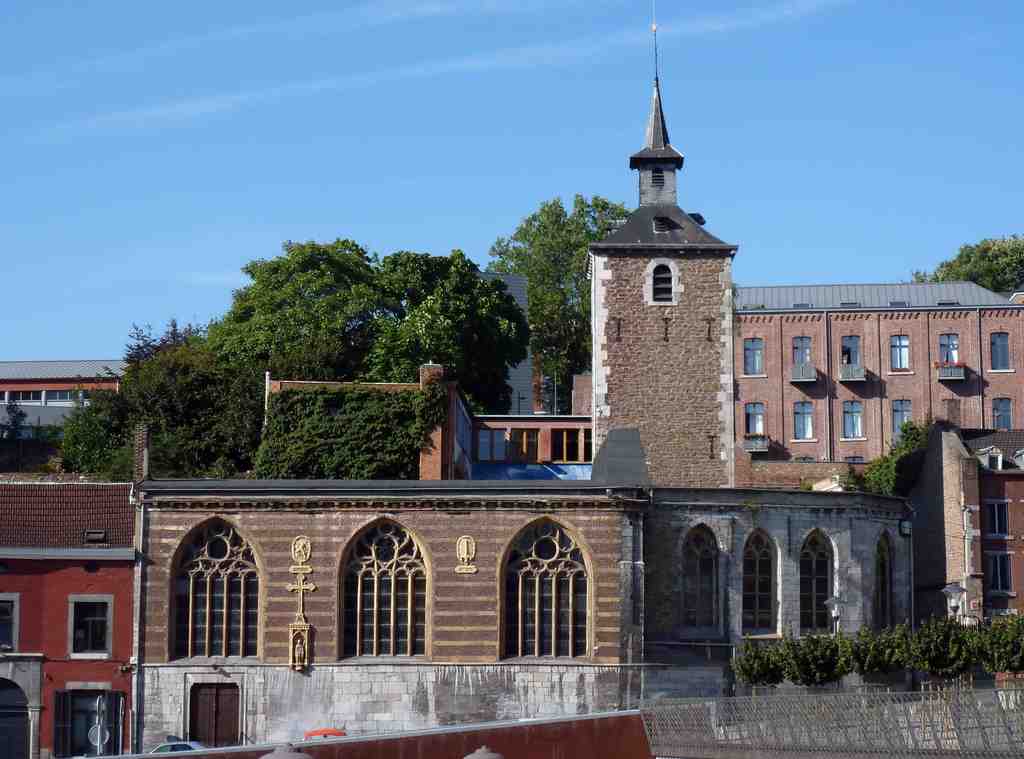
To spot the Church of Saint Servatius, look for a sturdy square stone tower peeking out above the rooftops next to dramatic, striped brick and stone walls with tall, arched Gothic windows-right at the foot of the hill beneath the Liège citadel.
Imagine yourself now, right outside this curious old church-though I have to warn you, this place has seen more drama than a soap opera set! It all began back in 933, under the watchful eye of Bishop Richer, who decided it was high time to rebuild after the Norsemen had ravaged Liège in 881. So started the Church of Saint Servatius, a survivor born out of ashes, doing its best impression of a medieval phoenix.
Picture medieval Liège, narrow streets bustling with merchants, the scent of woodsmoke, and the constant hum of church bells. Amid this, Saint Servatius found its feet. Though first written about in 1189, by the 13th century it had grown into the sturdy Gothic marvel catching your eye today. In those days, the church wasn’t just a place of worship-it was home to hermits right up until the 15th century. I promise, their daily routine certainly had fewer snooze buttons than ours.
Liège’s history is a game of ‘Dodge the Disaster’, and this church has an impressive scorecard. It dodged destruction in 1468 when the Bourgundians sacked the city, but wasn’t so lucky in 1491, when an orkan-yes, a full-blown storm-took a battering ram to it! The 16th century pitched in, too, with a crumbling spire collapsing onto the vaults in 1583. Luckily, Pastor Jean Curtius rolled up his sleeves and patched things up, blending late Gothic style with a sprinkle of Renaissance flair.
France then decided to join the party. Revolutionaries arrived in 1794, shattered churches and convents, and soon Saint Servatius was confiscated and sold for a hefty sum. But stubborn as a Belgian waffle, the church came back to life as a parish church. Fast forward to 1883, and all that modern railroad construction rattled the church again, quite literally-the vibrations forced more repairs.
Even fires fancy a bit of Saint Servatius. In 1981, a blaze tore through the church; all that remained standing afterwards were its bare stone walls-like the world’s most somber birthday cake. Since then, restoration efforts have managed to revive much of its structure, though the high roofs never returned, and some interior columns had to be entirely rebuilt.
Peek at the exterior-see the blue limestone around the choir and the charming red brick and marlstone stripes in classic Maasland style. Don’t miss the sculptures on the southern side: Saint Servatius himself, a medieval coat of arms said to be Bishop Richer’s, and a 933-dated relief of the legendary Perroen of Liège. Gothic windows here boast delicate tracery, like stone lacework that’s endured the ages.
Inside, much has changed. The sumptuous 18th-century Baroque décor, intricate stuccowork, and most precious artworks didn’t make it after the great fire, but some 13th-century columns hang on, stubborn as ever. In the choir, surviving fragments of stained glass shimmer beside plainer windows. Among the few treasures that escaped destruction are a stone statue of Saint Servatius, a 1665 wooden figure of Saint Balbina, a 1571 marble-and-bronze baptismal font, and a handful of ancient tomb crosses. Even some paintings and silver relics, like a goblet-shaped reliquary, survived centuries of turmoil-and the clumsiest movers in Liège.
So as you stand outside, take in the patchwork of styles and scars, every stone whispering tales of calamity, repair, and resilience. You’ve just met the real Saint Servatius-a church that never lets a disaster keep it down for long! And if you smell smoke, don’t worry… it’s probably just a local barbecue, not another chapter in the saga.




