
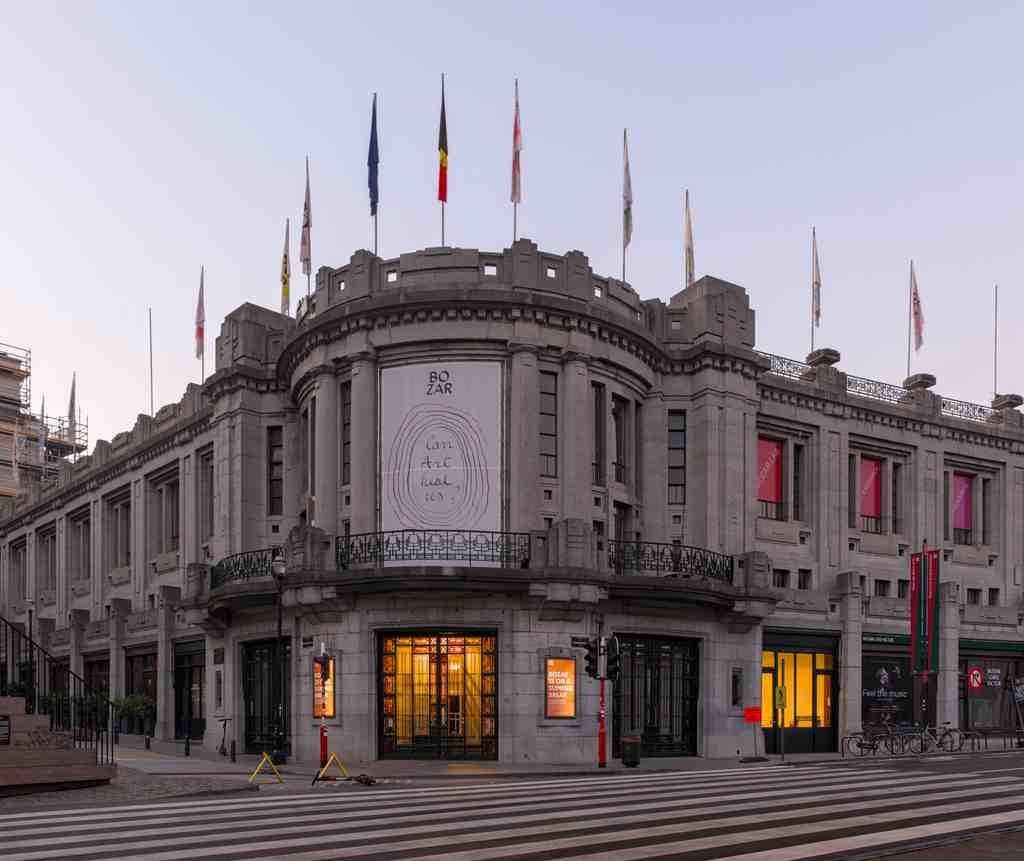
You’re looking for a grand grey stone building with a curved Art Deco façade, lots of flags on the roof, and a glowing entrance right at the busy crossing of Rue Ravenstein - spot the big “BOZAR” banners and you’re there.
Welcome to the Centre for Fine Arts, or as the locals lovingly call it, BOZAR! Imagine Brussels in the 1920s: jazz is playing, skirts are getting shorter, and here, this striking building is about to change the city’s artistic heartbeat forever. But would you believe, the dream of a fine arts centre here actually began in 1856, when the authorities had big ideas - but very empty pockets. Over the next sixty years, plans ran out of money, locations got vetoed, and one proposal even suggested putting it where the stock exchange stands. Brussels, always dramatic!
Flash forward to the aftermath of World War I: Belgium is finding its feet, and a banker with a brilliant moustache (and bank account) called Henry Le Bœuf steps in. Alongside the King and Queen, they hire none other than Victor Horta - the architect who usually made buildings curl and swirl in Art Nouveau style. But here, Horta gave us something lean, geometric, and truly modern: Art Deco, dressed up for a night at the theatre.
Don’t let this orderly exterior fool you - underneath, the plot of land was a nightmare: steep, oddly shaped, and wedged between posh neighbours. Horta had to design the place so it wouldn’t block the King’s view from the palace to Town Hall. Plus, the city insisted there be shops at the front, hoping for a bit of rent to keep things lively. Talk about an architect’s balancing act!
Construction finally kicked off in the 1920s, with more drama than some of the operas eventually performed here. The team faced impossible slopes, rainwater trickling where it shouldn’t, and tight budgets. They switched designs countless times, even arguing over what the concert hall should sound like - big thanks to a Parisian acoustician, who diplomatically declared “Make it concrete!” It took years, but in the end, Horta created a sculpted horseshoe concert hall where musicians could feel wrapped in the audience’s energy.
The first exhibition opened in 1928, with art from Belgium to Russia and a performance by the legendary Ballets Russes ballet company. Imagine a parade of glamorous guests, royal family and all, stepping into marble floors and golden details, the smell of paint barely dry. It wasn’t all cocktails and applause, though, and within the first years the ambitious program almost bankrupted the place. Management changed hands, and by the 1930s, BOZAR was hosting everything from jazz to car shows to avant-garde kitchen installations. Seriously, if these walls had a calendar it would look like an explosion of sticky notes.
But history kept marching on - even during World War II, when German officers held events here, concerts and auctions quietly continued so the building wouldn’t be shut down completely. The city’s artistic community got creative, launching youth music groups and experimental theatre troupes in defiance of propaganda. After the war, a burst of color and creativity swept through with new festivals, art from Dalí and Picasso, and major film events. The giant Henry Le Bœuf concert hall (right here inside this building) became home to everything from symphonies to the legendary Queen Elisabeth Competition, where musical dreams are still made today.
By the 1970s and 80s, things got a bit dicey - money troubles, leaky roofs, and a wave of student protests in May ‘68. In true Brussels fashion, the solution was: art for everyone! They opened a new Forum space, filling it with lectures, pop-ups, and that unique brand of Belgian democracy, with a thousand committees arguing at once. Later came Europalia, a festival of international art that added a swirling parade of countries and cultures to the programme.
A major restoration in the early 2000s peeled back decades of changes and brought the halls back to Horta’s vision - and now, in the 21st century, BOZAR hosts everything from Picasso and Yves Klein to rooftop concerts and cinema. In 2021, a fire caused panic, water splashed everywhere, but, like a true diva, BOZAR bounced back quickly, and the music continues.
So, whether you want to see blockbuster exhibitions, world-class orchestras, movies, or just enjoy the rooftop sunset, this curved, flag-festooned building on Ravenstein is the beating heart of Belgian culture. And to answer the question on the banner: Can art heal us? BOZAR certainly gives it a very good try.
To expand your understanding of the facilities, directors or the trivia, feel free to engage with me in the chat section below.


