
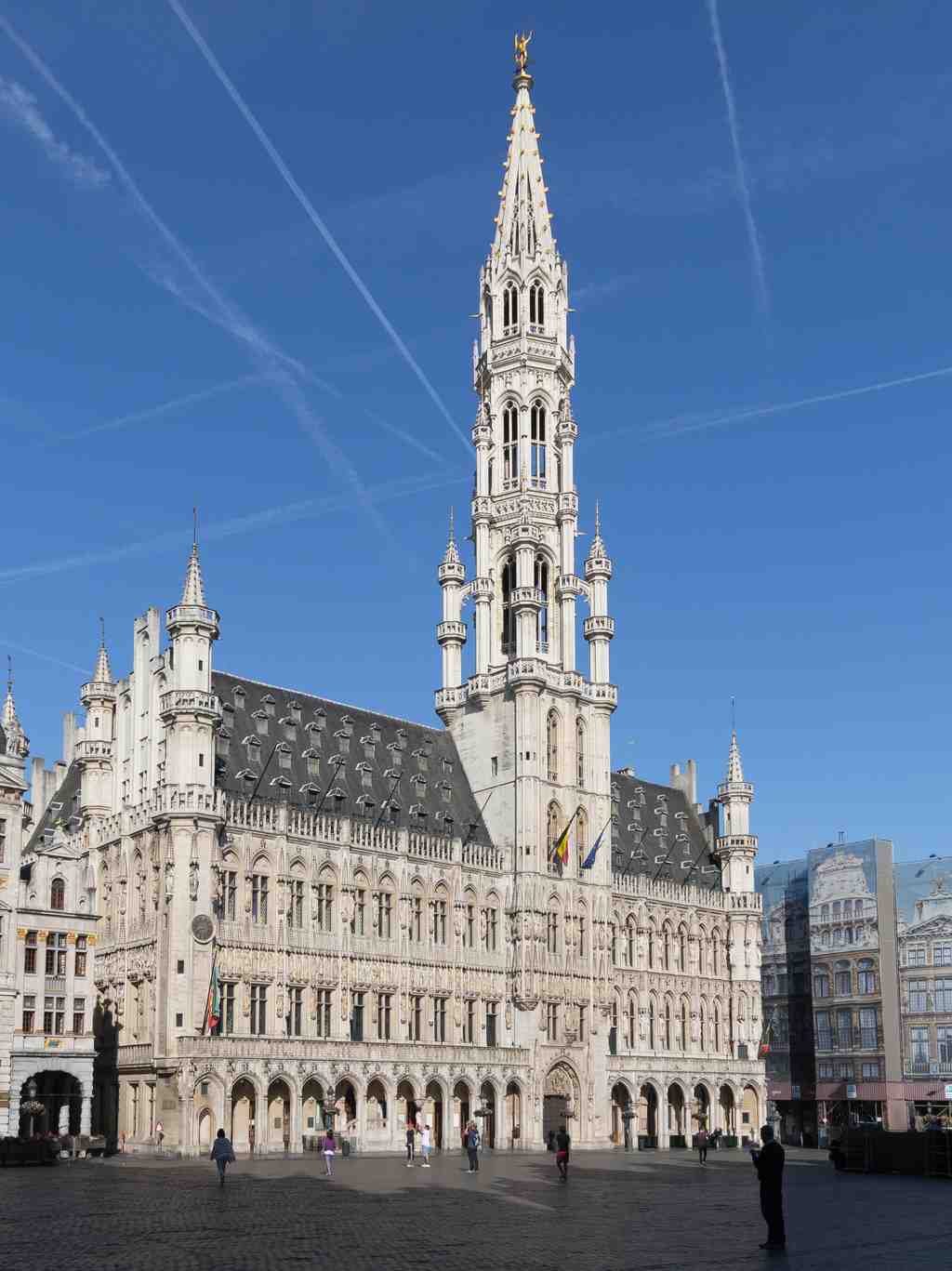
To spot Brussels Town Hall, just look straight ahead for a grand, stone building crowned with an impossibly tall and slender spire-like a Gothic wedding cake topped by a golden statue-standing proudly on the south side of the wide cobblestone square.
Welcome to the beating heart of Brussels - the magnificent Town Hall! As you stand here, take a deep breath; you’re looking at the city’s very last surviving piece of the Middle Ages, right where power has pulsed for over 600 years. The Town Hall was built in stages starting in 1401, so you’re actually seeing centuries stitched together in one awesome structure. If you glance up, that incredibly tall, decorated tower-stretching up to 96 meters-is topped by Saint Michael, Brussels’ patron saint, forever caught in the act of slaying a dragon. Not a bad gig if you like a view!
But things have not always been so peaceful here. Imagine it’s August 1695: thunderous explosions ring out as cannonballs rain down on the Grand-Place. A French army, hoping to win a war on a different front, is bombarding Brussels. The city center is blazing-wood and stone alike turned to ash. Yet even as most of the square is flattened, this Town Hall, despite being the main target, miraculously stays standing, like a stubborn survivor amidst the ruins. Of course, in the chaos, the inside is gutted. Priceless art and records, including masterpieces by Rogier van der Weyden, are lost to the flames. But the stony shell holds.
Fast-forward: the people of Brussels rebuild what war destroyed. By the early 1700s, the Town Hall is not only restored but expanded, with the addition of rear wings in the elegant Louis XIV style. Those new wings hosted the powerful States of Brabant, where nobles, clergy, and commoners all jostled for attention. Imagine the air buzzing with secrets and the clack of boots on marble floors.
In the 1800s, the Town Hall gets a serious Gothic glow-up. Brussels’ architects add nearly 300 statues-count them next time you’re bored! Statues perch everywhere, from knights of the noble houses to local saints and even the virtues themselves: Prudence, Justice, Fortitude, and Temperance. Some of the most expressive faces you’ll see aren’t people in the crowd, but ancient dignitaries frozen above you in stone.
Walk around, and you’ll notice all sorts of quirky details. Do you see all those fierce gargoyles sticking out? Some look almost human (on a bad hair day), others are animals or beasts from fairy tales. There’s even a story lurking behind the slightly off-center tower-legend says the embarrassed architect leapt from the top on realizing his “mistake.” But more likely, it’s just what happens after two centuries of crazy expansion plans.
If you step inside the courtyard, look down: the pavement is marked by a star, the exact geographical center of Brussels-a true city of balance. Fountains here are guarded by allegories of the nearby rivers. Inside, every room is a treasure trove: tapestries, portraits, and even a ballroom. During wars, these same rooms served as hospitals and headquarters for revolutionaries, and more than once, they hid the brave and the desperate.
A place of pomp, plot twists, and pageantry-no wonder Brussels’ Town Hall became a model for city halls across Europe, inspiring buildings in Vienna and Munich. Even today, life swirls around it like a medieval fair. So next time someone says, “Meet me at the Grand-Place,” you’ll know you’re standing in the shadow of Brussels’ most dramatic and enduring legend.
Wondering about the architecture, interior or the influence? Feel free to discuss it further in the chat section below.


