
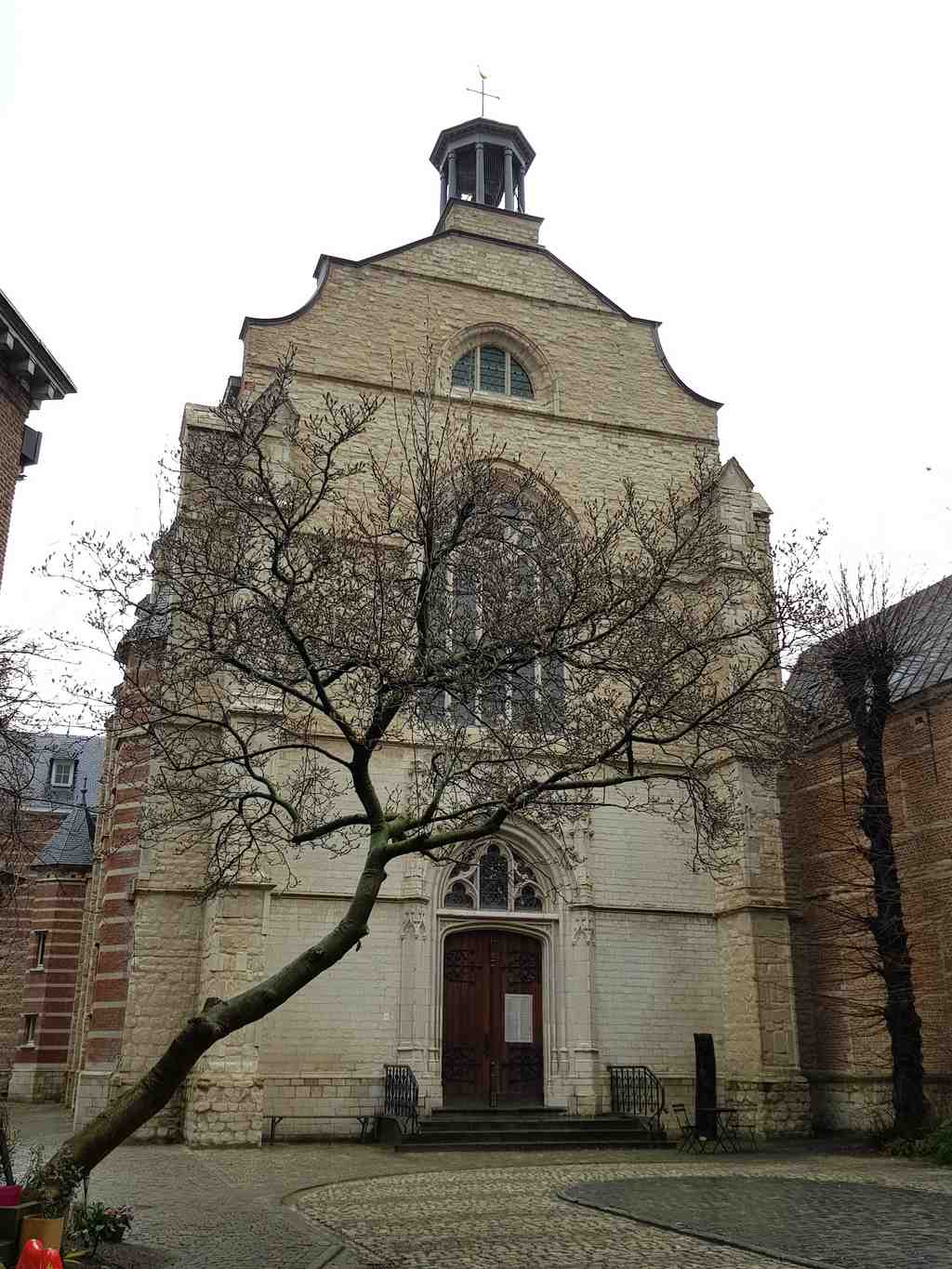
You’re nearly there! Look straight ahead for a solid, pale stone church with a sloped, almost triangular roof and a little lantern-shaped bell house perched right on top. There’s a bare, twisty tree reaching toward its entrance-almost as if it’s trying to shake your hand. The big wooden doors and the soft, carved details above them give away its late-Gothic style. This is the Brabant Mount of Olives, tucked away on the Lange Winkelstraat!
Now, imagine stepping back in time. Antwerp’s streets are far quieter-except for a few horses clomping past. This church once belonged to a secret Protestant community, hiding when it was dangerous just to believe the “wrong” thing. The Brabant Mount of Olives wasn’t just a landmark, but a lifeline for Antwerp’s Protestants during the Austrian Netherlands. No big flashing signs here-just whispers, nervous laughter in candle-lit rooms, and a painter named Jacob Jordaens, who hosted secret gatherings in his own home. If walls could talk, these would probably gossip!
The first stone was placed in 1615 by Isabella of Spain herself, along with her very powerful husband Albrecht. But power shifts fast in Antwerp-first the Catholics, then the Protestants, then armies marching through. At one wild point, this church was a horse stable, then a bakery for soldiers, and after a fire, its tower crashed down with a heart-stopping roar. Talk about multitasking!
Finally, in 1821, with the drama cooled and a new king in town, the church was handed to the Protestants. The old tower was never rebuilt, but a bell was hung in a neat little cage up top, where it still sits today. If you hear a distant toll, you’ll know whose story is echoing across Antwerp-it’s the memory of secret faith, stubborn hope, and a church that just refused to disappear.
Ready for the next stop? I promise, fewer horses-though no guarantee on ghosts!




