
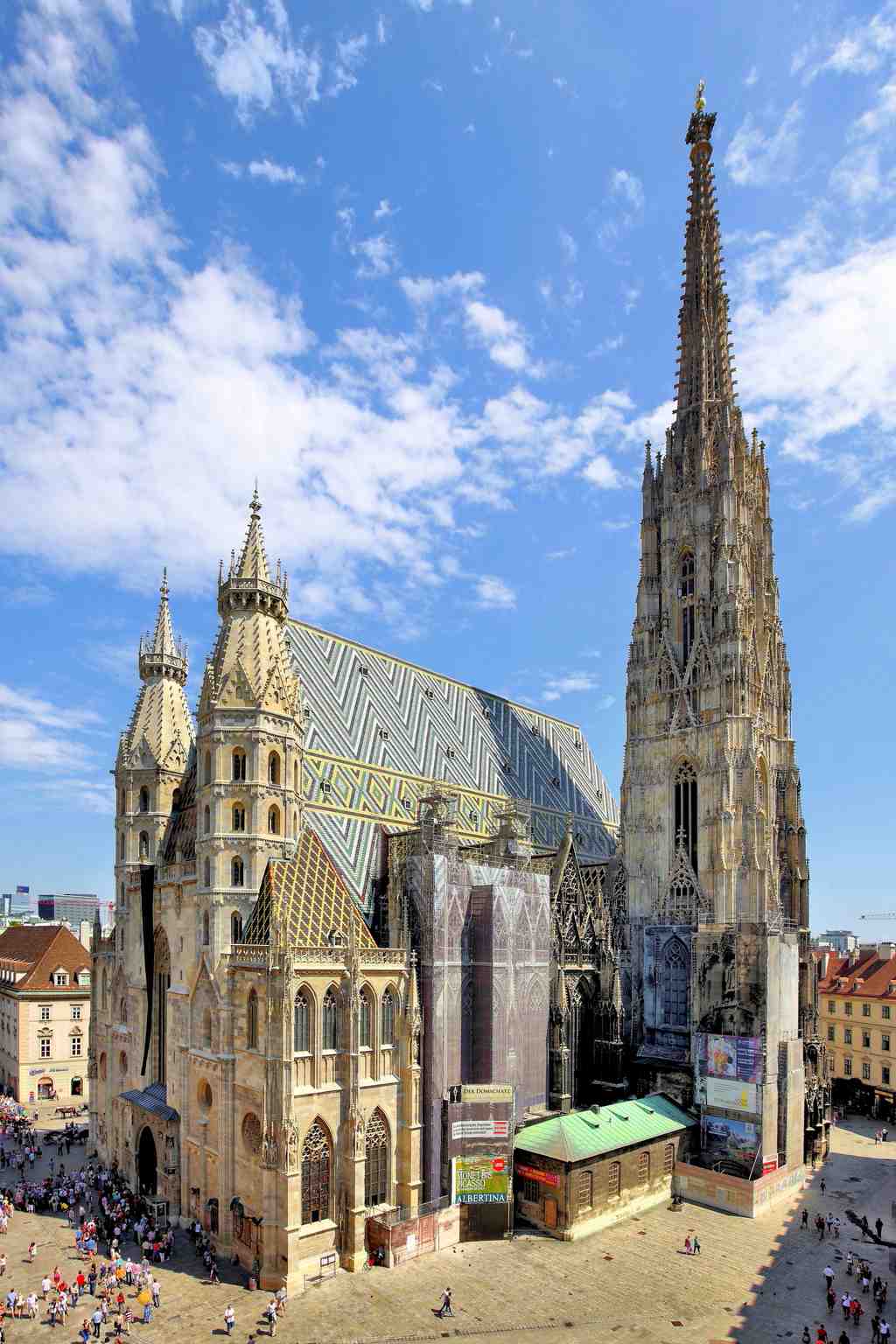
That soaring building ahead with its pointed towers, one shooting up high above the city, and a roof glittering like a patchwork quilt of colorful tiles-yes, that’s St. Stephen’s Cathedral! Just look for the dazzling zigzag rooftop and the enormous southern spire: you can’t miss it.
Standing here, you are taking in more than eight centuries of Vienna’s most beloved landmark, a place that’s seen crusaders, emperors, everyday Viennese, and arguably even Mozart’s ghost hustle past its massive doors. Imagine: back in 1137, this spot was chosen-not on a quiet field as once thought, but right atop an ancient Roman cemetery. Some very old neighbors lie under your feet-excavators even found graves here from the 4th century. The first church was a humble parish, but Vienna grew so fast, they outgrew four churches in no time. You can almost hear the commotion of the 12th-century construction site as Bishop Reginmar and Margrave Leopold IV figured out where to place this parish church, marking Vienna as a real city for the first time.
The cathedral you see now is a patchwork of dramatic stories, fiery disasters, and ambitious dukes. After fires and a whole lot of expansion, the Gothic spire you see-the “Steffl,” as locals affectionately call it-shot up 136 meters and took 65 years to finish. There’s a local joke that it’s so tall that even the clouds must take a detour around it! That spire served as Vienna’s lookout post during the Ottoman sieges, and, believe it or not, there’s even a tiny apartment up there for the night watchmen who would ring the bells if they spotted trouble or a stray fire.
Speaking of bells, the cathedral houses a giant called “Pummerin”-the “Boomer”-which weighs over 20,000 kilograms! When it sounds, the whole city listens. This bell is a survivor: it was recast from cannons captured from the Ottomans (take that, invaders!). After World War II, shattered pieces from the old Pummerin were melded into this one, so when the bell tolls, it’s echoing hundreds of years of Viennese courage and a good dose of recycling.
Don’t forget to tilt your head and look up at that roof-230,000 glazed tiles create shimmering mosaics: imperial double-headed eagles, the coats of arms of Vienna and Austria-history written in color. The roof’s so steep, when it rains, it gets a good scrub for free; the tiles have been shining ever since (except when air pollution turns bits black, but hey, the restoration crews are on it). Fascinated by numbers? Climb the 256 steps to the spire’s top, and you’ll earn serious bragging rights-and maybe a serious craving for strudel afterwards.
At your feet, you’ll find the city’s medieval measurement standards-metal bars that let merchants check the length of their cloth, right on the cathedral wall. And there’s a more macabre detail: the catacombs beneath, packed with the bones of over 11,000 souls, a result of centuries of burials-and the occasional bubonic plague outbreak. Among the honored dead, you’ll find Habsburg dukes and Emperor Frederick III, whose grand tomb took more than four decades to finish.
Now, try to spot Vienna’s quirks: by the main door, called the Giant’s Door, there was once a mammoth thighbone hanging above-nothing says “welcome” like prehistoric décor. Look out for “Christ with a toothache” and the playful Fenstergucker, a sculptor peeking from his own window-proof that medieval artists had a sense of humor, too.
Inside, the wonders continue, from St. Mary’s famous weeping icon to Mozart’s wedding, kids’ baptisms, and funeral. This was his neighborhood parish! If all these walls could roll their eyes-or maybe tap their foot to a Mozart tune-they’d have plenty of tales. Through fires, wars, and the relentless tick of time, St. Stephen’s Cathedral carries Vienna’s spirit, always watching over the city from its bright mosaic rooftop, rain or shine.
If you're curious about the exterior, interior or the conservation and restoration, the chat section below is the perfect place to seek clarification.




