
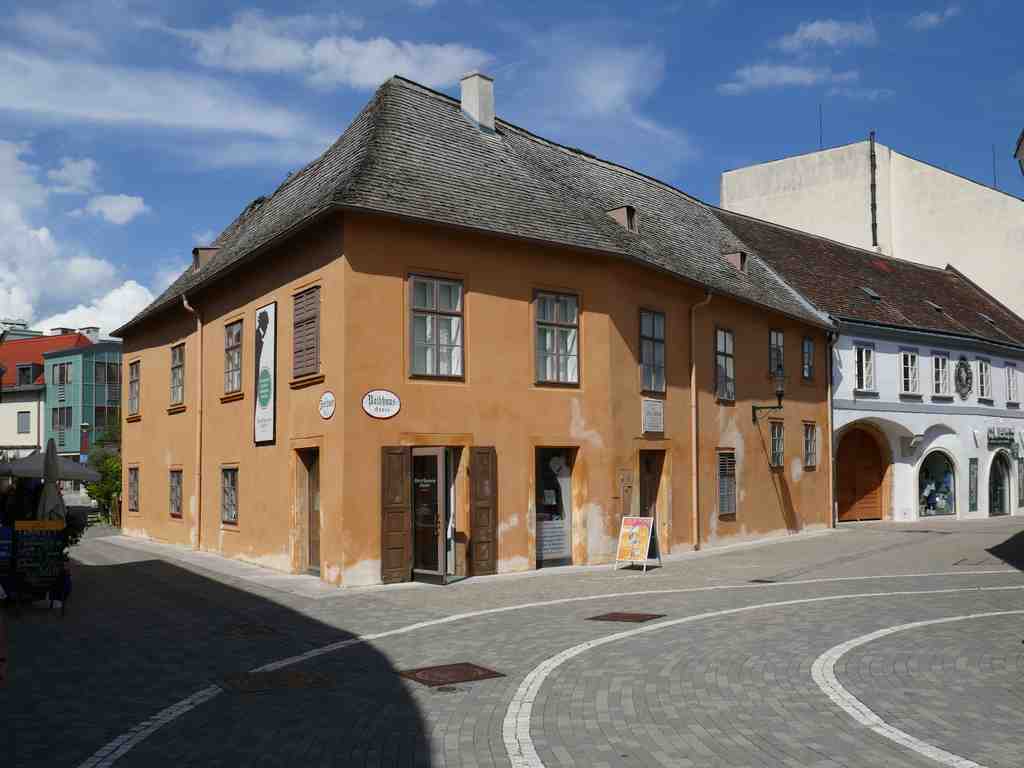
To spot the Beethoven House Baden, look for a slightly weathered, yellowish-orange two-story building with a distinctive tiled roof right on the corner of Rathausgasse, its facade marked by rectangular windows and a sign with Beethoven’s profile hanging over the door.
You’re now standing in front of a building with a story that stretches back to the days when Baden was filled with horse carts, busy bakers, and the occasional-well-disappearing owner during the Turkish invasion of 1529! The Beethoven House is no ordinary house; it’s a time capsule where music history was literally scribbled on the window shutters. Once, this quirky old building was home to craftsmen, bakers, locksmiths, and even a copper smith, who, rumor has it, probably never played a single piano note in his life. The house itself dates to the 16th century and has seen so many renovations that it likely doesn’t even recognize itself in the mirror anymore.
But, the real headline comes in the 19th century, when Ludwig van Beethoven checked in-not once, not twice, but for three epic summers: 1821, 1822, and 1823. He wasn’t here just for the scenery or the spa cures (though, who could resist a Baden bath?), but to wrestle with one of his biggest musical giants: the Ninth Symphony-Ode to Joy and all that. Imagine the scene: Beethoven in the upstairs apartment, framing his day between a humble sleeping room and a cramped workspace, grumbling over the lack of paper, and, in a burst of desperate inspiration, jotting his genius directly onto the shutters overlooking Rathausgasse.
During the early 1800s, this house belonged to Johann Bayer, a copper smith and carriage driver, and his wife Ursula. Their biggest claim to fame? Some half-hidden wall paintings they left behind and, of course, renting out rooms to a stubborn, slightly unkempt tenant named Beethoven. In fact, Beethoven was such a memorable guest-always a bit restless, never staying twice in the same spot-that when he actually wanted to return for a third stay, the landlord made him agree to what I like to call the “Window Clause”: replace any window shutters he used for music notes, because Bayer had already been selling them off as prized Beethoven memorabilia!
Picture people outside in the hot summer, hearing faint music and possibly some heavy sighing coming from above. Beethoven’s Ninth, part of Europe’s greatest collective playlist, was put together right here. And he wasn’t just composing that-some of his other works, like Wellington’s Victory and the Missa Solemnis, echoed off these walls, though probably not quite as much as his muttering about missing sheets of paper.
As time moved on, the house morphed with the city: after being a copper smith’s domain, it became a bakery around 1870. Imagine, future visitors buying fresh bread in the same spot where symphonies simmered in Beethoven’s mind. Then, in the 20th century, the city of Baden took the baton and transformed the home into a tribute to Beethoven's genius. In 1965, they opened these very rooms-restored, expanded, and waiting for Beethoven fans and the merely curious.
The house was thoroughly restored and updated again in 2014. Now, as a museum, it offers three floors of exhibits-one dedicated just to Beethoven’s creative outpourings in Baden. If you walk inside, you’ll find yourself moving through dramatic displays, digital listening rooms, and upstairs, the very rooms where Beethoven found inspiration. There’s a space completely devoted to the famous fourth movement of the Ninth Symphony-imagine how powerful that must feel, standing where that music was born.
So, as you gaze up at this unassuming building, know that it’s not just a house-it’s the birthplace of musical miracles, with a few scratched-up shutters and maybe a croissant or two in its colorful past. Now, shall we see what Beethoven left behind for us next?


