
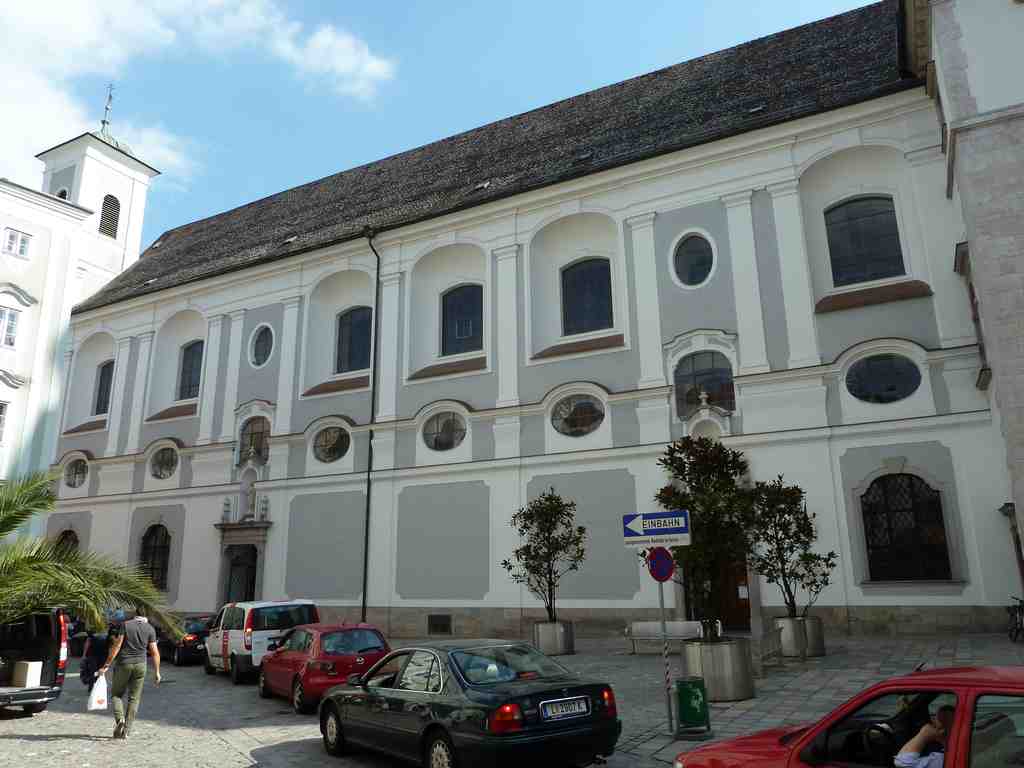
Looking to your left, you’ll spot the Minorite Church by its elegant, creamy façade rising three stories high, topped by a wide sloping roof, with detailed decorative work framing its front and a slender tower peeking out on the far side - it’s wedged right into the row of historic city buildings, so keep an eye out for those ornate portals.
Now, let’s dig in…and trust me, there’s more going on with these walls than meets the eye. This is the Minorite Church, also fondly called the Landhauskirche: the ONLY Rococo-style church in all of Linz. Imagine stepping into the mid-1200s - this was the stage for the first Franciscan monks who arrived in town, the so-called “Minor Brothers,” or Minoriten. Their job? Spiritual guidance, humility, and running the city’s earliest monastery, which made this spot, for several centuries, *the* religious headquarters for Linz.
Of course, things got a tad complicated during the Reformation. Here come the politics: by 1562, Emperor Ferdinand the First decided he’d had enough of monks running the show, so he sold everything but the church and cloister to the local government. Think of it as a 16th-century corporate takeover - with slightly more Latin thrown around. The church itself survived a few centuries of musical chairs: Jesuits moved in for a while, as part of the Catholic “Counter-Reformation”-basically an answer to Luther and his busy friends. Eventually, the Franciscans regained control, but by the late 1700s, Emperor Joseph II pulled the plug on monasteries altogether and repurposed the next-door buildings for...government offices. So, when you see officials heading into the Linzer Landhaus, you can thank this complicated history.
But let’s talk about the building staring back at you. Although the original church was medieval Gothic, you’re seeing a timeless Rococo showpiece created by Johann Matthias Krinner in the mid-1700s. The main entrance-actually, there are two-deliver you into what feels more like a divine ballroom than a solemn chapel. Picture bright, airy spaces, gentle stucco swirls and cherubs overhead, and six deep side niches each packed with unique altars-almost like having your spiritual options laid out like a box of deluxe chocolates.
Speaking of chocolates, the high altar is the crown jewel: marble that’s not marble (stucco work, crafty and thrifty), flanked by sculptures and paintings-don’t miss the brilliant “Annunciation” by Bartolomeo Altomonte, practically shimmering with gold. The side altars are no slouches either, blending architecture and altar into seamless Rococo style. You’ll find saints with dramatic stories and some wild backstories...one even features Saint Joseph of Cupertino floating in midair, which certainly gives new meaning to “uplifting.”
Listen carefully and you might hear the grand organ-original parts dating back before Columbus hit America-yet the keys play thanks to a modern rebuild in 2009, part of Linz’s stint as European Capital of Culture. If organ music could talk, this one would probably have a few opinions about city politics.
Now, in the sacristy, you’ll see more ornate woodwork and red marble than many royal palaces. It’s often called the most beautiful sacristy in Linz-though I wouldn’t bring that up near the Ursuline Church unless you want to start a rivalry.
Today, the Priestly Fraternity of Saint Peter keeps tradition alive with Mass in Latin, Tridentine-style. So there’s a good chance some things here haven’t changed for hundreds of years.
Alright, time for something completely different. When you’re set, Linzer Landhaus is just a minute’s walk west.




