
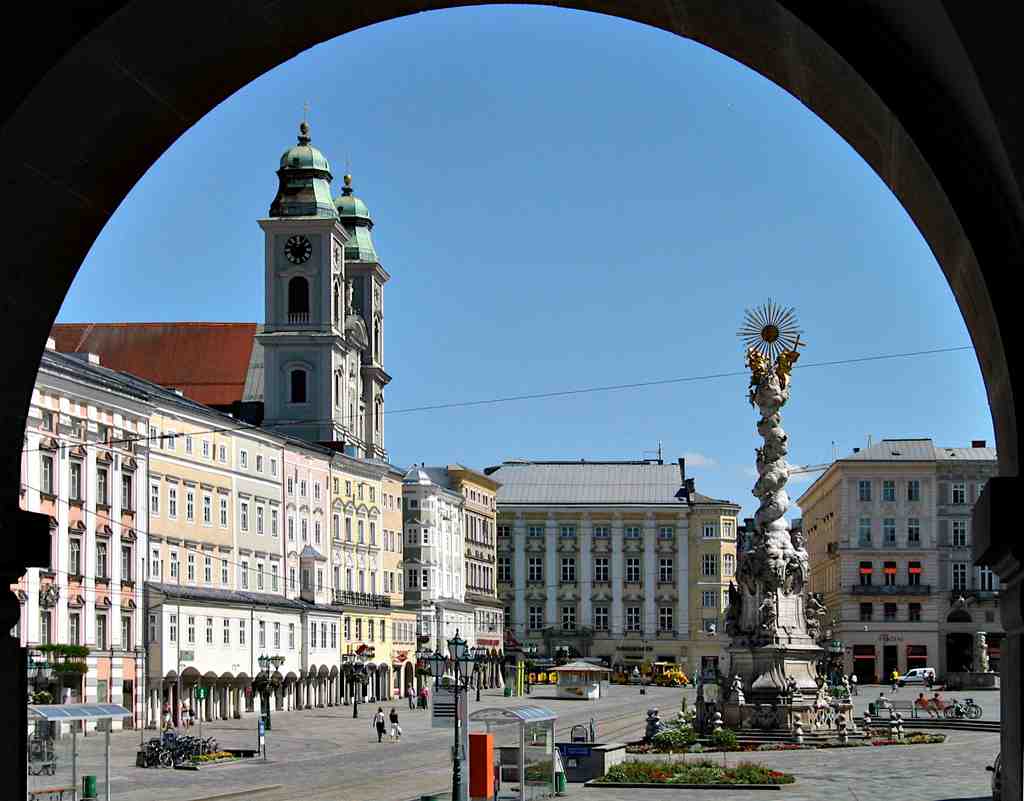
On your right, you’ll see a massive rectangle of open space lined with tall, pastel-hued buildings and ringed by lively cafes and tram tracks - this is Main Square, the beating heart of Linz.
Now, Main Square - or Hauptplatz, as the locals put it - isn’t just big, it’s monumental. In fact, with around 13,000 square meters, it’s one of the largest enclosed squares in all Austria. Today, it’s separated from the Danube River by just one road and a few chunky bridgehead buildings. But if you squint a little, you’ll notice how the buildings surrounding it have oddly narrow facades and seem to stretch way back. That was... let’s call it ‘prime real estate strategy’ from the old days, when property prices right here were sky-high because everyone wanted in on the action.
Let’s jump back to the early 1200s. Imagine this space being staked out with nothing more than ropes, measuring sticks, and a seriously ambitious town council. In 1207, when Linz expanded, this very square and the city church got marked off. By around 1230, the shape you see now was in place - roughly three times longer than it is wide, stretching almost the length of two football fields.
Now, the square’s seen a parade of different names. It started as “An dem Markt” - basically ‘at the market’ - then picked up a few catchy titles over the centuries, including the dramatic-sounding “Platz des 12. Novembers” after the First Republic was declared. Throughout the 1900s, its name kept getting updated to follow the political winds... and not always in ways anyone would be proud of. But since 1945, ‘Hauptplatz’ has stubbornly stuck.
It’s always been a place of gathering, trade, drama... and, at times, a little darkness. Back in the day, public executions were an honest-to-goodness event held right here. People would pack in for year markets, tournaments, even legendary weddings - like the one in 1521 when Archduke Ferdinand tied the knot and celebrated with a tournament that sounded suspiciously like a medieval rager.
Take a look toward the dazzling stone pillar near the center - that’s the Trinity Column, or Dreifaltigkeitssäule. It’s one of Linz’s most recognizable landmarks. The locals erected it in the early 1700s to say thanks for surviving fire, plague, and war. Nowadays, people pass it daily, barely glancing, but those old symbols carry a lot of weight if you know the backstory.
You’ll also find the Old Town Hall here - still the mayor’s office after 500 years - and the quirky Feichtinger House with its musical clock. And if you’re the kind to seek out oddities, there’s a relief of a Roman family stuck on Number 10, left over from the days when Linz was a Roman outpost called Lentia. There’s even an elephant carved into Number 21. Yes, that IS as random as it sounds - it was put there to mark the visit of a real elephant with the imperial entourage in the 1500s. Linz knew how to throw a parade.
Main Square is still the city’s living room. On Fridays you’ll find a proper farmers’ market; Saturdays, a flea market with more bric-a-brac than most basements; and come winter, the air sings with mulled wine and Christmas cheer at the market stalls. And through it all, trams glide, locals chat, and the market rings echo off stone.
Oh, and if you’re feeling underground... literally... you should know there’s a whole warren of World War 2 bunkers and a parking garage just below your feet. That’s the thing about this place - every layer, above and below, has a story.
Ready for Old Cathedral (Linz)? Just walk southeast for 2 minutes.




