
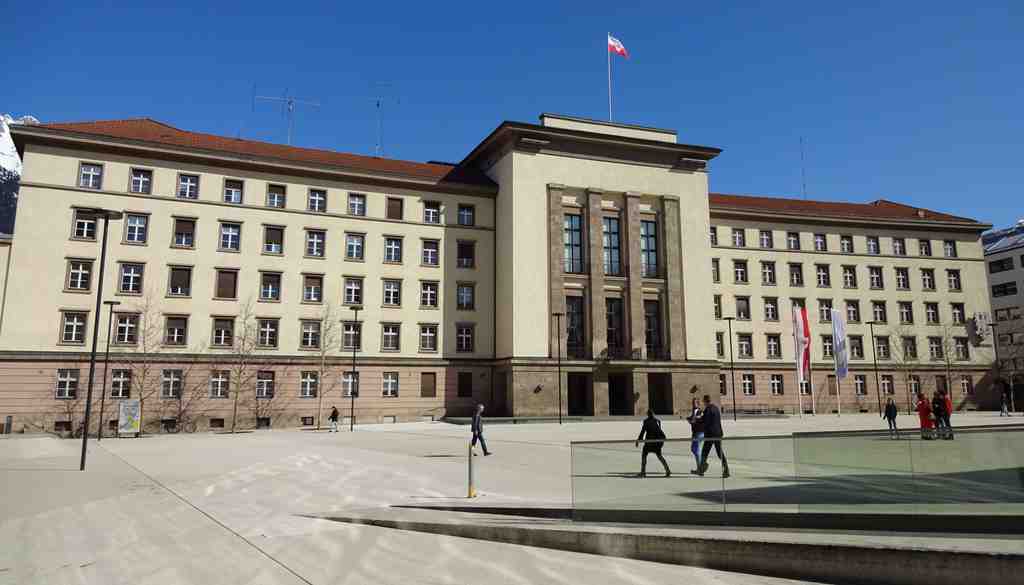
To spot the New Country House here in Innsbruck, look for a grand, cream-colored building straight ahead with rows of square windows, a flat red roof, a tall central section with impressive columns, and a proud flag waving at the very top-it takes up practically the whole side of the square, so it’s hard to miss!
Now, let me take you on a journey through the remarkable-and sometimes turbulent-life of the building right before your eyes. Imagine standing here back in 1939: the world feels tense, an uneasy silence hangs in the air, and this very spot has just been transformed by an enormous, stern new building-one that seemed to sprout overnight, and not by accident.
The New Country House, or "Neues Landhaus," wasn’t always the administrative heart of Tyrol. Built in the late 1930s by two architect brothers, Walter and Ewald Guth, its birth is rooted in a rather dark chapter of history. Picture the rapid, bold construction-crews hammering, brick dust swirling-when this site was chosen to become the Nazi regional headquarters, or "Gauhaus," for Tyrol and Vorarlberg. The building’s look is heavy, inspired by the mighty New Reich Chancellery in Berlin, with columns and symmetry that almost shout “authority!” If you peek above the side entrance (don’t worry, no need for binoculars), you’ll catch the Tirol and Vorarlberg coats of arms clinging to the facade-silent witnesses to a complex past.
The Nazis found the Old Country House, just down the street, far too cramped for their oversized ambitions. So, they dreamed up this extension, hoping it would anchor a huge new Nazi forum-but those grandiose plans never survived the chaos of war. When World War II ended, the swastikas and eagles quickly vanished, replaced in 1960 with something more local and proud: a stone Tyrolean eagle inspired by a medieval drawing from the Zenoburg. Imagine the relief and the cautious, hopeful footsteps as Innsbruck tried to heal its wounds and reclaim this space for democracy.
And still, this isn’t just a relic. Today, the New Country House-now with a shiny new neighbor, "Landhaus 2," added in 2005-buzzes with the work of the Tyrolean administration. Right across the square, you’ll find the Liberation Monument, built just after the war, and not far from there, the Pogrom Memorial: both stand as firm reminders never to forget the painful lessons of the past.
In recent years, the city has wrestled with how to remember and interpret this building's story. Historians and artists have debated, guided tours have led curious crowds (with maybe a nervous joke or two), and even now, explanations outside spark arguments and protests-not because people want to forget, but because the past can sometimes be heavy to carry. The square itself, newly transformed after a design competition, now welcomes you to wander, reflect, and perhaps imagine yourself in the shoes of the many different people who have stood here before.
History isn’t always easy, but here, every stone is buzzing with stories-old secrets, new truths, and the hope that by being honest about where we’ve come from, maybe we can shape a better future. And hey, at least today, the only uniforms you’ll see are from office workers heading for their afternoon coffee!


