
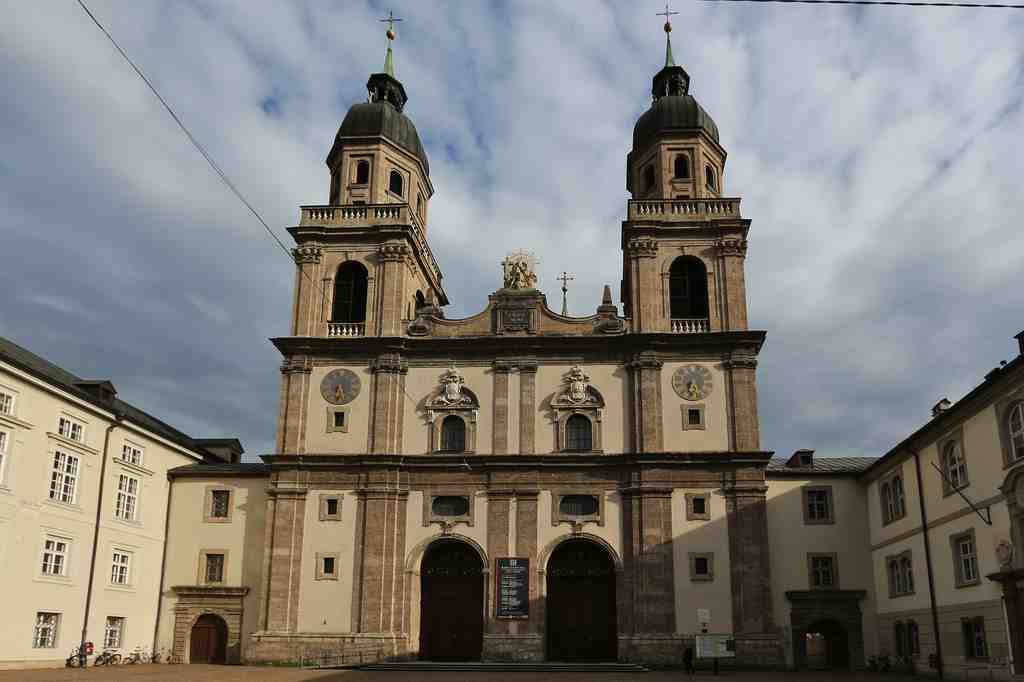
To spot the Jesuit Church, just look for a grand, light stone facade with two tall, octagonal towers topped with onion domes and clocks on each side-it stands proudly in the square, impossible to miss with its strict, symmetrical front.
Welcome to the mighty Jesuit Church of Innsbruck! As you stand before these two towering guardians, take a moment to picture the scene almost four hundred years ago, when this place was nothing but plans and fresh ambition. Instead of the sounds of traffic, you’d have heard the clatter of hammers and the shouting of stone masons, led by the creative minds of Karl Fontaner and Christoph Gumpp the Younger. They weren’t building just another church-they were bringing the extravagant spirit of early Baroque to the mountains, inspired by famous masterpieces from Rome and Salzburg. Their work was so ahead of its time, it must have felt like someone was installing WiFi in the 1600s!
The facade right in front of you is a lesson in drama and elegance. Let your eyes follow the strong lines of the pilasters, stacked like architectural “Russian dolls,” each row more elaborate as your gaze climbs: Doric at the bottom, Ionic in the middle, and Corinthian at the top-like a classical fashion show. The two towers above you seem to launch skyward from the third story, and, if you look closely, each is crowned by a lantern-topped dome. Yes, it’s a bit like a giant cake-just with more marble and a lot fewer calories! Crowning the facade is a powerful scene: the Holy Trinity, perched on a volute gable, watching protectively over the city.
Step inside, and you’re enveloped in another world, a swirl of white light and shadow, with splashes of reddish marble and steel-gray accents. If you listen closely, you might hear the bustling of city life fade away, replaced by the gentle echo of footsteps on polished floors. This church is short and stout on the outside, but open and soaring within thanks to its domed crossing and arches. There’s a hidden drama even in the structure: the main hall is flanked by chapels, then galleries above, then windows which let sunlight paint moving mosaics on the walls.
Legend walks hand-in-hand with history here. Since 1575, the remains of Saint Pirminius have rested in this very church. He wasn’t just anyone-he’s one of Innsbruck’s city patrons, a relic traveler whose bones were spirited away from a former monastery by a determined abbot keen on saving them from destruction. After a heroic journey-worthy of its own Netflix miniseries-his relics were finally settled here. Today, they’re housed in a shimmering shrine crafted by Rudolf Millonig, proof that even a saint needs a stylish place to rest.
This church knows a thing or two about sound as well as silence! Its bells have stories of their own. Until 1901, the grandest was known as the Silver Bell-cast in the 16th century and weighing as much as a small elephant. When the seven-bell chime went up in 1901, it was one of the largest in the entire Austro-Hungarian Empire. Wars, though, took their toll, and only the Silver Bell survived them all, faithfully ringing for decades on its own. But Innsbruck loves a comeback story, so in 1959, the city celebrated with the creation of the enormous Schützenglocke-a colossus dedicated to heroic defenders and chiming every Friday at 3 p.m. for the hour of Jesus’s death. Fresh bells were added over time, each ringing out their own chapter of Innsbruck’s history-one even honors university martyrs, another celebrates strong women in the Bible, and a fourth is named for beloved local figures.
Inside, you’ll find other treasures: gleaming wrought iron from the 1600s, a beautifully reconstructed high altar, and even playful details-look for cherubs shaped like miniature Mozart’s, making music from their hidden balcony. There are also somber reminders of the past, with humble monuments to eleven Habsburg family members-including the church’s original sponsors and their children.
Finally, the church has played host to thinkers and dreamers across centuries, from respected Jesuits to famous theologians. So, whether you’re drawn by art, acoustics, relics, or the faint hope of catching a medieval ghostly choir rehearsal, the Jesuit Church invites you to step in, look up, and let a little Baroque magic raise your spirits. Honestly, if these walls could talk, even the statues would lean in to listen!
Want to explore the architecture, place of worship of st. pirminius or the equipment in more depth? Join me in the chat section for a detailed discussion.


