
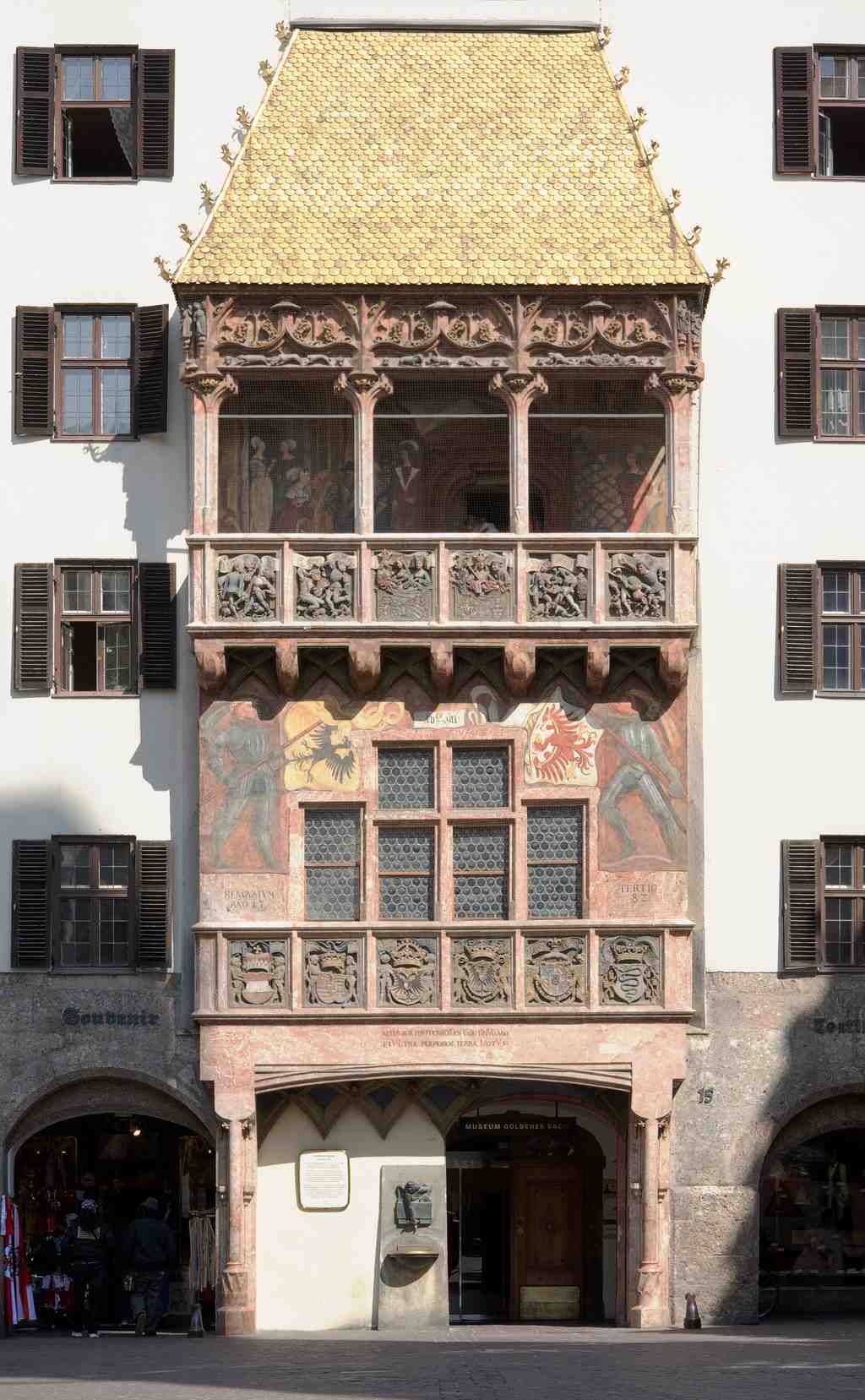
Ahead of you, you'll spot the Goldenes Dachl by looking up for a small, ornate balcony sticking out from a white building, topped with a dazzling golden roof made of thousands of shimmering tiles.
Picture yourself here on a chilly morning in the late 1400s, the street alive with the bustle of horses’ hooves and the banter of Innsbruck’s townsfolk. The Goldenes Dachl-meaning the Golden Roof-shines above you, its late Gothic balcony gleaming in the sunlight. That magnificent roof? It’s covered in precisely 2,657 fire-gilded copper shingles, all sparkling like a pile of gold coins. And trust me, this was no ordinary bit of home improvement. Emperor Maximilian I, always a fan of making an entrance, commissioned this spectacular oriel in 1497 to show off his wealth, mark the turn of the century, and, let's be honest, have the fanciest place in town to watch knightly tournaments and festivals on the street below.
But the Goldenes Dachl holds more than just royal parties. Imagine 1420, when this was just the “New Court,” a stately home for Tyrolean lords. By 1500, it became an international symbol-and not just for the view. Look more closely at those reliefs along the balcony. You’ll see the mighty Maximilian with his two wives (yes, two!), his clever chancellor, a troop of jolly fools, and wild, mask-wearing dancers called Moriskentänzer. All around are coats of arms and mysterious symbols-a sort of medieval emoji collection, if you ask me!
Now, behind the shiny façade lie darker stories. In 1536, right here in front of this sparkling roof, a preacher named Jakob Hutter met a tragic fate, burned publicly as onlookers watched in horror. Yet, the Goldenes Dachl stood witness to it all-celebrations, tragedies, and secrets.
If you’re into mysteries: that odd lettered band running behind the figures on the balcony puzzled scholars for centuries. It mixes Latin, Greek, Hebrew, and even some strange Egyptian-seeming symbols. People spun wild theories about what it meant. Only in 2020 did an amateur historian claim to crack the code, revealing it reads “Ego sum lux mundi”-“I am the light of the world.” Enlightening, isn’t it?
The Goldenes Dachl has inspired stamps, athletic challenges, and even international competitions! Since 2005, athletes have soared in the Golden Roof Challenge right beneath these golden shingles, trying to catch just a bit of that imperial glory. But sometimes, that golden shine proved tempting-thieves have actually stolen gold shingles more than once, only for the pieces to pop up in post boxes or be found in the streets, as if the city itself wanted its crown jewels returned.
Today, the Goldenes Dachl continues to sparkle-now home to a museum and the secretariat of the Alpine Convention. Step closer, let your eyes absorb the sun-drenched gold and centuries of stories. Imagine yourself as a festival-goer, a royal guest, or even a code-breaker in medieval Innsbruck. How many layers of mystery, joy, and drama can one tiny golden roof shelter? Welcome to the shining heart of the city!


