
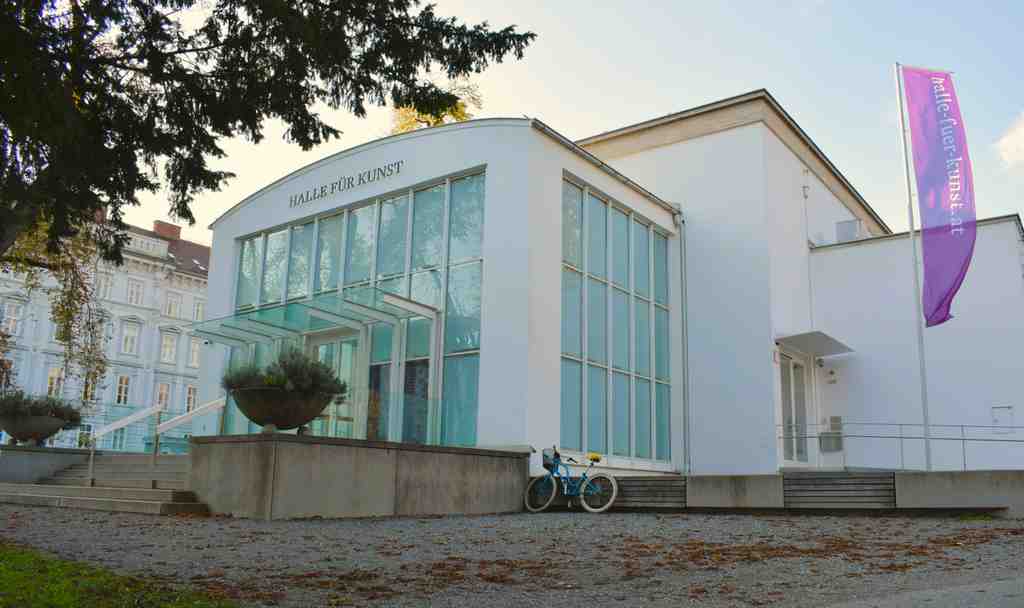
To spot the Halle für Kunst Steiermark, look for a bright, modern white building with a tall wall of glass windows and a bold sign above the entrance reading “HALLE FÜR KUNST”-plus, if you see a bright purple flag fluttering nearby, you’ve made it!
Welcome to the finale of our Graz adventure, the Halle für Kunst Steiermark-though don’t worry, there’s no test at the end! Picture yourself standing on these steps, with reflections glinting on the glass panes and perhaps the murmur of excitement from art lovers drifting out as you approach. But this building, sparkling in the light, comes to you wrapped in a most unusual story-one that spans over a century, rattles with debate, crackles with resistance, and bursts open with artistic creativity. Let’s rewind the clock and set the scene.
It all began at the dawn of the 20th century, as local art societies dreamed up a home for creativity-a Künstlerhaus, or artists’ house. Back in 1903, art lovers started gathering coins, every penny tucked away like a hopeful promise into a construction fund. By 1909, city leaders agreed on a spot in the city park for this new cultural haven. But no good story is without a twist! Suddenly, nearly 1,300 esteemed citizens whipped up a petition against the location, egged on by a member from the City Beautification Committee-talk about an artistic cliffhanger. Discussions snowballed, alternative sites were hotly debated, and it was clear that even art could stir up passions strong enough to ruffle the city’s proper collars.
Money continued to trickle into the fund, and by 1938, the dream seemed within reach-until history struck a sour note. With Austria’s annexation, the art societies were shut down and their precious savings were seized. The dream, it seemed, had been packed away with the dust of war. Yet, as if artists and dreamers could ever be kept down, after the war ended, the societies rose again in 1948 like creative phoenixes. They demanded their assets-seized by the Nazis-back, not to line pockets, but to build the Künstlerhaus at last. Here’s a fun bit of trivia: One society even gave up the right to reclaim its funds in exchange for permanent say in the exhibitions. If that’s not teamwork, I don’t know what is!
Finally, in 1951, amid the city’s slow recovery from the devastation of war, the building went up at Burgring 2. It was literally constructed from the rubble-old bricks reborn into halls that would soon echo with creative energy. Designed by architect Robert Haueisen and inspired by the famous Wiener Secession, this free-standing temple to contemporary art was meant to show off the very best of Styrian and Graz artistry. When it opened in 1952, the first director was the painter Leo Scheu-a man whose own past was tangled in tumultuous times.
Inside, the building feels like a sculptor’s daydream-high and open halls, a striking apse to the north with its slightly raised floor, columns supporting the soaring ceiling, and sunlight streaming through those vast panes. There’s even a ramp snaking gently beside the main steps as if to say, “all are welcome; bring your vision.” Over the years, so many artists and art societies shared this space, like the Künstlerbund Graz and the Sezession Graz, each leaving their creative fingerprint.
But the plot thickens! From 2003 to 2012, it was part of the Universalmuseum Joanneum, opening its walls to international talent. Grand exhibitions blazed here-one year, Le Corbusier’s designs filled the hall; another, the art of Paris between 1900 and 1959. And let’s not forget: for decades, the famous “Dreiländer-Biennale Trigon” brought together artists from Austria, Italy, Yugoslavia, and-over time-many other lands, turning these halls into an artistic crossroads.
Of course, where there’s art, there’s drama! In the 2010s, new leadership by Sandro Droschl brought international flair and a sprinkle of controversy. When local artists saw their display time squeezed, they staged a clever protest-submitting dozens of blank canvases, like a silent chorus for lost opportunities. Fortunately, budgets were raised, the building underwent yet another transformation, and in 2021 it reemerged with its current name: “Halle für Kunst Steiermark,” a beacon of creative freedom and modern energy.
As you stand here, imagine all the arguments, debates, brushstrokes, and bright ideas that have shaped these very walls. Behind its graceful facade, the Halle für Kunst Steiermark holds a living, breathing history-a space where Graz, Austria, and the broader world come together to celebrate the ever-evolving adventure of art. And who knows? Maybe your own footsteps will inspire the next chapter here!




