
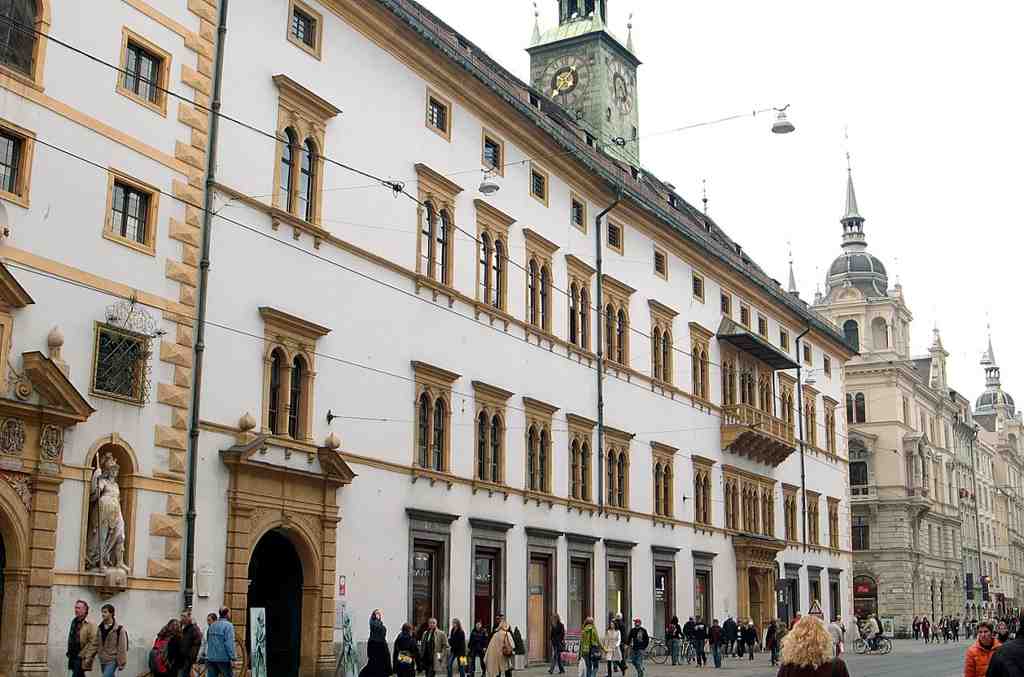
To spot the Graz Country House, just look ahead for a long, light-colored Renaissance building with rows of arched windows and a distinctive tower with a greenish clock on top, right on the bustling Herrengasse street.
Now that you’re standing outside, let me take you back to the 16th century-a time of fancy hats, dueling nobles, and a bit of architectural one-upmanship. Close your eyes for a moment and picture the street as it was nearly 500 years ago. The Graz Country House, or “Landhaus,” first started taking shape around 1527, becoming one of Central Europe’s earliest showstoppers of the Renaissance. Just imagine the clatter of boots and the swish of cloaks as the city’s powerful landowners swept in to their grand new headquarters.
At the corner of Herrengasse and Landhausgasse once stood a humble citizen’s house, but the ambitious Styrian nobles quickly transformed it-because, as history shows us, nothing says “influence” quite like a huge building with arcades and courtyards. The architects kept adding on: first came a few Renaissance touches, then sweeping arches, airy glass walkways, and, eventually, not one, but three buzzing inner courtyards where you could almost hear whispers of secret deals and political drama swirling in the air.
The masters behind this feat were a true Renaissance dream team, including the Italian architect Domenico dell’Allio, who was so good at building fortresses and palaces that no one dared question his taste in decorative columns. He championed those graceful round-arched windows and designed the famous three-story arcaded courtyard. Legend has it the courtyard was one of Graz’s social hotspots-today it hosts everything from open-air concerts to a magical ice nativity scene every Advent, twinkling with fairy lights.
Now, for a bit of mystery! Take a good look to your right as you stand by the entrance-you’ll notice an old copper plaque, the “Rumortafel.” Since 1588, it’s been warning folks not to get too rowdy or, as it eloquently puts it, “cause a ruckus” when important meetings were happening inside. Imagine a time when heated debates needed this official reminder-otherwise, you’d risk a fine for bickering too loudly. Suddenly, your last office meeting doesn’t seem so intense, does it?
The Graz Country House wasn’t built in one go-over centuries, it grew, mutated, and swallowed up old houses like a particularly hungry dragon. The Rittersaal, or Knights’ Hall, was added in the first floor to host magnificent assemblies. Three floors up, noblemen gathered by fireplaces beneath stucco ceilings decorated with the coat of arms of Styria, painted somewhere around 1650, then covered up and forgotten for centuries until a burst of mid-20th-century curiosity revealed them again.
By the baroque period, the interiors were glittering with ornate gilded stoves and elaborate frescos. Here’s a fun detail: the main entrance’s stone archway is one of the oldest Renaissance gateways in Graz-its huge, metal-clad doors have watched centuries of history march through, from richly dressed barons to modern tourists like you.
For a while, all the weapons and armor of the local army were even stored inside the Landhaus-until it got too crowded and they built the neighboring Arsenal instead. If you listen carefully, you might imagine echoes of clanking swords and heavy boots hurrying up the stairwells.
Up on the roof, don’t miss the copper-plated clock tower crowned by a weather vane in the shape of a panther, symbolizing Styria. The bell inside, cast in 1586, has survived every war and melted cannon order ever since-quite the lucky escape artist.
Even now, this building is the beating heart of Styrian politics, with the Landtag parliament still gathering in the baroque assembly room, the “Landstube.” If you peek inside, you might spot grand mirrors, blazing chandeliers, and lively murals depicting everything from ancient battles to an allegorical “Blessing of Peace”-a wish this old house has always carried.
Over the centuries, the Graz Country House has been a courthouse, a fortress, a parliament, and a social playground, all stitched together by generations of master builders who somehow managed to keep the whole place unified and harmonious. Blending old and new, grand and cozy, mysterious and welcoming, it stands here as a true witness to Graz’s colorful and dramatic history. So give those old doors a wink of respect-you never know what secrets are hiding behind them!




