
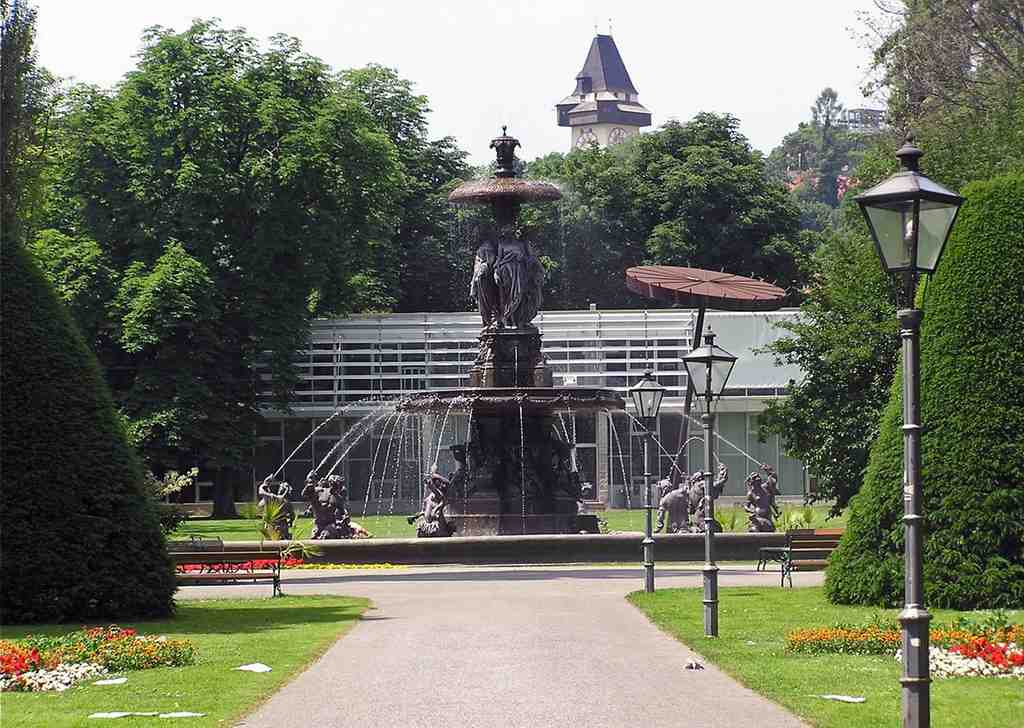
Straight ahead, you’ll spot Graz City Park by finding the grand cast-iron fountain bursting with water, surrounded by old gas lanterns, manicured hedges, flowerbeds, and plenty of tall, leafy trees shading benches.
Welcome to Graz City Park, where history, relaxation, and a touch of fairy tale magic are waiting to greet you! Take a deep breath and let’s imagine what it was like back in the 1800s. Instead of the peaceful scene you see now, this spot was once a military glacis-a stretch of open land used for drills and defense, definitely more boots and bayonets than birds and benches. But people in Graz had bigger dreams for this space. The city council, led by the ambitious Mayor Moritz Ritter von Franck, decided that grazing soldiers should make way for strolling citizens. If only all city planning meetings had such dramatic plot twists.
Securing the land wasn’t a walk in the park-pun very much intended! For years, negotiations with the military went back and forth, with land swaps and deals sharper than a gardener’s spade. Finally, in 1868, Graz traded the Feliferhof (imagine cows looking a bit confused at soldiers moving in) for this prime stretch of now-priceless green. And so, with deals done and plans drawn, the vision for Graz’s City Park started to blossom.
The very first blueprint didn’t just include flowerbeds and trees, but even a grand Kursalon (because what’s a park without a fabulous place to dance or grab a lemonade?), and-wait for it-a water pipeline! The city’s “Verein zur Stadtverschönerung”-that’s the rather fancy-sounding Beautification Society-took up the spade, held competitions, and gave out prizes to the best designs. It was like Graz’s very own “Park Idol.” The first tree was planted in 1870, accompanied by great hope: could beautiful nature lower the bubonic plague of high mortality rates that troubled Graz back then? Not quite magic, but shade was certainly an improvement!
With time, Graz realized rules are made to be broken (gently). Originally, no buildings were to pop up here-except one Kursalon-until the city thought: “Wouldn’t this be a great spot for the new university?” Seems like everything in Graz just wants to be where the green grass grows!
A key vision of the park was to mimic the style of an English garden. Picture double alleyways on old embankments, rare and exotic trees (the kind that make botanists swoon), and rows of iron benches-600 of them, which is enough for a good old-fashioned game of musical chairs. As the shadows lengthened and dusk settled, the park’s gas lanterns would flicker on, their warm light catching on the branches. In the 1970s, those lanterns switched loyalties to electricity, but the elegant posts remain.
Today, try to imagine the gentle clink and echo as you stroll past the 1,989 trees-yes, someone actually counted them! Over time, the park has become a living gallery. You can bump into stone busts of the likes of Johannes Kepler, Peter Rosegger, and Robert Hamerling. It’s like a “who’s who” of Styrian culture, except everyone’s remarkably quiet.
At the center stands the magnificent Stadtparkbrunnen. This fountain has a story worthy of its own blockbuster: designed by Jean-Baptiste-Jules Klagmann, with bronzes cast by Antoine Durenne, it was a star of the 1873 Vienna World Fair-think of it as the Beyoncé of fountains! Graz snagged this beauty after Vienna turned it down, negotiating a ten-year installment plan (take note, shoppers) and in 1874 it arrived on five train cars, cheered and admired by a crowd of eager townsfolk. On the name day of Emperor Franz Joseph I, Graz’s mayor ceremonially turned on the water, and the city has never looked back-well, except maybe to admire that beautiful fountain some more.
After the scars of World War II, the fountain returned in sparkling glory, thanks to the donations of Graz’s citizens. There’s even a protective fence, because after all those years, you want your bronze statues to stay put.
The park continued to grow and change: busts were added, music pavilions erected, open-air art flourished, and spaces were cleared for big events-imagine crowds gathering, the trees rustling, and bikes zipping past on the new cycle paths. Even today, debates swirl about the future, with everyone wanting their slice of the green.
So, take a moment here-close your eyes and let the echoes of the past blend with the lively present. The City Park of Graz isn’t just a patch of grass and a few benches; it’s a living story, growing and blossoming along with the heart of the city itself.
To expand your understanding of the origin, formation or the planned expansion, feel free to engage with me in the chat section below.




