
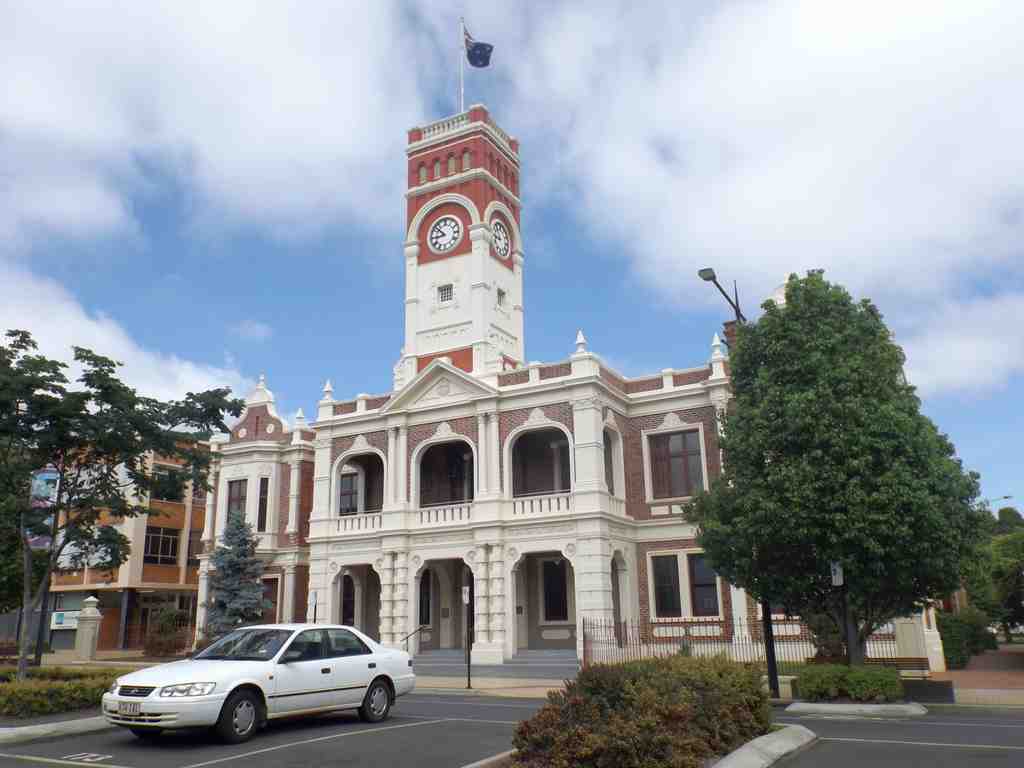
You're approaching Toowoomba City Hall, which should be easy to spot on your left. Look for a grand, two-story building with a stunning clock tower rising above it. The building is a combination of red brick and cream-painted stone, giving it a stately, historic look. The clock tower is adorned with the clock face on each side and a flag flying high at the top. The symmetrical facade features elegant arches and columns, and you can see wide steps leading to the main entrance.
Toowoomba City Hall is not just any building; it's a heritage-listed treasure at 541 Ruthven Street, designed by the imaginative Willoughby Powell and constructed in the year 1900 by Alexander Mayne. This iconic structure was the first purpose-built city hall ever in Queensland and the very spot where Toowoomba was declared a city. Fancy that!
Originally, this building was a one-stop-shop for municipal business, a tech college, a school of arts, and even a public hall. Talk about multifunctional - it could give today's multi-use buildings a run for their money!
Toowoomba itself has quite the backstory. The region was first settled in 1842, with the area now known as Drayton attracting early settlers. But thanks to a drought in the late 1840s, residents began eyeing the Drayton Swamp Agricultural Area, a place with abundant water, coolly nicknamed "The Swamp." This area was surveyed and sold in 1853 and officially named Toowoomba in 1858.
The Borough of Toowoomba was proclaimed in 1860, quickly followed by the first town hall in James Street in 1862. Fast forward to the 1860s and 1870s, Toowoomba saw rapid expansions: railways, schools, foundries, and even draining those swamps and setting up waterworks.
As Toowoomba blossomed into a vital Darling Downs hub, the town's prosperity was mirrored in its impressive structures. The necessity for a new town hall led to the construction of this City Hall we see today, which, by the way, replaced older versions and centralized the town's activities.
When you finish soaking up the history here, head over to our next stop, the ever-beautiful Laurel Bank Park.




