
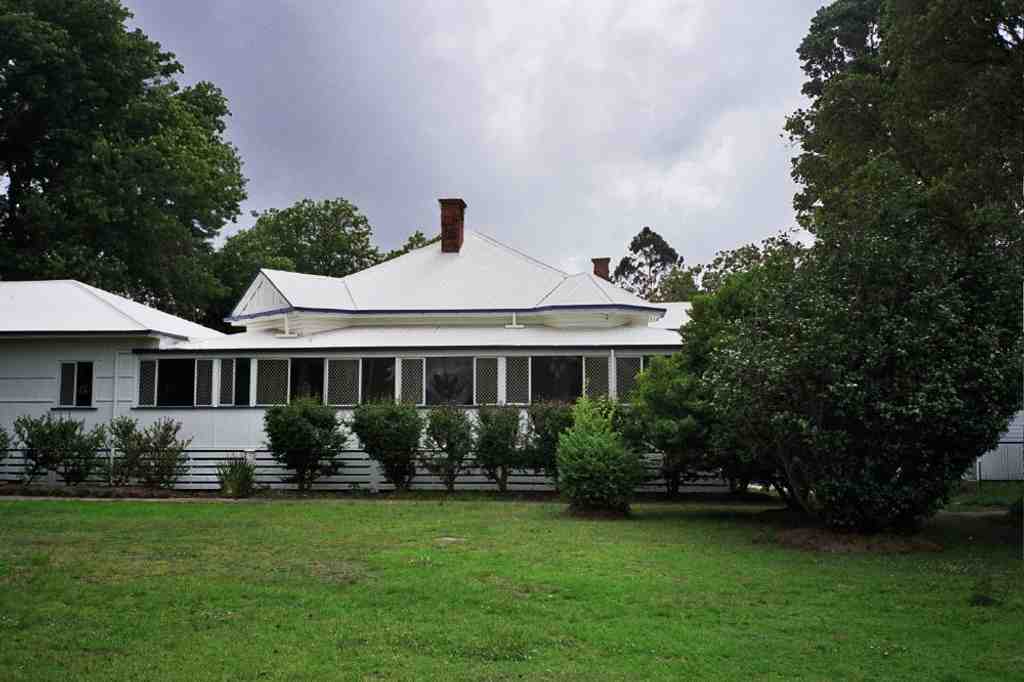
Standing here on Tourist Road, just look for a large, low-set white timber house with a striking multi-gabled roof and red brick chimneys, nestled amongst lush green lawns and mature trees-it’ll be right in front of you, partially hidden by a row of well-kept shrubs and hedges.
Now, let’s step into the story of Unara-imagine yourself in the early 1900s, the sweet scent of camellias and magnolias drifting on the cool mountain air, the rustle of wind weaving through giant pine branches overhead. In front of you stands not just any house, but a home with a view that rolls out all the way down the Range into the Lockyer Valley, a spot so prized that only the most notable citizens could call it their own. Built around 1906, Unara was the grand dream of Sir Littleton Groom-one of Queensland’s political heavyweights and a man whose footsteps echoed through every corridor of power from Toowoomba to the hallowed halls of Parliament in Canberra.
Picture Sir Littleton himself: a sharp legal mind, locally born, with politics practically in his blood. In fact, when his father, William Henry Groom, who had once been the Mayor of Toowoomba and a founding member of Parliament, passed away, Littleton simply dusted himself off and took up the family tradition, representing Darling Downs with gusto for decades. During his long career he took on everything from attorney-general to Speaker of the House of Representatives. Not many folks could say they ran the show in Parliament with a booming voice and still be knighted for it!
But let’s duck under the shade of that enormous oak at the back and explore the house as it might’ve felt then-pass through the main entrance beneath its gabled roof, step onto the wide front verandah that wrapped around like an invitation to breathe in the crisp Toowoomba air, and walk down a central hallway lined with tall doors and glimmering leadlight windows. Imagine elegant parties with laughter echoing off pressed metal ceilings, the warmth from three handsome red brick fireplaces, and the soft light colored by stained glass filtering through glorious bay windows. If those walls could talk, they’d have more gossip than a morning radio show!
Time, of course, kept marching. When Littleton Groom passed away in 1936, the pomp and bustle faded, and Unara began a new chapter-first as a guest house and then, in a plot twist worthy of a mystery novel, as a Mothercraft Home for newborns and weary mums in 1945. Can you picture it now? This stately old building alive with the gentle cries of babies, the quiet footfalls of nurses, and the hopeful chatter of new mothers. New wings sprang up, a laundry block appeared, and-true to the times-little hospital sinks popped up in unexpected corners. The Federation Bungalow flair stayed, but the place was always evolving, adapting, surviving each new role in stride.
Through all the decades, from rowdy political debates to the soft hush of caring for the tiniest new lives, Unara’s sturdy timber and graceful lines kept their dignity. Even after its days as a health center faded, local community services moved in, and the garden-thick with camellias, wisteria, magnolias, and neat gravel drives-remained a picture of peace and quiet beauty.
Here, as you stand on the path where once distinguished guests and later anxious new parents would have tread, you’re tracing the steps of history both grand and humble. Every corner-each pressed metal ceiling, each sash window, each aged tree outside-whispers a memory of Queensland’s past, from political prestige to gentle nurture. And across the road, fittingly, stands a memorial to Sir Littleton Groom, watching over the home where his legacy was built-almost like he couldn’t quite leave the place behind.
So next time someone tells you old houses are just wood and nails, send them over to Unara, where the echoes of the past are as lively as ever-and where, I daresay, even the ghosts are probably debating politics or swapping tips on baby care!




