
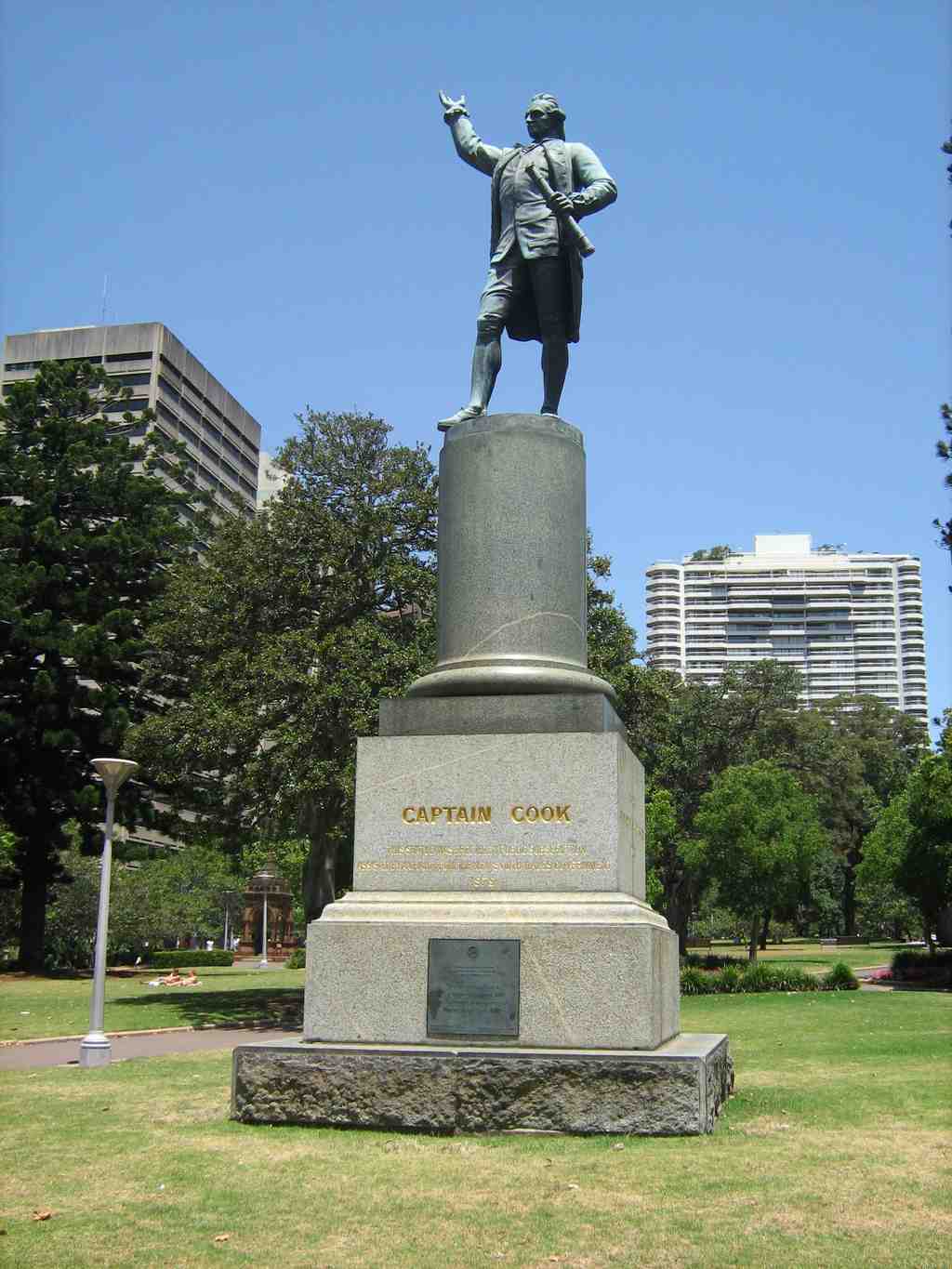
Alright, legend, keep your eyes peeled ahead for a towering bronze bloke standing high and mighty atop a chunky granite pillar-he’s holding a spyglass in one hand, the other hand pointed dramatically towards the sky, right there in the middle of Hyde Park.
Now, you’re standin’ face-to-face with one of Sydney’s larger-than-life yarn-spinners: Captain James Cook, cast in bronze and immortalised smack-bang in Hyde Park. Picture this-back in the 1860s, every Sydneysider and their dog was yakkin’ about putting up a big statue of this famous British explorer, but turning big talk into cold hard cash was a mission. They passed the hat around for yonks, collecting coins and notes, and finally scraped together a tidy £1,777 thanks to the Australia Patriotic Association. That’s a fair few bob to honour a fella who never even set foot in Sydney Harbour!
But then comes a good dose of drama-on March 27, 1869, Prince Alfred himself, Queen Vic’s second son, gets in on the act, laying down the foundation stone in Hyde Park while crowds turn up in their Sunday best for the spectacle. They were probably hopin’ for a statue any day now, but mate, it took them another nine years and a serious case of empty pockets to actually finish the job-most of the money ended up coming from the New South Wales Government, not just from public donations like the shiny inscription would have you believe.
The big ask for the actual statue went all the way to London, and Thomas Woolner, a top sculptor and member of the Pre-Raphaelite Brotherhood (not a bikie gang, just a bunch of arty types), got the gig. Now, he knew Cook’s spot was windier than a southerly buster, so he went for solid bronze-a statue so tough it could survive anything Sydney could throw at it. Woolner’s Cook is a real showpiece: the explorer holds a telescope in his left mitt, a look of satisfaction on his face like he’s just spotted the world’s biggest barbie on Botany Bay, and his right hand shoots towards the clouds as if to say, “Cop a look at this new Southland, would ya?”
But the adventure didn’t stop in the sculptor’s studio. Before Cook could lord it over Hyde Park, the statue got a cheeky debut in London; it even stole the show near the Athenaeum Club, earning rave reviews for being full of “force and spirit.” Meanwhile, the granite block for the base had its own bush adventure-dragged out of a quarry in Moruya, rolled on rattly rails for six miles, and then shipped to Sydney on a schooner called Settler’s Friend. Just outside Jervis Bay, there’s a late-night barnacle buster: gets clipped by a 400-ton barque. Out comes the axe, they hack the boats free, and against all odds the Settler’s Friend limps into Port Jackson, block still on board, not even a kangaroo in sight.
Come February 25, 1879, all of Sydney turns out for the grand unveiling. The day’s declared a public holiday, and let me tell ya, about 60,000 folks-marines, volunteers, society bigwigs, thirteen bands, and two hundred kids belting out the anthem-packed the park in a two-mile-long parade. The statue, hidden behind a Union Jack, is finally revealed by six soldiers in a scene that’d make a Rainbow Serpent blush. Boffins and bishops, pollies and punters, nearly everyone you could name turned up to help make it the most patriotic hoedown New South Wales had ever seen.
That night, to top off the spectacle, they whacked an electric light atop the post office to shine down on Cook’s bronzed mug. The light was so bright, they reckoned you could read a newspaper two miles away-talk about making headlines!
Of course, there’s a bit of bother in the fine print. The inscription says Cook “discovered this territory” in 1770, but anyone who’s checked a map knows old mate landed at Botany Bay, not Sydney Harbour. And Cook wasn’t even the first European to spot Australia-Dutch, Portuguese, name a nation, they all had a squiz. Even the origin story of the funding’s a bit sus; most of the cash came from the government, only a bit from the good people.
But however you cut it, Cook’s statue is a monster chunk of Sydney’s history, perched on a fifteen-odd-ton block of granite. If you take a squiz at the plinth, you’ll see inscriptions on every side-Cook’s birthplace, his fateful end at Owhyee, and a tribute from the Yorkshire Society. The statue’s been standing here ever since, a bit of a show-off with his spyglass and sky-pointing, reminding every Aussie of grand adventures, heated debates, and a city that loves a good celebration. So, have a proper gander and imagine yourself in the middle of that roaring 19th-century crowd-bit different from the buskers and joggers of Hyde Park today, eh?




