
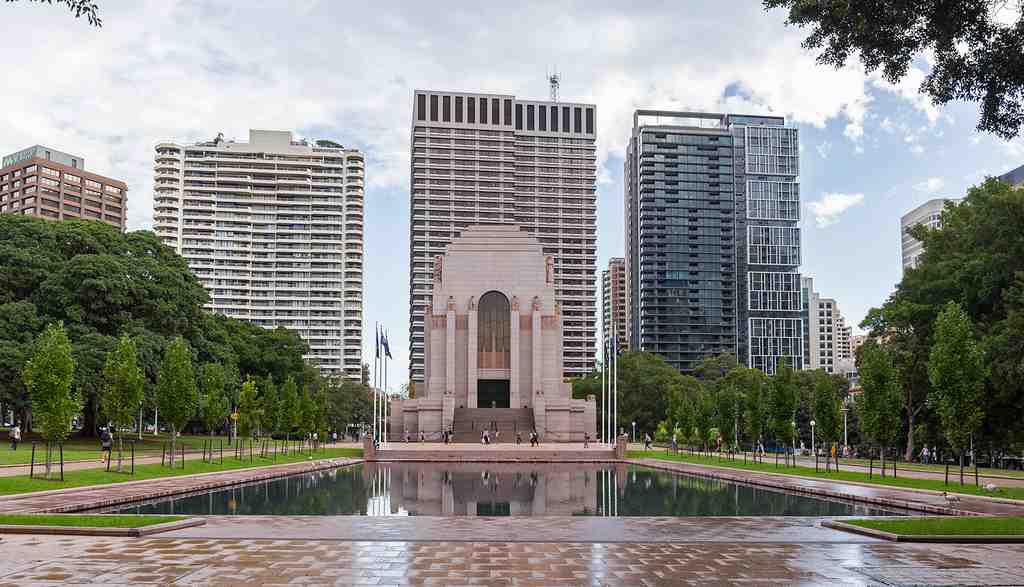
Alright, mate, look straight ahead through the line of gum trees and you’ll spot the Anzac Memorial-it's that massive, pale pink Art Deco building with a wide staircase and tall, narrow windows, right at the end of the long reflection pool.
Now, let’s paint a picture for ya: You’re standin’ on ground that was once home to the Gadigal people, part of the Darug nation, with roots runnin’ back 25,000 years, and this bit of Hyde Park was where they’d have fierce battles-that’s proper ancient turf you’re on, not just a patch of green!
Fast-forward to the 1900s, it’s World War I, and young Aussies are gettin’ shipped off under the banner of “ANZAC”-that’s the Australian and New Zealand Army Corps, but let’s be honest, everyone just knows it as the spirit of the digger: brave, tough, and never backs down. Imagine the tension in the air as blokes crowded the streets, signing up, and those left behind started thinking, “How the heck do we remember ‘em all?”
That’s where this memorial comes in. They kicked off fundraising on Anzac Day in 1916-just a year after Gallipoli-hopin’ to build more than just a statue; they wanted a whole shebang: a place for remembering, a spot to help grieving families, offices for returned soldiers, and a living monument etched with every sacrifice. It took years of argy-bargy between government, soldiers, and the many passionate women’s groups (who weren’t shy about speakin’ up, by the way). The big compromise? To make it a shrine of remembrance-somethin’ solid and beautiful, standing right here in Hyde Park.
Spot the building? That Art Deco style with all the sharp angles and the grand steps was whipped up by Bruce Dellit-young, Aussie-born, and mad keen on making somethin’ striking. On the outside, it’s all covered in amazing sculptures by Rayner Hoff-figures showing all the branches of the services, not just the fellas but the nurses, too. Hoff wanted everyone to know the sacrifice wasn’t just on the battlefield, but at home as well.
Inside, if you ever get a squiz, there’s a golden dome glittering with over 120,000 tiny stars-one for every New South Welshman or woman who served. Down below is the striking sculpture “Sacrifice,” showing a fallen digger carried by womenfolk, raw with grief and strength. You’ve got the Pool of Reflection out front-stand close, mate, and you might just catch your own mug in the glassy water, like all those souls remembered here.
Opening day in 1934 was a cracker: 100,000 punters packed the park, the Duke of Gloucester made the speech, and you would’ve heard everything from the thump of boots marching to the sniffs of those remembering loved ones.
But this spot ain’t set in stone-well, it is, but you know what I mean. Over the years it copped a bit of controversy, like when anti-war protesters sat right here in the ‘70s, or feminists gave it a spray in ‘75 saying it stood for more than just the blokes. It’s been a rallying point, a stage for peace, and a living heart of the city.
Take a moment, listen for the birds or distant city hum, and picture those generations-from fierce Aboriginal warriors to ANZAC troops to everyday Aussies-each carving a bit of their story into this sacred patch. It’s not just a memorial, it’s a yarn of old ghosts, big dreams, and the stubborn Aussie spirit that refuses to be forgotten.




