
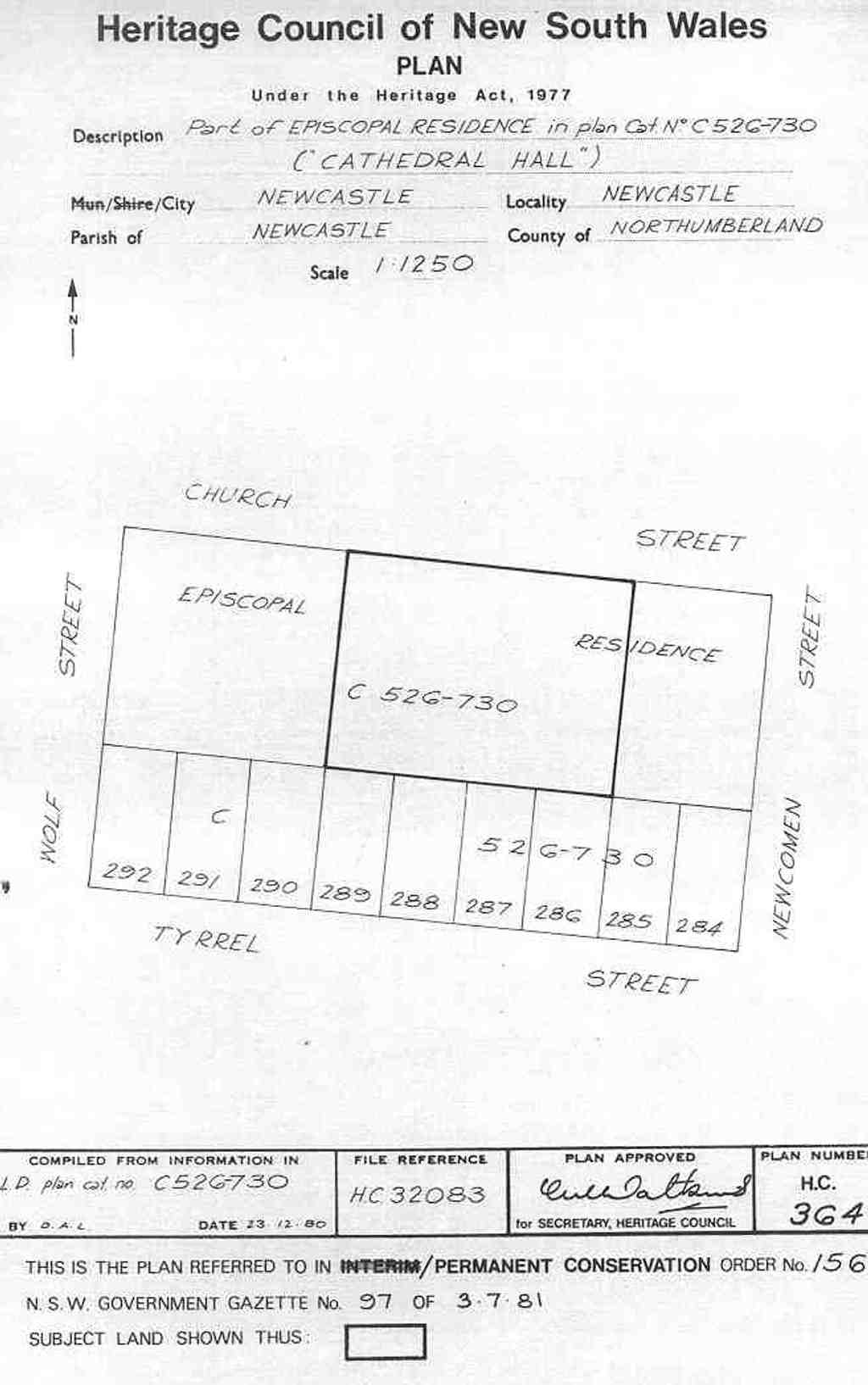
To spot Horbury Hunt Hall as you walk along Church Street, look for a striking, somewhat sturdy brick hall on your left, just where Church Street meets Wolf Street; its somewhat “plain” and “barn-like” appearance with late Victorian details will give it away.
Now, take a deep breath and imagine yourself standing here in Newcastle, but wind the clock back to the late 1800s. The ground under your feet is busy with carts and chatter and the great dream of building a cathedral is alive all around you. But before the magnificent Christ Church Cathedral could rise, there was a little problem-the old church had to go, and Newcastle's faithful needed somewhere to gather. Enter the hero of our story: John Horbury Hunt, the renowned architect with a taste for innovation almost as legendary as his beard.
Picture Hunt striding up Church Street, plans in hand, eyes twinkling with ambition. He was asked to design a “pro-Cathedral”-a temporary home fit for worship, right here, on the opposite side of Church Street from the cathedral’s future footprint. At the same time, Hunt needed to replace the old Christ Church School, which the Department of Public Instruction had just snapped up. No pressure, right? Well, Hunt wasn’t a man to shy away from a challenge. By 1878, his sturdy new hall was up, its roof pitched low and buttresses standing sentinel against the wind. Hunt tossed in groups of lancet windows, single-stepped buttresses, and stringcourses that zipped around its brickwork. For a dash of flair, he added late Victorian touches like wooden, mullioned windows and a shingled clerestory. Some people loved it, but others called it “severely plain” or “barn-like”-which, let’s be honest, in the 1880s was the architectural equivalent of a scowl and a sniff!
But the drama didn’t stop there. In the great soap opera of Newcastle church-building, the Dean, Arthur Selwyn, enters stage left. The Reverend was as influential as they come, but his relationship with Hunt was, well, rocky at best. As Hunt’s brick walls went up, Selwyn grumbled about the design, and eventually, Hunt was off the project! In swooped Frederick Menkens, an architect with a flair for interiors, and suddenly the inside of Horbury Hunt Hall began to sing with an American stick-style arcade. Imagine the tension-a building that’s half Hunt’s brisk innovation, half Menkens’ decorative artistry. Selwyn, Hunt, and Menkens: a trio of strong personalities, each one leaving their fingerprint in brick and stone.
For 18 extraordinary years, this “temporary” building wasn’t just a hall; it was the beating heart of Newcastle’s Anglican parish. Every Sunday, the faithful walked up the hill, through Newcastle’s sea breezes and coal dust, to gather here. Weddings, funerals, Christmas bells-all echoed against these walls. It was only after almost two decades that the Cathedral finally opened and Horbury Hunt Hall became the “Cathedral Hall,” a quieter, steadfast witness to the passing of generations.
The twists continue. Over the years, the building found fresh purpose-first with Newcastle Grammar School, who gave it new life as part of the campus, then through a careful restoration after some rough times left mortar crumbling and plaster peeling. Even with changes-some of them not so gentle-Horbury Hunt Hall kept its spirit. Sure, its once-famous city views have faded as Newcastle’s skyline grew, but if these bricks could whisper, you’d hear stories of faith, conflict, and community.
When you look at this hall today, remember: this isn’t just “another old building.” It’s a landmark for the bold experimenters, the stubborn critics, the worshippers who didn’t mind a drafty barn if it meant the community could stand together. It’s a place that carries the legacy not just of an ambitious architect and a demanding Dean, but of Newcastle itself-always growing, always ready for the next chapter. And hey, even if you agree it looks a bit “barn-like,” never underestimate the barns of history-they tend to have the best stories.


