
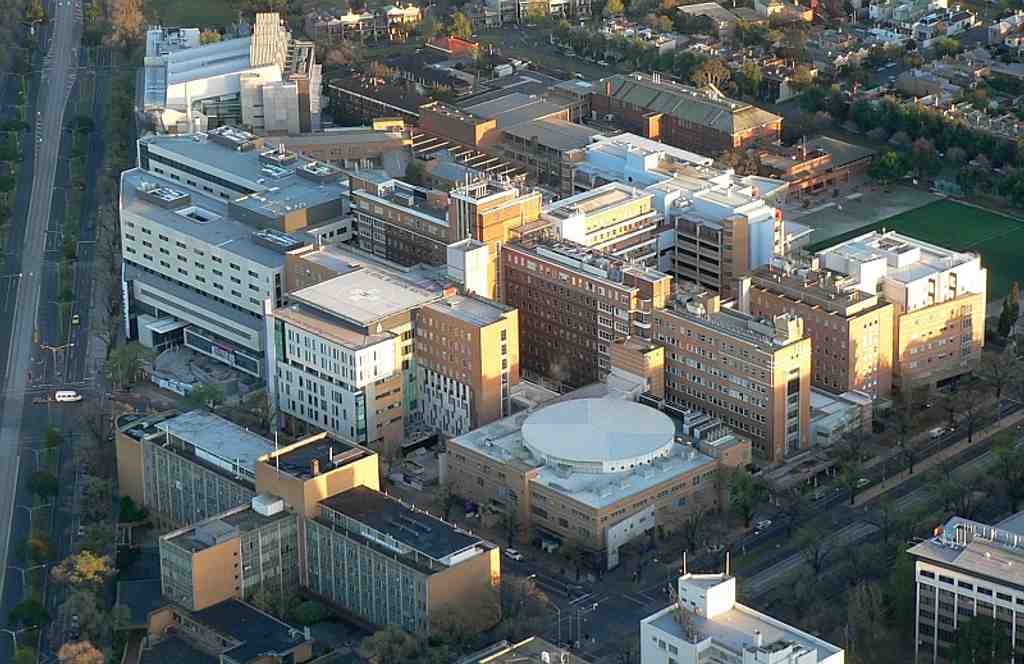
To spot the Royal Melbourne Hospital, look for a sprawling cluster of multi-story brick and glass buildings stretching along Grattan Street, with a noticeable circular building and tall hospital wings surrounding it.
Imagine you’re standing here on Grattan Street, facing this vast, bustling complex that almost feels like a city within a city. Close your eyes for a second and listen - you might catch the buzz of conversation, the rumble of ambulances arriving, or even the distant whirr of a helicopter landing on the hospital’s rooftop helipad. You’re not just outside any hospital; you’re at the front doors of the Royal Melbourne Hospital, one of Australia’s true giants of medicine.
It all began way back in 1848, when Melbourne was still struggling to shake off its “wild west” gold rush days and the city needed a place for the sick to find refuge. The first hospital sprang up on the corner of Swanston and Lonsdale Streets-a far cry from this modern hub. Picture old carriages rattling by, nurses in long starched aprons, and gas lamps flickering against the night. By the early 20th century, the Melbourne Hospital was bursting at the seams, so it was knocked down and rebuilt on a grander scale, even swallowing up a few more city blocks in the process.
But in the 1930s, they needed a bigger, better base, so the hospital spread out to where you stand now. Here, on Grattan Street, the Royal Melbourne Hospital opened its doors during World War II. In fact, the place was still under construction when the U.S. Army’s 4th General Hospital swooped in, setting up a temporary barracks with tents in Royal Park, just north of this spot. For two war-torn years, American soldiers were treated here until the hospital was finally finished, and in December 1944, doctors and patients moved in for good. It was the stuff of movies: convoys, soldiers, nurses, and doctors all bustling around new, echoing hallways-no doubt with a few “where’s the X-ray room?” moments to boot.
Through the decades, the Royal Melbourne Hospital earned a reputation for saving lives and pushing medical boundaries. Today, it’s one of Victoria’s busiest, and definitely not a place for hypochondriacs! With one of the largest Emergency Departments in the state, it’s a magnet for ambulances day and night. It’s a trauma centre, a leader in research (you’ll find top brains here, often working on robotics, infectious diseases, and even robotic surgery-yes, like real-life sci-fi!), and a lifeline for patients needing everything from stroke and cardiac care to cutting-edge transplants. If you hear an alarm or the swoosh of emergency doors, you’re listening to the heartbeat of the hospital in action.
It’s also a place of learning and teaching. It’s always crawling with students in crisp white coats, sitting in on everything from emergency simulations to daily grand rounds-where the drama of real cases gets dissected with a bit less blood, and a lot more brainpower. Fancy yourself as a future doctor or nurse? Don’t worry, there’s enough training here to keep you busy for decades (and probably enough coffee inside to keep you awake for just as long).
The hospital hasn’t stood still, either. It’s seen new wings, fresh faces in charge, and groundbreaking studies every year. Leaders like Professor Shelley Dolan, who took the helm after a worldwide search, help drive the hospital’s mission forward, while legends like Professor Christine Kilpatrick AO, who retired in 2023, are still remembered for shaping its story.
So as you stand here, listening to the pulse of this sprawling hospital, remember: you’re looking at more than bricks and glass. This place has witnessed everything from wartime drama to midnight emergencies, from medical breakthroughs to laughter in the corridors. It’s a living, breathing part of Melbourne’s heart-and that’s something you can really feel.
Want to explore the services and specialties provided, postgraduate training, the clinical school and nursing education or the fellowship positions in more depth? Join me in the chat section for a detailed discussion.




