
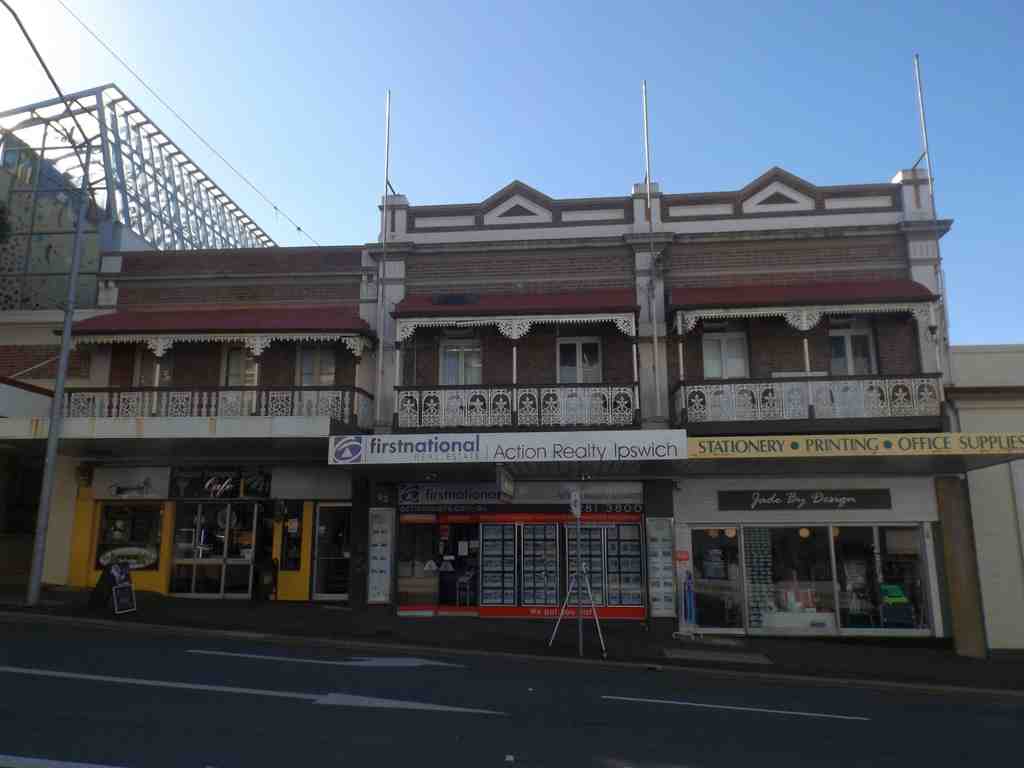
As you walk along Brisbane Street, keep an eye out on your right for a charming row of three two-story brick buildings. You'll know you’ve found William Johnston’s Shops when you see their distinct architectural features: two gables on the right side, iron lacework balconies with ornate detailing, and a brick façade that boasts a lovely interplay of red and beige hues. Below these balconies, you'll notice awnings that shield the shops and give a hint of Victorian-era charm.
William Johnston's Shops are a heritage-listed row of three shops that have stood majestically at 93 Brisbane Street, Ipswich, since their construction between the late 1870s and 1893. The shops were added to the Queensland Heritage Register on October 21, 1992.
The story starts in 1876 and 1877 when William George Johnston purchased two adjacent pieces of land on Brisbane Street. The land previously hosted the Clarendon Hotel, which, following a dramatic event of fiery destruction in 1875, left a blank canvas for Johnston’s vision. William Johnston didn't waste any time, using a £400 mortgage from the Ipswich and West Moreton Permanent Benefit Building and Investment Society to fund the construction of a two-story brick building in 1877.
Interestingly, before the fire, the site was home to the Queens Arms Hotel, established by George Thorn around 1843/44. The hotel was renowned for its fantastic hospitality, shadows of which perhaps linger under today's structure.
Beneath these 1877 buildings, some locals like to believe that the cellar remains from the original Queens Arms Hotel, potentially making it the oldest surviving structure in Ipswich, although concrete proof is absent.
After Johnston’s first brick shop was constructed, it found a new tenant as Dan Kennedy opened the Victoria Hotel between 1883 and 1891. Over the years, the adjacent shops were believed to have been built around the 1880s, appearing in photographs as early as the 1893 flood.
The shops transitioned through various hands and purposes, standing the test of time and the changing tides of commerce. Today, they remain a testament to Ipswich's rich commercial history from the bustling late 19th century to now. If those walls could talk, they’d certainly tell some fiery, yet fascinating tales!


