
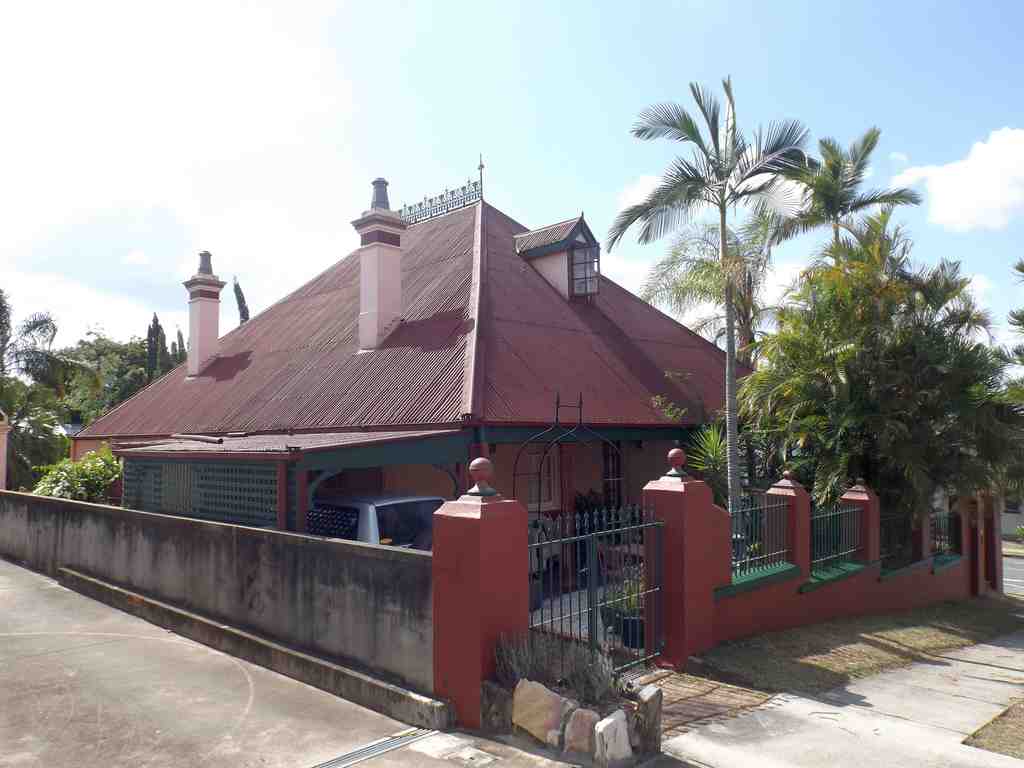
As you approach stop number 11, Brickstone will be on your left. Look for a charming, two-storey house with a distinctively steep, metal roof. The roof is a standout feature, with dormer windows peeking out like watchful eyes on three sides. You'll also spot two prominent chimneys reaching up from the roof, adding to the house's historic charm. The structure is surrounded by a solid red brick fence with green railings and an inviting front yard.
Now, let's dive into the fascinating history of Brickstone!
Brickstone, also known as Brixton, is a heritage-listed detached house located at 11 Murphy Street, Ipswich. Built around 1864 by the notable local builder William Hancock, this house stands proud as a relic of Queensland’s early days. It's like a Victorian-era Snapchat filter was applied to the whole house, preserving its High Victorian style from a major renovation in the 1980s.
Originally, the land on which this house stands was purchased in 1861 by a local wheelwright, Mr. James Kirby Swan. By around 1864, he was already residing here, suggesting the house was built in the early 1860s.
William Hancock, the builder of the house, has quite a resume. He migrated from England in 1856 and contributed significantly to Ipswich's growth, constructing numerous notable buildings, including the first railway workshops and laying pipes for the waterworks in 1877. His work is a testament to the boom Ipswich experienced during that time, spurred by coal mining and wool and cotton production.
Interestingly, Brickstone wasn't just Hancock's brainchild. He lived in this house briefly in 1875. Over the years, the house saw various owners and occupants, including Hancock’s own family members. Around the 1920s, it transformed into flats, undergoing significant alterations including the closure of the attic and removal of stairs.
But, fast forward to 1985, the house received a grand revival. Kirk Jensen and Peter Gelherr bought the property, reversed the flat conversion, and restored its Victorian charm, adding a set of recycled stairs and reopening the attic with delightful dormer windows.
So, as you stand here admiring Brickstone, know that you’re looking at a piece of history that has weathered almost two centuries and has stories hidden in every brick and tile!


